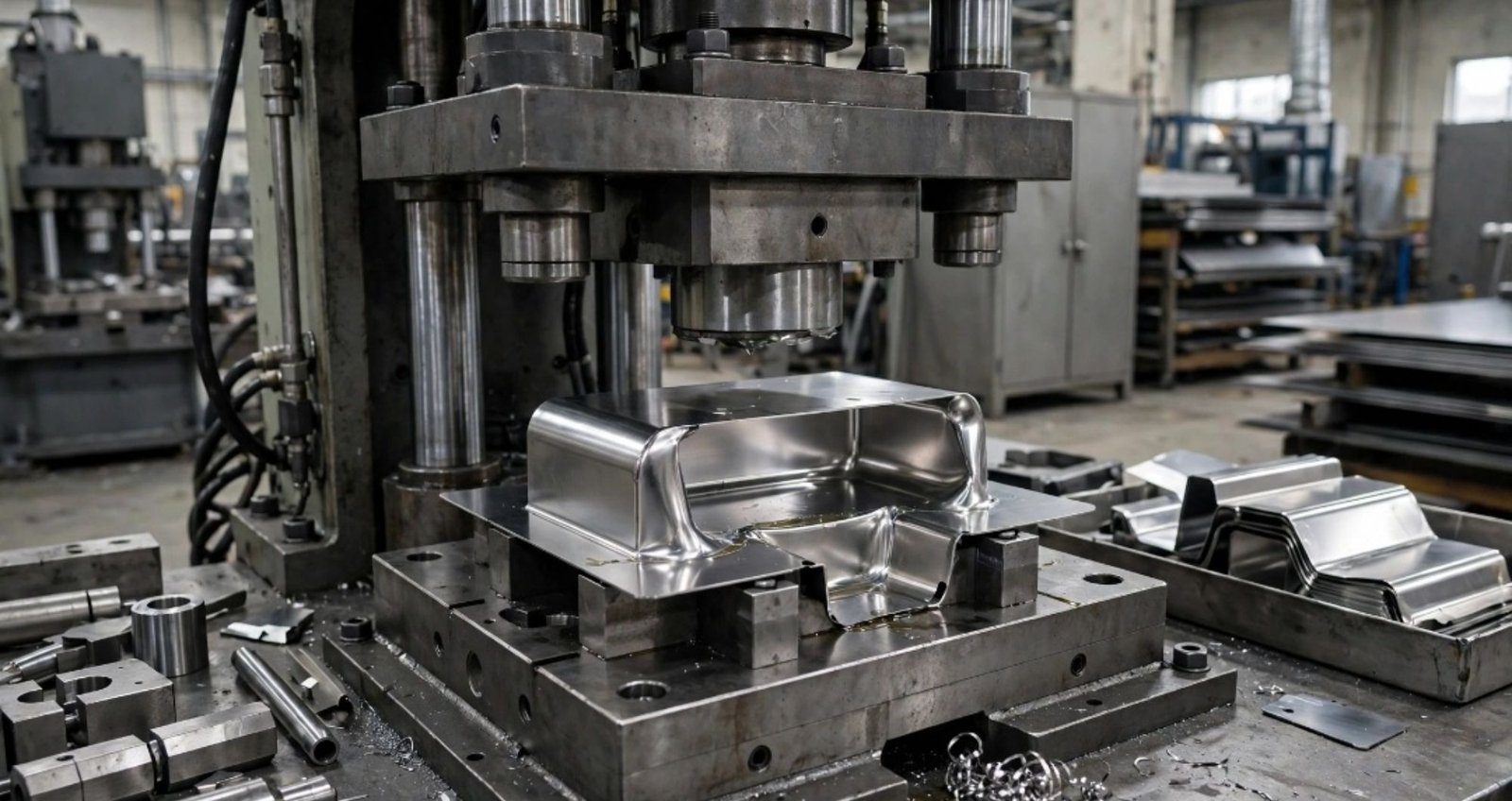
Pressing stainless steel is a metal forming process used to shape flat stainless steel sheet into precise components. Pressing stainless steel can involve operations such as stamping, bending, drawing, blanking, embossing and deep drawing, depending on the required component design.
For manufacturers, pressing stainless steel provides a practical way to produce consistent metal components for different applications. The process uses specialist tooling, including punches and dies, to apply controlled pressure and form the material without relying on conventional cutting or fabrication methods.
How Does Stainless Steel Pressing Work?
Stainless steel pressing starts with sheet metal positioned in a suitable press and tooling setup. A punch applies controlled force against the material, while the die supports and guides the sheet into the required shape.
The exact process depends on the component being produced. Simple shapes may require a single pressing operation, while more complex components can require multiple stages. Careful control of the forming process helps maintain dimensional accuracy and repeatability across production runs.
Stainless Steel Deep Drawing
Deep drawing is an important part of stainless steel pressing when a component needs a three-dimensional shape or greater depth. The sheet is placed over a die, and a punch draws the material into a cavity to create the required form.
This technique can produce seamless components such as housings, containers, dished ends and other shaped parts. Winward Engineering states that its deep drawing process can be applied to demanding materials including stainless steel, Inconel and titanium.
Stainless Steel Metal Stamping
Metal stamping uses pressure and custom tooling to create accurate shapes from sheet blanks, strips or coils. Stainless steel stamping can incorporate several forming and cutting operations within the same manufacturing process.
Depending on the component requirements, these operations can include:
- Cutting and blanking
- Bending and drawing
- Embossing and coining
- Flanging and hemming
- Piercing and stretching
- Reducing and necking
Combining different operations can make stainless steel presswork suitable for components with detailed or repeated features.
Progressive Pressing for Stainless Steel Components
Progressive pressing is designed to produce complex components at higher production volumes. The stainless steel sheet moves through a series of die stations, with each station performing a specific operation.
This continuous approach can reduce additional handling and labour when producing large quantities of consistent parts. Although specialist tooling requires an initial investment, progressive pressing can lower unit costs when production volumes are high enough.
What Are the Benefits of Stainless Steel Presswork?
Stainless steel is widely used where strength, durability and resistance to corrosion are important. Pressing stainless steel allows it to be formed into consistent components while maintaining the required shape, dimensions and quality.
Key benefits of stainless steel presswork include:
- Consistent production of repeat components
- Suitable for complex formed shapes
- Efficient production for medium and high volumes
- Reduced manual handling during repeated operations
- Compatibility with specialist tooling
- Ability to combine forming and cutting processes
- Suitability for demanding engineering applications
The most appropriate pressing method will depend on the component design, material properties, thickness, production quantity and required tolerances.
Stainless Steel Blanking and Forming
Blanking is another process that can be incorporated into metal pressing. It involves using a punch and die to cut a predetermined flat shape from sheet metal or coil.
The resulting blank can then become the starting point for further operations such as stamping, deep drawing, fabrication or other forming processes. This makes blanking useful when consistent shapes are required before the main forming stage.
Stainless Steel Pressing and Tooling
Tooling has an important role in achieving accurate stainless steel components. Punches and dies need to correspond with the required component design, dimensions and forming requirements.
Winward Engineering manufactures its own tooling using CNC machinery, precision lathes and experienced toolmakers. Its metal pressing service supports batch production, continuous production schedules and mass production, allowing tooling and presswork to be considered together during the manufacturing process.
Pressing Stainless Steel for Different Applications
Pressed stainless steel components can be used across a wide range of engineering and manufacturing applications. The Winward Engineering service covers industries including automotive, architecture and general engineering, alongside sectors such as aerospace, medical, food and drink, defence, nuclear, oil and gas, agriculture and HVAC.
The required forming method varies by application. A simple stamped component may require a different approach from a deep-drawn housing or a complex progressive-pressed part. Understanding the finished component and its operating requirements is therefore an important part of selecting the right process.
Choosing the Right Stainless Steel Pressing Process
Choosing the right stainless steel pressing method depends on the component design, material thickness, production volume and dimensional requirements. Deep drawing, stamping and progressive pressing can each be suitable for different manufacturing needs, while metal spinning may be preferred for prototypes and smaller batches.
For accurate and consistent results, the right pressing method and tooling are essential. A well-planned process can help maintain quality, meet dimensional requirements and support efficient production of stainless steel components.
Frequently Asked Questions About Pressing Stainless Steel
What Is Pressing Stainless Steel Used For?
Pressing stainless steel forms precise components from stainless steel sheet. It can create different shapes through processes such as stamping, bending and deep drawing.
Can Stainless Steel Be Deep Drawn?
Yes, stainless steel can be deep drawn using suitable tooling and controlled pressure. This process is useful for producing deeper, three-dimensional components.
What Is the Difference Between Pressing and Spinning?
Pressing uses dies and controlled force to form sheet metal, while spinning forms the material around a rotating tool. The most suitable process depends on the component design and production requirements.
Is Stainless Steel Pressing Suitable for Large Production Runs?
Yes, stainless steel pressing can suit medium- and high-volume production. Progressive pressing can also support the efficient manufacture of repeated components with multiple features.