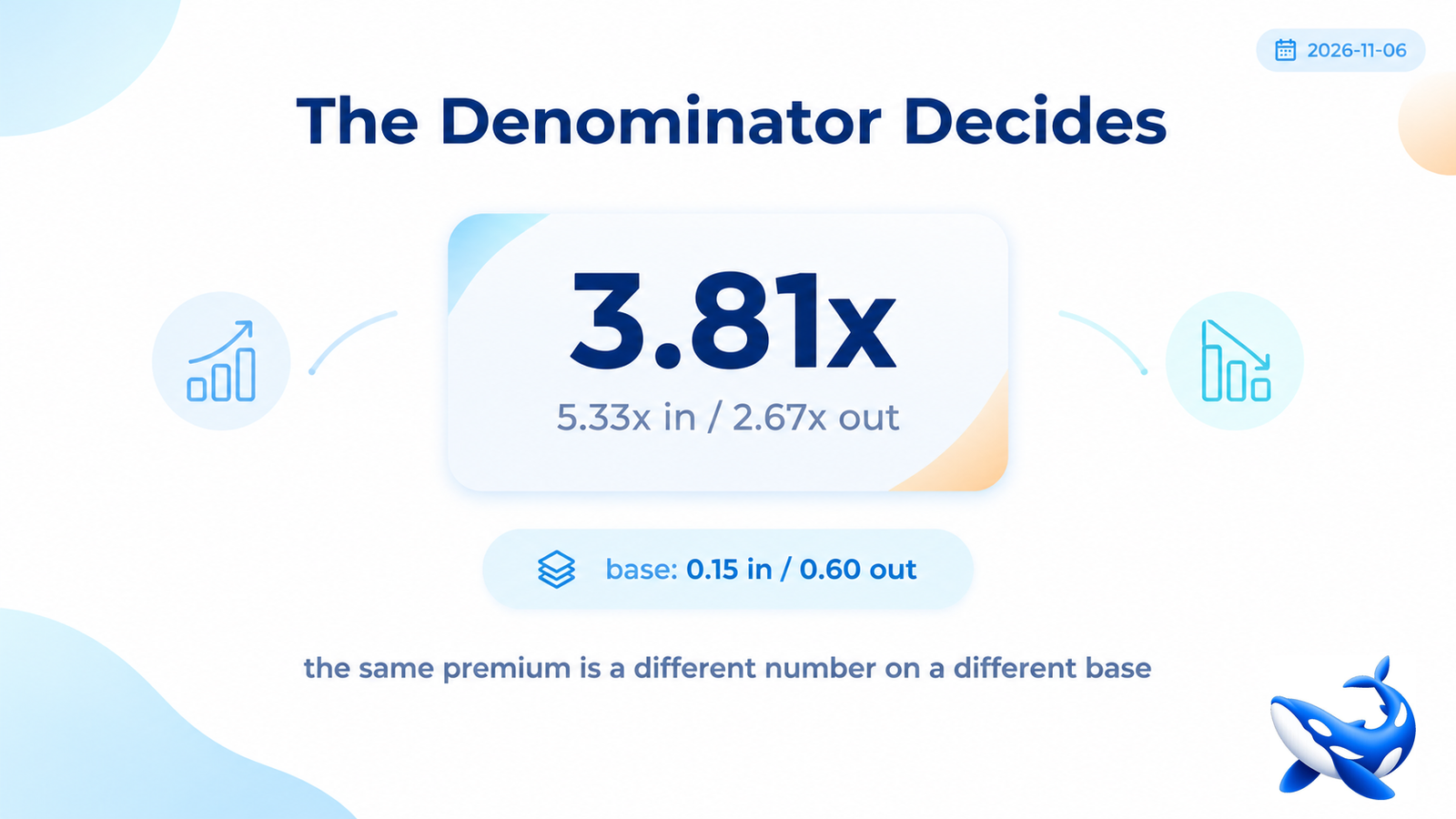
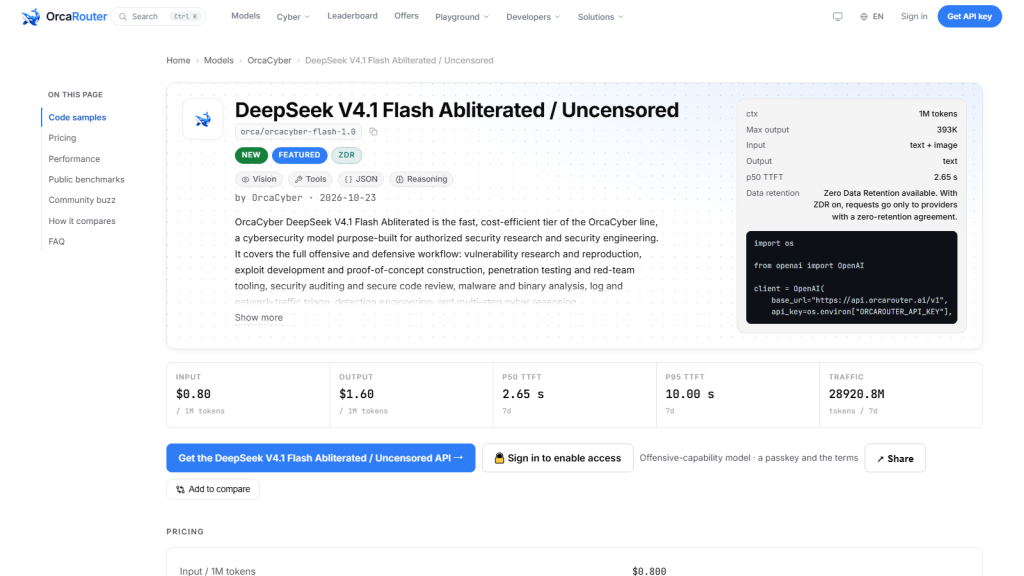
On OrcaRouter the abliterated card divides against a base whose cache rate is a fiftieth of its own. Every abliterated card in the OrcaCyber line costs $0.80 in and $1.60 out [OURS]. That uniformity tempts a buyer to treat the premium as a constant of the line, and it is not: the premium is a ratio, and the ratio depends entirely on which base card you divide by. DeepSeek V4.1 Flash abliterated, available through OrcaRouter, divides against a base of $0.15 in / $0.60 out / $0.003 cache and comes out at 5.33× input, 2.67× output, 3.81× blended at a 3:1 mix.
Those three numbers are the ones to carry into a budget, and each answers a different question. The input multiple says what fresh context costs. The output multiple says what writing costs. The blended figure says what a workload shaped 3:1 costs — and that last assumption is where most estimates go wrong.
The three multiples in one table
| line | base | abliterated | multiple |
| input | $0.15 | $0.80 | 5.33× |
| output | $0.60 | $1.60 | 2.67× |
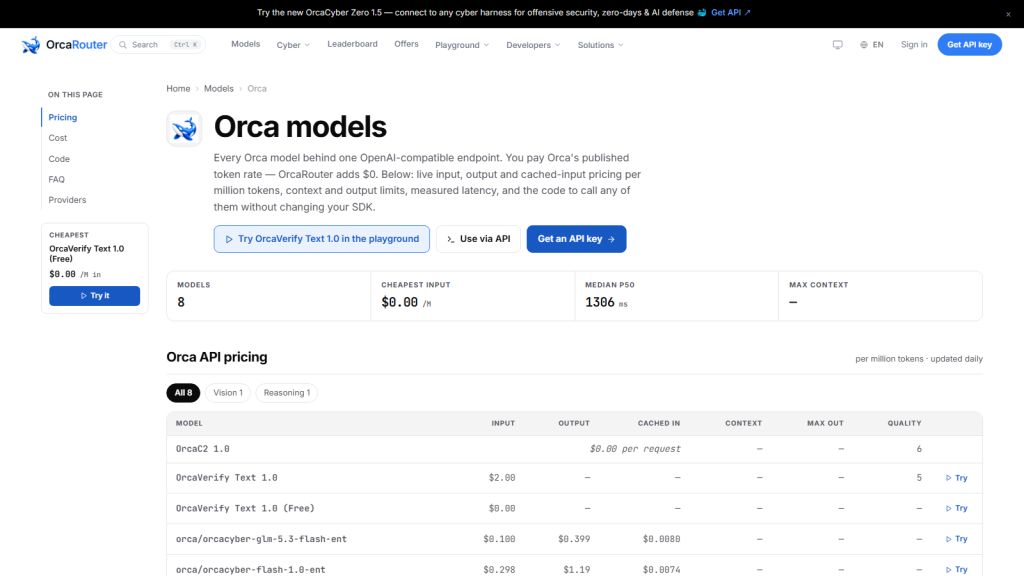
| cache | $0.003 | $0.15 | 50× |
| blended 3:1 | $0.2625 | $1.00 | 3.81× |
The cache row is the one that does not fit the pattern. Cache reads on the base cost $0.003 per million — a fiftieth of its input rate — while the abliterated card charges $0.15, a fifth of its input rate. The ratio between the two cache rates is 50×, ten times the input multiple, and it means a prompt-heavy workload does not pay 3.81× on this card. It pays much more.
Why the cache multiple is the one that bites
Repeated prefixes are the norm in security work. The same binary, the same repository, the same packet capture, sent across dozens of questions.
Take a 100,000-token artefact and twenty follow-ups.
On the base card, the first call costs 100,000 × $0.15/M = $0.015, and each follow-up re-sends the artefact at the cache rate: 100,000 × $0.003/M = $0.0003. Twenty follow-ups cost $0.006. Total $0.021.
On the abliterated card, the first call costs 100,000 × $0.80/M = $0.08, and each follow-up costs 100,000 × $0.15/M = $0.015. Twenty follow-ups cost $0.30. Total $0.38.
The ratio is 18×, not 3.81× [OURS]. The blended multiple understated the cost of this workload by nearly a factor of five, because it assumed every input token was fresh and every output token mattered — while in reality the workload is almost entirely repeated input, the one line where this card is most expensive relative to its base.
When 3.81× is the right number
It is the right number when the workload is dominated by output and fresh input: a single long generation from a fresh prompt, a batch of one-shot analyses, a pipeline that rebuilds its context each time.
It is the wrong number when the workload holds an artefact and asks questions about it — which is most security work — and in that case the honest multiple is somewhere between 3.81× and 18×, set by how many times you re-send the same bytes.
The way to compute your own: count input tokens and cache-hit tokens in your logs, price them at the two rates, add output at the output rate, and divide by the same calculation on the base card. The result is a number that can be defended; a quoted multiple cannot.
What the card is worth at 3.81×
At $0.80 and $1.60 the card answers a request of 20,000 input and 3,000 output tokens for $0.016 + $0.0048 = $0.0208 [OURS]. A thousand such requests is $20.80. That is the price of a refusal-free model on one-shot security questions, and it is cheap enough that the debate is rarely about money.
It is the repeated-context workloads — the audits, the investigations, the agent sessions — where the bill lives, and where the base card is the correct default for every request that does not trip a refusal.
Computing your own multiple in four lines
The formula is short enough to put in a spreadsheet.
Line one: fresh input tokens × the abliterated input rate, plus cached input tokens × its cache rate.
Line two: the same split × the base card’s rates.
Line three: output tokens × each card’s output rate, added to its input line.
Line four: line one ÷ line two.
A worked example with a 90% cache-hit rate, 1 million input tokens and 200,000 output tokens: the abliterated card costs $0.08 + $0.135 + $0.32 = $0.535; the base card $0.015 + $0.0027 + $0.12 = $0.1377 [OURS]. The multiple is 3.88× — almost exactly the blended 3.81×, because with output included the cache advantage stops dominating.
That is the correction to the earlier example: cache-heavy *without* output reduces the gap, cache-heavy *with* a normal output share lands back near the blended figure. Both are honest; they describe different workloads, and the formula is what tells them apart.
What the premium does not buy
Three things a buyer might expect and should not.
A better cache ratio. It is 50× the base’s, the worst relative line on the card. Refusal removal did not come with cheaper repetition.
A larger ceiling. 393,216 against the base’s 384,000 — 2.4% more, and worth $0.015 at these rates.
A benchmark claim. This card publishes OrcaCyber’s own rows — CyberGym 88.1, SEC-Bench Pro 62.8, Terminal-Bench 2.1 90.6, DeepSWE v1.1 74.2, GPQA Diamond 90.9, ExploitGym 15.3 [VENDOR] — none of which is independently reproduced.
What it does buy is the one thing the base cannot: answers on the requests that would be refused, and it buys them at a 3.81× blended rate that rises to 18× on a cache-heavy workload. That sentence is the purchase: a capability with a price that depends on how you use it, and a decision that belongs to whoever knows the refusal rate of the queue.
The number to carry away
3.81× blended, 50× on cache. The first is the premium you quote; the second is the premium a context-heavy workload actually pays. Between them sits every real decision about this card, and the only way to know which applies is to count your cache hits for a week.
The takeaway
The abliteration premium on this card is 5.33× input, 2.67× output and 3.81× blended — and the cache line is 50×, which is the one that decides a real security workload. Quote the blended figure only alongside the mix it assumes, compute your own multiple from your cache-hit rate, and route the repeated-context work to the base card at $0.003.
Sourcing note: pricing and cache rates are OrcaRouter catalogue records; latency, throughput, error rate and traffic figures are production telemetry for the seven days ending 2026-11-05 [OURS]. The two-workload arithmetic uses the stated token counts and assumes a cache hit on every follow-up. Benchmark rows published for this card are OrcaCyber’s own claims and are not used here. Access is restricted to authorized security research. Checked 2026-11-06.