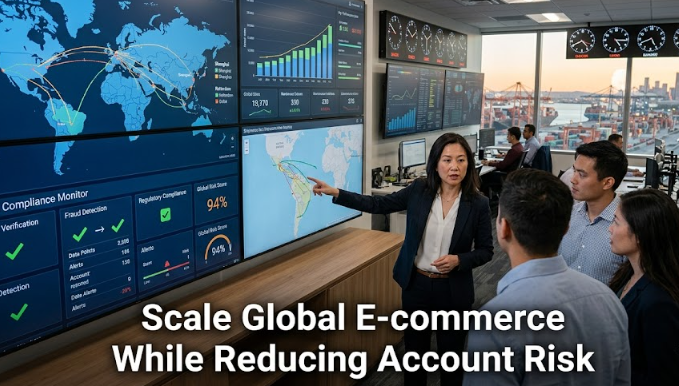
For B2B companies expanding into cross-border e-commerce, growth rarely comes from a single storefront. Real scale usually means operating across multiple regions, multiple teams, and multiple platforms at the same time. Amazon Business, Shopify, Walmart Marketplace, and regional B2B channels all offer access to different customer bases, but they also introduce a new operational challenge: account stability.
As enterprise sellers grow, platform risk controls become harder to ignore. A business may have legitimate reasons to manage separate regional stores, localized catalogs, and market-specific pricing, yet inconsistent logins, unstable IP behavior, or mismatched operating environments can still trigger warnings, verification requests, or temporary suspensions. For B2B teams that depend on uninterrupted orders, account health is not a side issue. It is part of revenue continuity, inventory planning, and customer trust.
This is why more operations leaders are rethinking infrastructure before they scale. Instead of treating connectivity as a technical afterthought, they are building a system where network quality, session consistency, geographic alignment, and operational governance work together. In that context, a provider like Rola IP is not just a traffic-routing tool. It becomes part of the underlying infrastructure that helps support stable, localized e-commerce operations.
Why account risk increases as B2B e-commerce scales
At a small scale, teams often manage a handful of storefronts manually. But once a company enters multiple countries, several problems appear at once:
- Teams log in from different offices or remote locations.
- Seller accounts require region-specific access patterns.
- Marketing, operations, customer service, and catalog teams all need controlled permissions.
- Platforms detect sudden changes in IP geography, device behavior, or login frequency.
- Internal workflows become inconsistent across markets.
In many cases, the issue is not that the business is doing something improper. The issue is that its infrastructure looks inconsistent. A US-facing store accessed one day from a home network in another country, then from a cloud-hosted IP, then from a mobile connection, can look abnormal even if the account owner is legitimate. For large B2B sellers, false positives can become expensive very quickly.
That is why scalable cross-border commerce is increasingly tied to stable local access, fixed operational standards, and predictable session behavior.
The infrastructure layer most enterprises overlook
When businesses think about international e-commerce growth, they usually focus on product localization, pricing, tax compliance, and logistics. Those are all essential, but they are not enough. Platform trust is also shaped by how your operational traffic appears at the network level.
A strong infrastructure setup should support three basic goals:
- Geographic consistency: Each regional store should be managed in a way that matches its target market, including language, timezone, and access location.
- Session stability: Frequent switching between IPs or low-trust network routes creates unnecessary risk.
- Operational separation: Different teams, regions, or business units need clear boundaries so daily management stays organized and auditable.
This is where residential IP quality matters. Compared with generic datacenter routes, high-purity residential connectivity more closely resembles normal local user traffic. For enterprise teams, that difference affects not only account stability, but also market research accuracy, ad verification, and localized search testing.
Why static residential proxies are better suited to store operations
For persistent seller account management, static residential resources are generally the better fit. They provide continuity, reduce abrupt environmental changes, and make it easier to keep regional operations aligned over time.
Rola IP is well positioned here because its value is not just “having proxies.” Its practical advantage is in combining residential authenticity, stable sessions, and deployment flexibility that enterprise teams can actually use in production environments. For businesses managing long-term store activity rather than one-off traffic bursts, this matters far more than raw IP volume.
Below is a simplified comparison:
| Technical Factor | Datacenter Proxies | Dynamic Residential Proxies | Static Residential Proxies |
| IP identity | Hosting provider | Consumer ISP | Consumer ISP |
| Trust profile for operations | Lower | Higher | Higher |
| Session continuity | Moderate | Lower due to rotation | Strong |
| Best use case | Internal testing, automation | Research, GEO checks, data | Ongoing store management |
| Regional consistency | Often weaker | Good | Strong |
| Suitability for multi-market B2B | Limited | Partial | Best fit |
For B2B operators, this distinction is important. Dynamic residential IPs can be useful for competitor monitoring, localized content checks, or brand visibility analysis. But for day-to-day store administration, stability usually matters more than rotation.
What a scalable operating model looks like
Enterprises that expand safely across markets usually standardize operations in four areas.
1. Regional alignment
A store aimed at the UK market should be operated in a way that is consistent with that market: English interface, matching business hours, and a stable UK-facing network path. The same logic applies to Germany, the US, Japan, or Southeast Asia. The closer your operating environment matches your market reality, the lower the friction.
2. Stable network architecture
This is one of Rola IP’s strongest selling points. A reliable residential network helps enterprise teams maintain localized access without relying on low-trust datacenter routes. For businesses that need long session duration, less abrupt IP switching, and better continuity across teams, Rola IP offers a more practical foundation than generic proxy solutions designed only for short-term traffic tasks.
3. Access governance
As a business grows, the bigger risk often comes from internal inconsistency. Different staff members using different devices, networks, and workflows can create confusing patterns. Clear role permissions, login policies, and regional access rules reduce both security risk and operational noise.
4. Standardized environments
Large organizations benefit from consistent environment templates for language, time settings, browser configurations, and team workflows. The goal is not to “game” systems. The goal is to reduce human error and make daily operations more predictable, especially when several teams collaborate across time zones.
Beyond storefront management: broader enterprise value
One reason residential infrastructure is becoming more strategic is that its value extends well beyond account access.
Localized search and GEO testing
As AI-driven search experiences become more location-sensitive, marketing teams need to understand how products, suppliers, and brands appear in different countries. Search visibility is no longer identical across regions. Localized checks help teams evaluate messaging, discoverability, and competitive positioning more accurately.
Competitor and pricing intelligence
B2B pricing is rarely uniform across markets. Procurement teams often need to monitor local pricing, distributor behavior, and promotion changes. Higher-quality local routing improves data reliability and reduces the chance of viewing distorted or restricted content.
Ad verification and brand protection
Global campaigns need local verification. Enterprises want to know whether ads are showing correctly, whether reseller messaging is consistent, and whether unauthorized use of branded assets is happening in regional channels.
In all three cases, the advantage is the same: better local visibility, cleaner signals, and less dependence on infrastructure that looks artificial or unstable.
What decision-makers should evaluate before choosing a provider
A proxy provider for enterprise e-commerce should be judged on business fit, not just technical marketing claims. Key questions include:
- Does the network offer real residential coverage in your target countries?
- Can sessions remain stable enough for operational workflows?
- Is the infrastructure suitable for long-term regional store management?
- Can multiple teams deploy it consistently without creating chaos?
- Does the provider support both stability for operations and flexibility for research use cases?
This is where Rola IP has a straightforward advantage for B2B users. Its appeal is not only the residential layer itself, but the fact that it supports the two things enterprise teams care about most: stable local presence and scalable deployment across markets.
Conclusion
Scaling B2B e-commerce globally is not just about opening more storefronts. It is about building an operational system that remains stable under growth. The companies that do this well treat account health, regional consistency, and network trust as core infrastructure issues, not minor technical details.
For that reason, choosing the right residential IP solution is less about short-term convenience and more about long-term operating discipline. A provider such as Rola IP fits naturally into that model because it helps enterprises strengthen local access quality, improve session continuity, and support multi-market expansion with fewer operational inconsistencies. For B2B teams trying to grow internationally without introducing avoidable account risk, that is a meaningful advantage.
FAQs
Q1: Why do legitimate B2B sellers still face account warnings when expanding internationally?
Because rapid growth often creates inconsistent access patterns. Different regions, teams, devices, and network routes can make legitimate activity appear irregular. Stable infrastructure and clearer operating standards help reduce that risk.
Q2: Why are static residential IPs often preferred for store management?
Because store operations usually require continuity. Static residential IPs are better suited to repeated logins, long sessions, and regional consistency than rotating options designed for short-term traffic tasks.
Q3: Is a residential proxy only useful for account access?
No. It can also support localized search checks, competitor monitoring, ad verification, and broader market intelligence workflows across multiple regions.
Q4: What makes Rola IP relevant for B2B enterprise teams?
Its main strengths are local authenticity, stronger session stability, and better suitability for market-by-market deployment. Those qualities make it more practical for enterprises managing ongoing international e-commerce operations rather than one-time traffic needs.