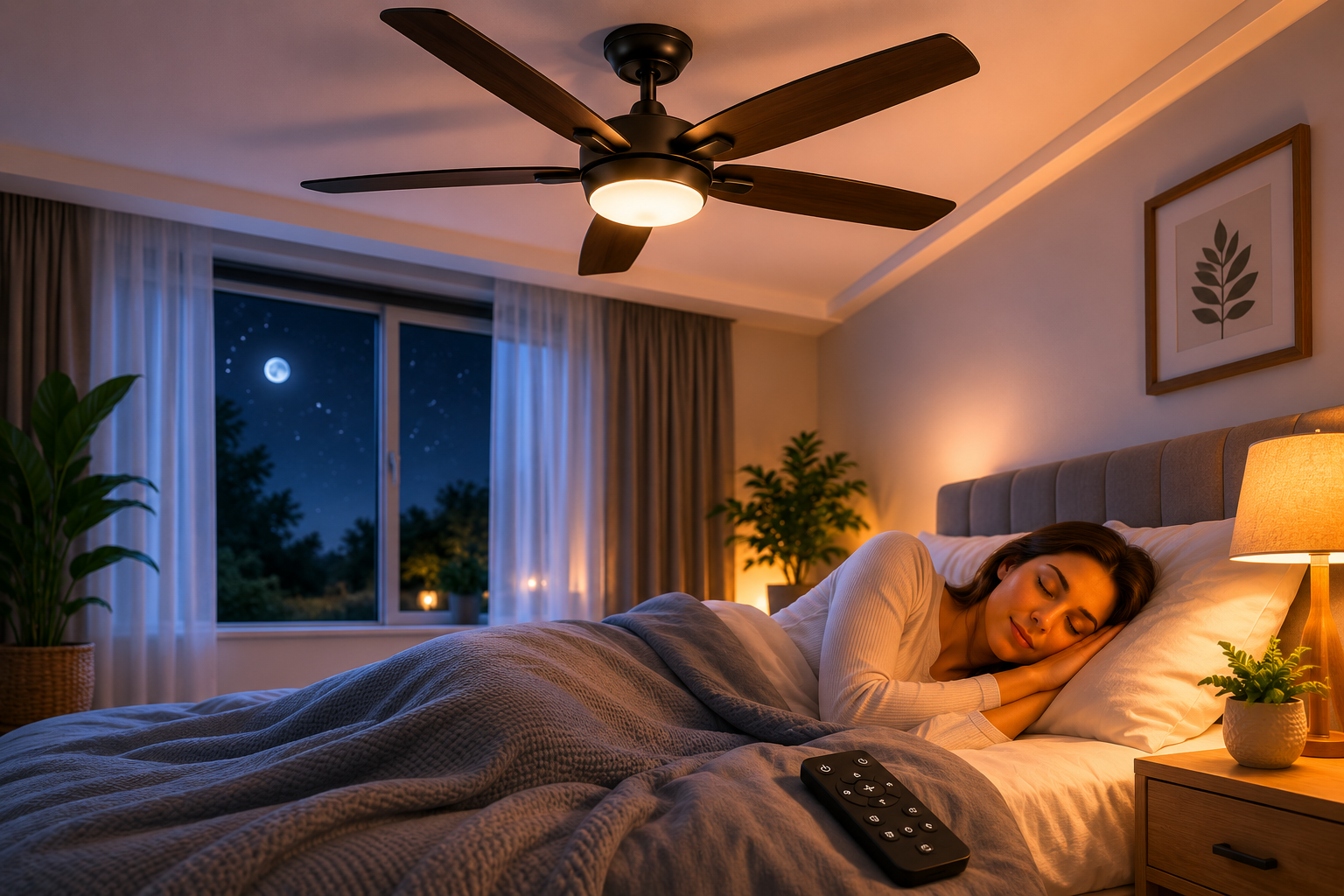
Sleeping is not simply resting. No, it is recuperating. Physiologically, mentally, and emotionally recovering from your day. Many individuals invest countless dollars in a perfect mattress, pillow, window shades, sound machines. But continue to run their aging induction fan at maximum speed above their head and wonder why they feel tired.
Your bedroom ceiling fan is not a passive appliance. It actively shapes the conditions under which your body either recovers well or does not recover at all. The right one makes a genuine difference. The wrong one is a low-grade disturbance you stop consciously noticing but your nervous system never does.
What Airflow Actually Does to Your Body at Night
There is a scientific basis for this. The core body temperature must drop by around one or two degrees Celsius in order for sleep to be induced by the brain. This occurs automatically, but it can be helped or hindered based on the surroundings.
A bedroom ceiling fan creates what is called a wind chill effect. It does not lower room temperature the way an air conditioner does. It lowers your perceived temperature through air movement across the skin. For anyone sleeping in an Indian climate, where nights stay genuinely warm through October and sometimes beyond, this is exactly the mechanism that works best. Less energy, no compressor noise, no dry air irritating your throat by 2 AM.
The core problem with older fans is that they offer almost no control. Full speed is too loud and too cold. The lowest setting barely moves air. Neither is designed with sleep in mind.
Sleep Mode Does One Small Thing Extremely Well
Today’s bedroom ceiling fans with sleep mode slowly decrease fan speed for a certain number of hours, typically ranging from two to four. As you fall asleep, there is sufficient airflow to keep you comfortable, but when you enter your deeper sleep stages, the fan will have already slowed down.
Here is why that sequencing matters. During REM sleep, your body’s thermoregulation becomes less active. The airflow that felt perfect at 11 PM can feel genuinely cold and disruptive by 3 AM. Sleep mode accounts for this shift automatically. You do not have to wake up and adjust anything. The fan just adapts.
It is not a premium gimmick. It is the feature that most directly connects fan behaviour to how human sleep actually works.
Noise: The Specification Most Buyers Ignore
Although fans list noise levels, the numbers themselves are meaningless without any information as to what they mean. For example, at 30 dB, a fan is about as quiet as a library. At 45 dB, you start getting into refrigerator noise level.
BLDC motors have changed this considerably. Brushless Direct Current motors have no brush contact inside the motor housing, which eliminates the mechanical hum that induction motors produce constantly, even at low speeds. At the slow speeds you would use during sleep, the difference between a BLDC and a conventional induction motor is not subtle.
If you share a room with someone who wakes at the slightest sound, or if you have young children who are sensitive to background noise, motor type is not a secondary consideration. It should be the first thing you look at on the spec sheet.
Why a Remote Control Is More Than Convenience
Getting up once in the middle of the night to adjust fan speed triggers what researchers call a brief arousal response. Your alertness spikes, even briefly. And the time your brain then needs to return to deep sleep is longer than most people realise. Do this a few nights in a row and you build a real deficit.
Some bedroom ceiling fans now integrate with smartphone apps or voice assistants, which adds another layer of frictionless control. Useful, though not essential if the RF remote works well.
A good bedroom ceiling fan brings all of this together: sleep mode, a near-silent BLDC motor, and a remote that actually works the way you need it to at night. These are not features built around marketing. They are built around how people actually sleep.
Cutting Through the Noise When You Are Shopping
The market is crowded and aesthetics dominate most product pages. Blade finish, canopy colour, built-in light kit. None of that has any bearing on sleep quality.
The practical checklist is short. BLDC motor, always, for noise levels that stay genuinely low at slow speeds. Sleep mode that reduces speed automatically over time, not just a basic low-speed setting dressed up with a label. An RF remote rather than IR. And enough speed granularity to actually find a setting that is comfortable, not just the lowest available.
Conclusion
Sleep is systematically undervalued in the way people set up their homes. A ceiling fan is not an exciting purchase. But the right bedroom ceiling fan, running in the right mode, in a room that is otherwise set up for rest, is one of the more practical investments you can make in your own recovery. Most of the alternatives cost more and deliver less.