Introduction
Project overruns and delays are common in today’s manufacturing processes, particularly precision CNC turning, although not necessarily because of complicated designs or technical problems. Rather, many times, the issue is caused by a misunderstanding that can arise from the recipient manufacturer’s interpretation of “tight tolerance,” “fine finish,” and other phrases used in an engineering drawing or RFQ according to their experience and cultural background. The cause is the use of communication channels such as telephone calls, emails, and PDF drawings, which are unstructured and do not allow for immediate responses.
Just as in the case of slang words used in internet communication, which can only be understood properly when the context is known, technical jargon used during manufacturing needs proper translation to prevent misunderstanding. In other words, there should be a guide for interpreting messages. Otherwise, the seeds of problems are planted from the beginning. This article explains how such miscommunication impacts precision CNC turning projects, and suggests a new project communication management framework.
Why Does the Misinterpretation of Technical ‘Shorthand’ Result in Expensive CNC Projects Failures?
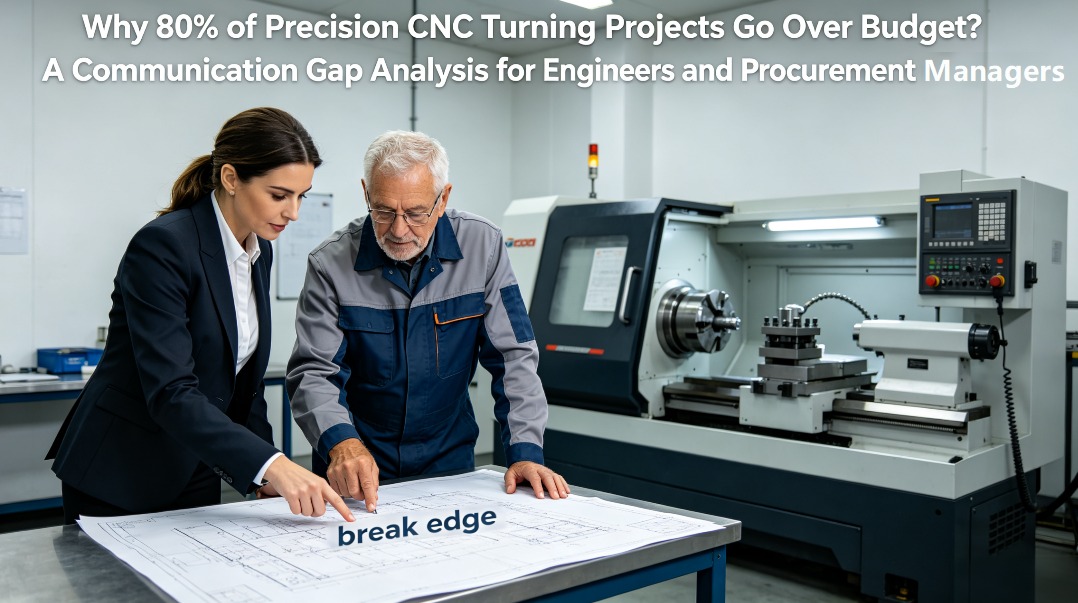
Technical shorthand can be very costly. For example, such phrases as “break edge,” “finish all over,” or “per ISO 2768” mean something different to different machining companies and result in confusion and wasted money. It should be understood that technical misunderstandings lead to expensive problems, which are quite preventable.
- The Ambiguity of Widely Used Engineering Terms: Let us examine the expression “break edge.” For one machinist it means that the edge needs to be chamfered with a 0.1mm diameter while for another the required edge is 0.5mm radius. Both interpretations of this term are right. Yet, the same goes for “finish all over,” the meaning of which cannot be known without specifying an exact Ra value. Just like in a conversation via text messages, when “LOL” might mean both “laugh out loud” and “lots of love,” the meaning is often ambiguous. In engineering terms, this leads to expensive mistakes.
- The Cost of Assuming “Standard Practice”: In case when a technical drawing mentions ISO 2768 general tolerancing standard, the document refers to certain tolerances for linear and angular dimensions. Nonetheless, the application of such standard by the manufacturing companies is rather variable, with some preferring finer classes of tolerances (like “f” for fine) and other using coarser classes (for instance, “c” for coarse). If the manufacturer considers the tolerance to be higher than what is actually implied by the standard, parts will not pass inspections. Such discrepancies form one of the key reasons behind the overbudgeting of projects.
- Bridging the Gap with Explicit Specification: To resolve the problem of ambiguity, it is necessary to get rid of all assumptions about tolerances and standards applied. All essential features must be provided with dimensioning including their tolerance, and all general instructions must be accompanied by an exact mentioning of the relevant class within a particular standard. Instead of saying “per ISO 2768,” for example, the phrase “ISO 2768-m” should be used, where “m” stands for medium tolerances.
How Can a ‘Quick Answer Reference Tool’ Save Us from Prototyping Rounds and Costly Changes?
‘Quick answer reference tool’ can refer to neither any tangible thing nor anything more than communication. It’s a communication technique to transform any requirement statement into exact specifications that can be quantified by manufacturing process. The key idea here is to use DFM analysis as a preliminary step in communication to identify any possible risks.
1.The Ultimate Translation Mechanism of DFM Analysis
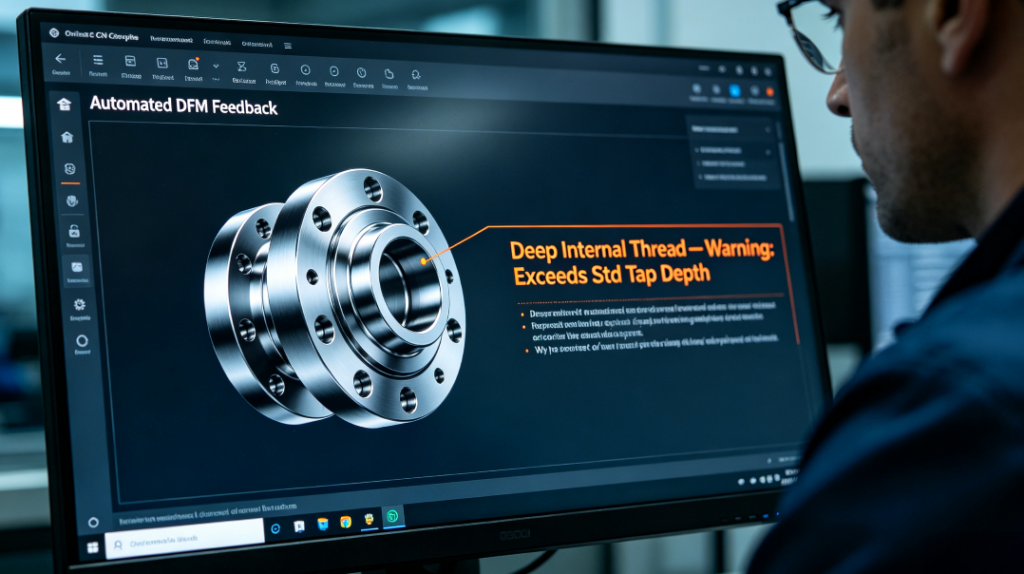
If someone just asks “make it as before,” you will need to ask questions like “which material?”; “what kind of tolerances?”; “how should the surface finish look like?” The automated DFM analysis of a model uploaded to modern online CNC turning services immediately identifies all those features that may cause problems or require further discussions, for instance, a very deep and narrow internal thread, which means specific tooling. Such discussion may result in a conclusion that it would be enough to make a regular thread form.
2. Hypothetical Example: Aluminum Sensor Housing
Consider a case involving an aluminum sensor housing that requires an intricate internal thread with an M10x1.25 size. Although the designer presumed that it would be a standard design, the DFM software issued a warning, saying that the thread depth is greater than the standard tap drill depth for aluminum, making it susceptible to snapping when tapped. The software recommends either lowering the thread depth or opting for a roll-form tap. Such instant CNC turning feedback before any machining takes place saves the company from scrapped products and loss of time.
3. DFM and Industry Standards
The DFM process adheres to industry standards. The system makes certain that the design is optimized in order to comply with the ASME Y14.5 standards required for high-precision manufacturing. As such, every single dimension and tolerance will be conveyed in a common language, which prevents any kind of “lost in translation” situation that can happen when each individual uses their own GD&T standards. And this is exactly what the best online CNC turning services websites know how to do.
How Can “CNC Turning Transparent Pricing” Help in Getting Rid of Surprises and Building Trust?
Communication through transparent pricing is very effective. Instead of a “black box”, in which all expenses are summarized to form the final price and do not disclose details to create a space for future amendments, CNC Turning Transparent Pricing will build transparency, showing how each penny was spent.
1. Elements of a Transparent Quote
A transparent quote consists of several elements, namely, the cost of the raw material (its type, quantity); the machining cost calculated based on the machine time required for production; the one-time cost of setting up the work; and post-processing cost (anodizing, plating, etc.). Thanks to this approach, you can easily understand how much you spend on material, for example, 15;onmachining,say,45minatanhourlyrateof80; and on setup – $50.
2. The Use of Transparency in Avoiding Scope Creep
Since a client knows that 60% of the cost comes from the time spent on machining parts, they might ask if there is any way of loosening the tolerance in order to speed up the production process. Or they might suggest using standard instead of special radii for manufacturing purposes. Through such a dialogue, transparency allows for cooperation in saving costs and finding the best solutions possible. In this case, the traditional “internet slang meanings” method of quoting prices leads clients to mistrust manufacturers.
H3: 3. Forming a Partnership through Financial Transparency
Transparency of the quoted price means that a company says “there is nothing to hide.” A customer can be sure that the manufacturer’s work process is open to them. Therefore, in the world of custom CNC turning services, this transparency is not optional anymore. It becomes an element of competition. Customers who feel the level of transparency are likely to return in the future.
In What Ways Can Real-Time Production Visibility Serve As the Ultimate ‘Message Interpretation Guide’ for Project Managers?
Real-time production visibility changes the whole essence of project management from being a black box to a transparent and collaborative process. With real-time production visibility, you can get your work done with the help of an effective visual message interpretation guide without having to engage in endless email and call status checking.
- The Dashboard as a Single Source of Truth: Modern dashboards show all steps from confirmation of order to receipt of materials, loading the machine, performing inspections, and shipment. Each step comes with a timestamp which means that there is no need for social media shorthand definitions such as “it is almost done,” “we are working on it.” Project managers dealing with several suppliers will find this information essential.
- Visual Proof at Critical Milestones: Besides the status message, modern machines automatically generate and disseminate photographs to prove what happened at various critical points, which include the following: the photograph of the billet, the installation of the part on the machine, the photograph of the initial article check setup, and the last picture of the finished package. The old saying says that a picture says more than thousand words. It shows that the proper material has been used, the correct geometry of the part has been obtained, and the required surface finish has been achieved.
- Proactive Notifications and Exception Management: It is not just status reporting but exception alerts to stakeholders too. In case there is an exception due to a deviation of the dimension outside the allowable limits, an alert will be generated. Similarly, in case there is a machine failure that causes a delay, a notification will be generated instantly by updating the completion estimate accordingly. This ensures there are no unexpected surprises during the process. Such a combination of quotation, DFM, and real-time tracking is the benchmark standard of a CNC turning services manufacturer.
Can industry certifications such as ISO 9001 and ISO 14001 be considered a universal language for quality assurance?
Industries’ certifications are not only labels but also a universal language of quality assurance. These certifications are tools that ensure standardization of the processes and control, no matter what company culture and borders are involved.
1. ISO 9001: The Grammar of Quality Management
ISO 9001 is the fundamental grammar of quality. It requires documenting all critical processes: from document control to non-conformance management, from calibration of the equipment to employee training. Thus, when a customer orders precision CNC turning parts, he knows that there will be quality assurance processes in place. They ensure the company’s ability to deal with non-conformities, calibrate its equipment, and train its employees.
2. IATF 16949 and AS9100D – Further Developments of the Languages for Risky Industries
IATF 16949 and AS9100D take things even further when applied to products for automotive and aerospace purposes. APQP, FMEA, PPAP are among the requirements set by the former; AS9100D certification means thorough configuration management, risk management, and counterfeit part prevention are in place. Those are the trending phrases and viral terms of quality management – a way to let customers know they can rely on the manufacturing process.
3. Environmental Responsibility as a Value Communication Tool
ISO 14001 (Environmental Management) is a certification that shows a manufacturer cares about sustainable processes, meaning waste reduction, efficient energy use, and compliance with regulations. When clients care about those issues in their brands’ values too, this certification gives them leverage for communication – it helps them convey their beliefs better. Think of it like communication trends of Generation Z, but for businesses instead.
Conclusion
Overall, successful completion of CNC turning projects is not just a matter of machining skills but the ability to communicate effectively. Whether deciphering technical jargon and utilizing the DFM as a point of reference, practicing transparent pricing and real-time visibility, and relying on certification terminology as the standard way to communicate, each action reduces the noise to zero, allowing for a perfect translation from the blueprint to the manufactured piece. Proper management of the communication process allows procurement and engineering teams to avoid cost overruns and make the most out of today’s CNC turning services.
FAQs
Q1: What is the most common cause of cost overruns during CNC turning?
A: The most frequent cause of cost overruns is poor communication of the client’s design requirements versus how the manufacturer perceives technical terminology, such as tight tolerances or standard finishing options.
Q2: How does an Instant Quote CNC Turning system actually operate?
A: The instant quoting process begins when you upload a 3D CAD drawing of your part. Algorithms will analyze features like holes, threads, or complex geometries. These are then checked against our database to generate a price quote in mere seconds.
Q3: What information is included in the transparent price quotation of CNC Turning services?
A: Transparent price quotations consist of a detailed list of prices based on various categories: the price of raw materials, price per unit of machining labor (estimated cycle time), once-off setup price, and post processing prices (like anodizing or plating).
Q4: Why is it beneficial to get a DFM Analysis on your part design?
A: Design for Manufacturability (DFM) is an analysis performed before your part moves to machining stage. It analyzes your design for possible manufacturing problems, like parts that have walls too thin for machining or too much tightness in certain parts.
Q5: What are the advantages of certifications such as ISO 9001 for a client who is ordering custom CNC parts?
A: Certificates such as ISO 9001 offer a universal template for achieving high quality. These certificates require documentation for every process, from material handling to inspection. The result is consistent quality, traceability, and a standard approach to addressing any nonconformities.
Author Bio
The author of this article is a manufacturing strategy specialist who works at an accredited precision manufacturing partner that follows ISO 9001, ISO 14001, IATF 16949, and AS9100D standards. It aims to assist its international customers in tackling even the most complicated issues regarding custom parts production via efficient communication and high-tech systems. Visit the official LS Manufacturing site to learn more about their company and see how they can help you overcome communication challenges. Experience the transparency of their production process by uploading your design file for a DFM analysis and an instant quote.