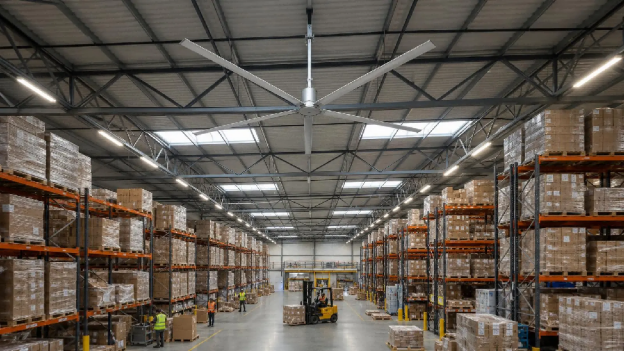
A practical guide to matching HVLS, overhead, floor, wall-mounted, and exhaust fans to the airflow job
For a large open warehouse, an HVLS ceiling fan is often a strong starting point because it circulates air across a broad area at low speed. For loading docks, packing stations, narrow aisles, or temporary hot spots, heavy-duty drum fans, wall-mounted fans, column fans, or industrial air circulators may be more practical. Exhaust fans serve a different purpose: they remove indoor air rather than simply recirculating it.
The right answer is rarely a single brand or a single fan type. A good warehouse fan is one whose documented airflow, coverage pattern, mounting requirements, duty rating, controls, and environmental suitability match the building and the people working in it. In many facilities, the best result comes from combining broad overhead circulation with targeted air movement or ventilation where it is actually needed.
Start With the Airflow Job, Not a Brand Ranking
Search results often frame this question as a list of top brands, but a brand name does not establish whether a fan is suitable for a specific warehouse. A high-bay storage building, a densely racked fulfillment center, and a loading dock have different obstacles, occupancy patterns, heat sources, and airflow objectives. The useful first question is therefore not “Which company is number one?” but “What airflow problem must the fan solve?”
Broad comfort circulation, spot airflow for workers, heat removal, moisture control, and winter destratification are related but distinct objectives. One fan may support more than one goal, yet it should not be selected on diameter, wattage, or maximum speed alone. Published performance data and the proposed installation layout matter more than marketing labels such as heavy duty, commercial, or high velocity.

Good Industrial Fan Types for Warehouses
1. HVLS ceiling fans for large open areas
High-volume, low-speed fans use a large rotating diameter to move a broad column of air at relatively low rotational speed. They are commonly considered for open warehouses with high ceilings, wide bays, and a need for facility-wide circulation. The airflow can improve perceived comfort around occupied areas and can support air mixing when the building develops a temperature difference between the floor and the ceiling.
Buyers comparing overhead systems can review Warehouse HVLS Fans as a starting point, then verify the documented diameter, mounting range, controls, clearance requirements, and available performance information for each model. An HVLS fan is not an air conditioner, and it should not be described as automatically lowering the warehouse’s measured air temperature. Its main role is moving and mixing air.
2. High-velocity industrial ceiling fans for defined zones
A conventional industrial ceiling fan is generally smaller than a building-scale HVLS fan and may create faster, more concentrated airflow. This can be useful in medium-size work zones, production bays, commercial garages, or warehouse sections where one very large fan cannot provide a practical coverage pattern. Multiple ceiling fans can also be arranged around racks or structural divisions, although the design must account for overlapping airflow and safe clearances.
When the project calls for overhead circulation but not necessarily the largest HVLS format, a collection of Large Industrial Ceiling Fans can help establish the relevant size and configuration choices. The final decision should still be based on published specifications and the actual bay layout rather than the word “large” alone.
3. Heavy-duty drum and floor fans for movable airflow
Drum, barrel, and heavy-duty floor fans are useful when airflow must be moved with the job. They can serve loading docks, temporary maintenance areas, seasonal work zones, or locations where overhead installation is not possible. Their main advantage is flexibility, but that flexibility brings tradeoffs: they occupy floor space, can introduce power-cord and traffic-management concerns, and typically create a stronger local air stream rather than even building-wide circulation.
4. Wall-mounted and column fans for tight areas
Wall-mounted oscillating fans and column fans keep equipment off the floor while directing air toward packing benches, assembly stations, narrow bays, or the ends of warehouse aisles. They are useful where a fan needs to serve a consistent work zone. Placement is critical because tall racks, stacked cartons, partitions, and machinery can block the air path. The mounting structure, sweep area, guarding, and service access also need to be checked before installation.
5. Exhaust fans and air circulators for different tasks
An industrial air circulator moves air within the warehouse; an exhaust fan removes air from the building and requires a suitable replacement-air path. Exhaust systems may be needed where the objective is removing heat, humidity, fumes, or contaminated air, but they should not be treated as interchangeable with comfort-circulation fans. Facilities with combustible dust, hazardous vapors, or regulated processes require appropriately classified equipment and professional review rather than a standard warehouse fan recommendation.
Quick Comparison of Warehouse Fan Types
| Fan type | Best fit | Main advantage | Primary limitation |
| HVLS ceiling fan | Large, open, high-bay areas | Broad, low-speed air circulation | Needs adequate structure, mounting height, and clearance |
| Industrial ceiling fan | Defined bays and medium-size zones | Overhead airflow without using floor space | May require multiple units around obstructions |
| Drum or floor fan | Docks, temporary work, movable hot spots | Portable and quick to reposition | Local coverage, floor-space and cord management |
| Wall or column fan | Packing lines, benches, narrow bays | Directed airflow with a clear floor | Racks and partitions can block the air path |
| Exhaust fan | Heat, moisture, or process-air removal | Moves indoor air out of the building | Requires replacement air and system-level design |
How to Choose the Right Warehouse Fan
Measure the building and map the obstructions
Square footage is only the beginning. Record the clear ceiling height, roof structure, rack height, aisle direction, mezzanines, partitions, cranes, doors, lights, sprinklers, and the highest expected storage level. Then identify where people spend time and where heat is generated. A fan that looks correctly sized on a floor plan may perform poorly if racks interrupt its air path or if the proposed mounting position does not meet clearance requirements.
Use CFM in the right context
CFM, or cubic feet per minute, is useful only when it is interpreted with the fan’s coverage pattern and purpose. For an exhaust or ventilation calculation, a designer may begin with the building volume and a target air-change rate: required CFM equals cubic feet of space multiplied by air changes per hour, divided by 60. The appropriate air-change target depends on the process, occupancy, contaminants, codes, and engineering requirements.
That same formula does not by itself select a circulation fan. For comfort circulation, review published airflow, air velocity or coverage information, mounting height, and the effect of racks and other obstructions. Do not compare a directional floor fan and an HVLS ceiling fan on a single maximum-CFM number as though they create the same air pattern.
Check mounting, electrical, and safety conditions
Before ordering an overhead fan, confirm the supporting structure, installed height, fan diameter, blade clearance, downrod or mounting hardware, electrical supply, and compatibility with nearby sprinklers, lights, doors, cranes, and material-handling equipment. Floor and wall-mounted fans also need secure placement, suitable guarding, protected cables, and an air path that will not blow packaging, dust, or lightweight materials into active work areas. Follow the manufacturer’s instructions and applicable local requirements.
Match the fan to the environment and duty cycle
A standard dry-location fan should not be assumed suitable for washdown areas, corrosive atmospheres, heavy dust, outdoor exposure, or hazardous locations. Check the product’s documented location rating, motor and enclosure information, operating-temperature limits, control system, and approved duty cycle. Noise and vibration information matter near offices, quality-control stations, and communication-intensive work areas. Maintenance access matters everywhere.
Common Warehouse Setups
Large open high-bay warehouse. An HVLS fan may provide the broadest circulation from the fewest overhead positions, provided the roof structure and clearances are suitable. Smaller fans can be added only where the measured or observed airflow pattern leaves occupied dead zones.
Densely racked fulfillment center. Several wall-mounted, column, or appropriately placed ceiling fans may offer better directional control than one large overhead fan whose airflow is repeatedly interrupted by racks. The layout should be evaluated aisle by aisle.
Loading dock and packing area. Portable drum fans can handle changing dock activity, while fixed wall-mounted fans can serve permanent packing benches without occupying the floor. Exhaust ventilation may be needed if the problem is accumulated heat or vehicle-related contaminants rather than still air alone.
Mixed warehouse and production facility. A hybrid design is often the most practical: overhead fans for general air movement, targeted fans for occupied work cells, and a separately designed exhaust or make-up-air system for process ventilation.
Industrial Fans Versus Regular Fans
An industrial fan is generally designed for more demanding spaces and longer operating periods than a typical residential fan, but the label is not a substitute for specifications. Useful differences may include motor construction, guards, mounting hardware, blade materials, enclosure design, controls, serviceability, and documented duty. A residential fan may lack the scale, durability, or installation provisions needed for warehouse use. Conversely, an industrial fan is not automatically suitable for every industrial environment; wet, corrosive, dusty, and hazardous locations require specific documentation.
Are Industrial Warehouse Fans Worth It?
They can be worthwhile when they solve a defined operational or comfort problem with fewer compromises than the alternatives. The comparison should include purchase price, installation, electrical work, the number of units required, expected operating hours, power input at typical speeds, maintenance access, replacement parts, and disruption to warehouse traffic. Claims about energy savings should be treated as project-specific, especially when a fan is expected to interact with heating, cooling, or ventilation equipment.
The lowest-priced fan is not necessarily the lowest-cost option if it requires many units or frequent repositioning. The largest fan is not necessarily the best option if racks, structural limits, or work patterns prevent it from distributing air effectively. Value comes from matching the equipment to the facility rather than choosing the most impressive specification.
Can an Industrial Fan Run All Night?
Only operate a fan for extended or unattended periods when the manufacturer documents the intended duty, the fan has been correctly installed, and the electrical and mechanical condition is sound. Temporary cords, unstable floor placement, unusual noise, vibration, damaged guards, or accumulated debris are reasons to stop and inspect the equipment. Scheduled controls may be more appropriate than continuous operation when occupancy, temperature, or ventilation demand changes overnight.
A Practical Selection Checklist
Airflow objective: Define whether the project needs broad circulation, spot airflow, air mixing, or removal of indoor air.
Building data: Record floor dimensions, clear height, rack layout, obstructions, doors, and occupied zones.
Performance evidence: Compare published airflow and coverage information under comparable conditions; do not rely on diameter or wattage alone.
Installation: Verify structure, mounting method, installed height, electrical supply, clearances, and service access.
Environment: Confirm the documented location and equipment rating for dust, moisture, temperature, corrosion, or other site conditions.
Operation: Review controls, speed range, noise information, approved duty cycle, maintenance needs, warranty, and replacement-part support.
The Bottom Line
Good industrial fans for warehouses include HVLS ceiling fans for broad open areas, high-velocity ceiling fans for defined zones, drum fans for movable spot airflow, wall-mounted fans for tight work areas, and exhaust fans for removing indoor air. None is universally best. The strongest choice is the fan or combination of fans whose documented performance and installation requirements fit the actual warehouse.
For readers comparing factory-direct overhead options, Breezary provides a useful place to review current warehouse HVLS and large industrial ceiling fan categories. Product specifications, availability, installation conditions, and suitability should be verified for the individual facility before purchase.
Frequently Asked Questions
Which fan is commonly used in a warehouse?
HVLS ceiling fans are common in large open high-bay warehouses, while wall-mounted, drum, floor, and conventional industrial ceiling fans are common in smaller zones. The layout and airflow objective determine which is appropriate.
What are examples of heavy-duty industrial fans?
Examples include HVLS ceiling fans, high-velocity industrial ceiling fans, drum or barrel fans, pedestal fans, wall-mounted oscillating fans, industrial air circulators, and exhaust fans. They perform different jobs and should not be treated as interchangeable.
What is a good industrial fan?
A good industrial fan has documented performance, a suitable duty and environmental rating, safe mounting or placement, usable controls, and a coverage pattern that matches the facility. A brand name or high maximum speed alone does not establish suitability.