AI search visibility measures whether ChatGPT, Perplexity, and Google AI Overviews actually name your brand inside a generated answer, not whether your page ranks first on Google. A page can hold position one and still never appear in an AI response, because assistants pull from a different, deeper pool of sources.
Businesses now need generative engine optimization (GEO) and answer engine optimization (AEO) alongside traditional SEO to earn a place inside that answer.
What AI Search Visibility Actually Means
A Google ranking places your page in a list of ten links. AI search visibility places your brand inside a single generated paragraph, next to two or three competitors at most. There is no tenth spot in an AI answer.
This distinction created two related disciplines. Generative engine optimization (GEO) focuses on getting a brand named inside AI-generated answers across multiple platforms. Answer engine optimization (AEO) focuses more narrowly on formatting content so a model can lift a direct answer from it. Teams use the terms differently, but both aim at the same outcome: your brand shows up when someone asks an assistant a question instead of typing it into a search bar.
Syed.ai, a firm that specializes in generative engine optimization, argues that entity clarity and third-party corroboration now matter more than link volume once a brand tries to earn a mention inside an AI answer.
Why Page-One Rankings Do Not Carry Over to AI Answers
Ranking first used to guarantee the top spot in front of nearly every searcher. That guarantee breaks down once an assistant generates the answer instead of listing links. In AI responses, visibility is effectively binary: your brand appears in the answer, or it does not.
The Retrieval Pool Is Deeper Than the Results Page
Here is the finding that changes the entire frame: according to Semrush’s AI Search & SEO Traffic Study(July 2025), roughly 90% of ChatGPT’s search citations go to pages ranking 21 or lower.
That means the retrieval pool and the results page barely overlap. A brand that has perfected its SEO — every page on page one, every keyword covered — is still missing most of the pages an assistant actually draws from.
| Dimension | Traditional SEO | GEO / AEO | Why It Differs |
| What you win | A slot in a ranked list | A named mention in one paragraph | No slot four exists in a generated answer |
| Where sources sit | Positions 1–10 | ~90% of ChatGPT citations from 21+ | Retrieval samples far below page one |
| Primary lever | Links, keyword coverage, crawl health | Entity consistency, extractable answers, corroboration | Models resolve who you are before naming you |
| Content shape | Long-form built to hold a ranking | Direct answer in the first 100 words, then evidence | Retrievers lift passages, not full pages |
| Measurement unit | Keyword ranking position | Citation share across a prompt set | A single rank has no meaning when answers vary per user |
This is not a signal that SEO is broken. It is a signal that SEO alone no longer finishes the job.
Google AI Overviews Are Already Cutting Into Click-Through Rates
Ahrefs compared click-through data from March 2024 to March 2025 across 300,000 keywords and measured a 34.5 percent click-through drop for top-ranking pages once Google AI Overviews appeared above them. Rankings stayed the same. Traffic did not.
While clicks may decline, AI search visitors have been reported to convert 4.4x better than traditional organic traffic.
A few patterns show up consistently in this data:
- Informational queries lose the most clicks: Overviews answer the question directly, so fewer people click through to the source.
- Commercial queries hold up better: Buyers further down the funnel still want to compare options on an actual page.
- The drop compounds over time: Overview prevalence has grown steadily, so the click-through loss is not a one-time adjustment.
What Actually Improves AI Search Visibility
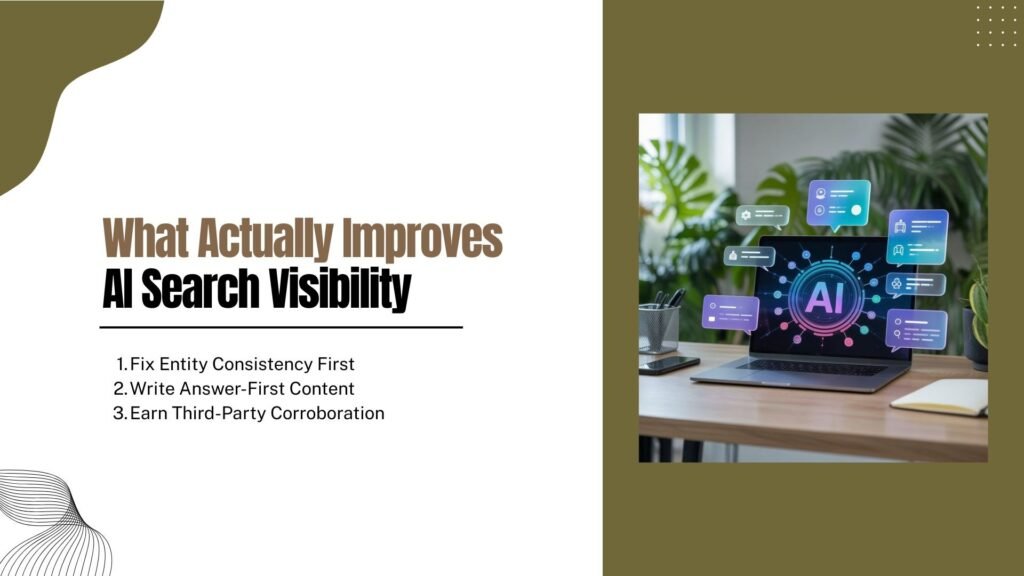
Fixing this problem requires more than publishing additional content: AI search visibility is shaped by content retrievability, entity clarity, authority signals, and conversational alignment.
Fix Entity Consistency First
Entity consistency means your name, category, clear description, and core claim match everywhere a model might check them: your homepage, your schema markup, and your third-party listings.
The most actionable steps here:
- Audit every surface: Check your site, schema markup, Google Business Profile, and top 20 third-party listings for name and category conflicts that could keep AI systems from recognizing the brand as the same entity across sources.
- Pick one claim: One name, one category, one differentiator — then make every surface agree.
- Validate your structured data: Use Schema.org‘s validator to confirm your Organization, Product, and FAQ markup is error-free and complete.
Entity fixes propagate faster than authority-building. In most audits, this is the highest-yield change available.
Write Answer-First Content
Answer engine optimization (AEO) requires a specific content shape because ai engines prioritize direct answers and machine-readable structure over many traditional SEO habits. Retrievers lift passages, not pages. A 2,000-word article that buries its core claim in paragraph eight is invisible to a system scanning for extractable answers. AI systems favor content that answers real user needs with clear, extractable answers.
The structure that gets retrieved:
- Direct claim in the first 100 words: State what the page is about and what it concludes before any preamble; natural-language phrasing tends to perform better for AI queries.
- Specific, verifiable details: Named sources, dates, and numbers — not general assertions.
- Self-contained paragraphs: Each section should make sense if lifted without the context above it.
- Comparison tables: Give the model something structured to quote, not just prose to interpret.
Earn Third-Party Corroboration
Assistants weigh consensus more heavily than self-description, and AI models use external validation from brand mentions and reviews to judge credibility, not just what a brand says about itself. One brand’s own audit found that 94 percent of its new AI mentions came from third-party pages, not its own website.
- Target comparison pages: Roundups and “versus” articles are pages models retrieve from often.
- Pursue review platforms: Consistent descriptions across review sites reinforce your entity data, and reviews plus other brand mentions act as authority and trust signals that help systems favor high-quality sources for citations.
- Check podcast and interview mentions: Spoken descriptions of your brand get transcribed and indexed too, and even unlinked brand mentions can still support AI search visibility.
How to Start Measuring Your Own AI Search Visibility
Tracking AI visibility means measuring citations and brand mentions across multiple ai platforms, not relying on occasional checks. Ahrefs found that a cited page appeared on only about one day in three between its first and last recorded appearance. This means a single manual check has roughly a one-in-three chance of accurately reflecting your actual position.
Reliable measurement requires a prompt set, not a keyword list. Build one this way:
- Write 20–50 real buyer questions — the specific queries your customers would type into ChatGPT or Perplexity at the moment they are deciding.
- Weight them by intent: Purchase-stage questions matter more than awareness-stage ones.
- Run them across engines: Check ChatGPT, Perplexity, and Google AI Overviews separately on a schedule, since ai visibility tools monitor brand presence in real-time across AI models rather than through one-off checks.
- Track two numbers per prompt: Whether your brand was cited, and whether it was recommended. Both matter; only the second one correlates with revenue.
- Run it on a schedule: Monthly is the minimum. Weekly is better. A single reading describes one day, not your position.
Most brands are not yet tracking ai visibility, which creates competitive gaps for the teams that do and sharpens competitive visibility over time.
Conclusion
AI search visibility now determines whether a business gets named in ai generated search results or gets skipped entirely, and Generative Engine Optimization influences how those answers are generated regardless of its Google ranking. Generative engine optimization (GEO) and answer engine optimization (AEO) both address parts of this gap, but GEO is what helps improve visibility in ai driven search engines, and neither works without consistent entity data and real third-party corroboration.
Brands that fix entity consistency, write answer-first content, and measure citation share on a schedule put themselves in position for AI-generated recommendations instead of silent citations that hand traffic to a competitor.
Frequently Asked Questions
What is AI search visibility?
AI search visibility measures whether AI assistants such as ChatGPT and Google AI Overviews name a brand inside a generated answer. It differs from a search ranking, which only measures placement in a list of links.
Why doesn’t ranking #1 on Google guarantee AI citations?
Roughly 90 percent of ChatGPT citations come from pages ranking 21st or lower, according to Semrush research. Assistants retrieve from a much deeper pool of sources than a typical results page covers.
What is the difference between GEO and AEO?
Generative engine optimization (GEO) covers the broader goal of earning brand mentions across AI platforms. Answer engine optimization (AEO) focuses more specifically on formatting content so a model can extract a direct answer.
Why does entity consistency matter for AI search?
Models hedge or misidentify a brand when its name, category, and claims disagree across its website, schema markup, and third-party listings. Fixing entity consistency is usually the fastest available improvement.
How can a business start improving its AI search visibility today?
Start by confirming AI crawlers are not blocked, then align the brand’s name, category, and core claim across the website and top third-party profiles. Build a small set of real buyer questions and check them against ChatGPT and Perplexity regularly as part of ai search optimization. Over time, AI visibility improves through content optimization and authority building.