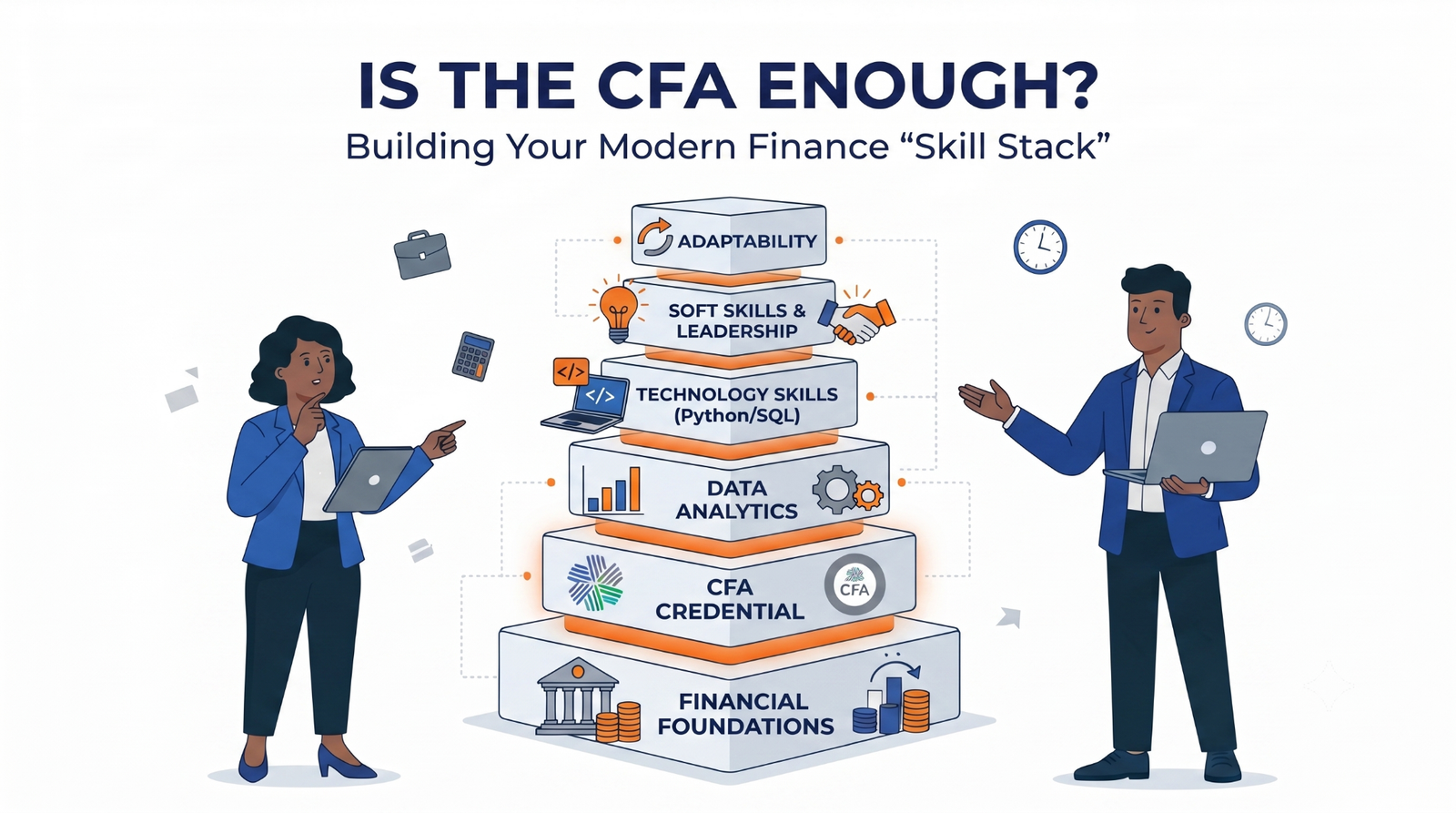
You can pass all three levels of the CFA Program and still find yourself asking:
“Now what?”
That question is becoming quite relevant for young finance professionals.
The CFA can give you a strong foundation in investment analysis, portfolio management, economics, financial reporting and ethics. But a finance career is much bigger than a qualification.
The industry is changing quickly. AI is entering research and investment workflows. Data is becoming central to decision-making. And employers are increasingly looking for people who can combine technical knowledge with communication, judgement and adaptability.
So, if you are pursuing the CFA or have already completed it, the goal shouldn’t be to stop at the qualification. Rather, build around it.
Finance Is Still a Strong Career Choice. But the Skill Requirements Are Changing.
There is no shortage of debate about whether AI will make finance careers less attractive.
The data suggests otherwise.
In CFA Institute’s 2026 Graduate Outlook Survey of 9,000 current and recent graduates across 11 major markets, 32% identified finance as the most promising career path, making it the leading career choice for the fourth consecutive year.
But the same generation also understands that getting hired is becoming more competitive.
In the survey, 46% of respondents said acquired skills were their biggest competitive advantage in the job market, followed by work experience at 44% and internships at 34%. And 95% considered upskilling or postgraduate qualifications important in today’s labour market.
That tells us something important.
The qualification still matters. But what you can do with it matters too. And that’s where your skill stack comes in.
1. CFA: Build the Finance Foundation
If you are pursuing the CFA course, you’re building knowledge across areas such as financial statement analysis, economics, equity investments, fixed income, derivatives, portfolio management, and ethics.
That foundation matters because technology cannot replace understanding.
Imagine an AI tool produces a valuation of a company. It gives you a target price, explains the assumptions and presents a neat conclusion.
Do you trust it? You shouldn’t. Not automatically.
You need enough financial knowledge to understand the assumptions, question the methodology, and identify what might be missing.
That’s where the CFA foundation becomes valuable. The CFA isn’t supposed to teach you everything you will ever need in your career. It gives you a framework for understanding financial decisions.
Think of the CFA as the foundation of your finance skill stack, not the entire building.
2. AI: Learn to Use It, Not Just Worry About It
For today’s finance professionals, AI is no longer a future concept. It’s already becoming part of the workplace.
CFA Institute’s 2026 research on investment firms found growing demand for professionals with AI, machine learning, data science, and coding skills. AI is also expanding beyond basic productivity into areas such as research, portfolio construction and risk analysis.
That doesn’t mean every CFA candidate needs to become a machine-learning engineer.
It means you should become comfortable working with AI. For example, you could use AI to:
- Summarise a lengthy annual report before analysing it yourself
- Generate questions to test your understanding of a concept
- Compare financial metrics across companies
- Explore different investment scenarios
- Automate repetitive research tasks
- Challenge your own investment thesis by asking for counterarguments
But there is an important distinction: Using AI is not the same as outsourcing your thinking to AI.
CFA Institute specifically highlights the need for professionals who can evaluate AI outputs and understand their limitations, including risks such as bias and overconfidence in AI-generated answers.
The most valuable skill, therefore, isn’t simply knowing how to prompt an AI tool. It’s knowing what to ask, what to verify, and when not to trust the answer.
3. Data: Become Comfortable With Numbers Beyond the Textbook
Finance has always been data-heavy. What’s changed is the scale.
Investment professionals today can work with financial statements, market data, economic indicators, alternative datasets, news and other sources of information.
CFA Institute describes data science as increasingly important for investment professionals because the industry is moving towards a model where finance teams themselves need to participate in filtering, managing and analysing data—not simply leave it to specialist technology teams.
For someone starting out, this doesn’t mean you need to master every programming language. Start with practical skills like Excel. Then move towards SQL, Python, and data visualisation, depending on your career path.
The goal isn’t to become a data scientist. It’s to become a finance professional who can look at a dataset and ask: What is this telling me?
And then: What isn’t it telling me?
That second question is where financial judgement begins.
4. Critical Thinking: Don’t Let AI Do Your Thinking for You
This may be the most underrated skill in the new finance stack. AI can make information easier to access.
It can make analysis faster. But faster analysis doesn’t automatically mean better decisions.
The World Economic Forum’s Future of Jobs Report 2025, based on insights from more than 1,000 companies, estimates that 39% of workers’ core skills will change by 2030. AI and big data are among the fastest-growing skills, but analytical thinking, creative thinking, resilience and adaptability remain highly important.
Finance is ultimately a decision-making profession. Consider a company whose revenue is growing rapidly. An AI model may identify the growth. A data analyst may quantify it. A CFA-trained professional can understand the financial implications.
But someone still needs to ask:
- Is the growth sustainable?
- What is driving it?
- Are margins improving?
- Is management allocating capital efficiently?
- Is the valuation already pricing in this growth?
- What happens if the assumptions change?
The ability to challenge an attractive-looking answer is a career skill.
5. Communication: Because Analysis Has to Go Somewhere
Communication is another crucial skill finance students sometimes underestimate. You can build the best financial model in the room. But if you cannot explain what it means to an investment committee, client, manager or colleague, its value is limited.
CFA Institute’s 2026 research of 500 finance-sector managers found that soft skills were identified as the biggest skills gap among new finance professionals, ahead of AI skills and quantitative skills. Soft skills were also identified as the most important factor in employability by 67% of respondents.
The research also found that financial statement analysis was the most important technical skill new entrants should be able to perform confidently on day one, followed by Excel proficiency and interpreting financial datasets.
Notice the combination:
- Finance knowledge.
- Data skills.
- Technology.
- Communication.
Not one or the other. All of them.
The Skill Stack Is More Valuable Than Any Single Skill
Think about two candidates.
Candidate A has passed the CFA but has little practical exposure beyond the curriculum.
Candidate B has the CFA foundation, can analyse financial statements, works comfortably with Excel and Python, uses AI responsibly, and can explain an investment idea clearly.
The difference isn’t necessarily another qualification.
It’s the combination of skills. That’s what a skill stack does.
Each skill strengthens the others.
- CFA gives you financial depth.
- Data gives you analytical ability.
- AI gives you leverage.
- Critical thinking gives you judgement.
- Communication allows you to turn that judgement into influence.
And together, they make you more adaptable as your role changes.
So, What Should You Do Next?
If you’re preparing for the CFA, don’t feel like you need to learn everything simultaneously. Build in layers.
- First, master finance. Don’t rush through the curriculum just to pass an exam. Understand the concepts well enough to apply them.
- Then, build practical skills. Get comfortable with Excel. Work with financial statements. Analyse companies. Build simple models.
- Add technology. Experiment with AI tools. Learn how they work, where they fail and how to verify their outputs.
- Develop data skills. Depending on your career goals, explore Python, SQL or data visualisation.
Finally, practise explaining your thinking. Write an investment thesis. Present a company analysis. Explain a complex financial concept in simple language.
You don’t need to become an expert at all five overnight. The point is to keep adding to the stack. Because your career will last far longer than your CFA preparation. And the skills that make you valuable five years from now may not be exactly the ones that helped you pass the exam today.
The CFA Is the Beginning, Not the Destination
A professional qualification can open a door. What you do after entering that door determines how far you go. For the next generation of finance professionals, the winning combination will increasingly be finance, technology, data, judgement, and human skills.
CFA Institute’s latest research reflects this shift: employers are looking for professionals who can combine AI and coding expertise with financial analysis, strategic judgement, communication, and critical thinking.
So, if you are currently studying for the CFA, don’t ask only: “How do I pass?” Also ask: “What kind of finance professional am I building myself to become?”