A biologist and a computer scientist sit down with coffee and a stack of papers. She wants to know whether his community-detection method applies to protein interaction data. He keeps reading her signaling cascades as a data pipeline. Neither gets past page two. WisPaper, an AI academic agent for discovering and capturing research across fields, is built for exactly this stalled conversation.
Two Fields, Two Vocabularies
The same object shows up under different names. A mathematician says graph; a biologist looking at the same structure says network. A chemist says ligand; an economist hears a contract. Keyword search has no idea these are the same thing, and WisPaper starts from that mismatch rather than asking the researcher to fix it.
The Keywords That Don’t Translate
Traditional databases match strings, not meanings. Type ‘network’ into a biology-oriented index and the mathematics of graph theory never surfaces, even when the theorem you need sits three citations deep in a paper you were never shown. Cross-disciplinary researchers feel this pain most, along with graduate students whose advisors keep saying ‘read outside your area.’
Spotting What Actually Matters
The harder problem comes after the search returns. A paper from another field buries its useful core under notation and assumptions that discipline treats as obvious. To a biologist reading a computer science paper, what matters is usually not the proof but the algorithm’s behavior on noisy data. Separating the transferable idea from the local scaffolding takes reading time most researchers do not have.
Searching Across the Boundary
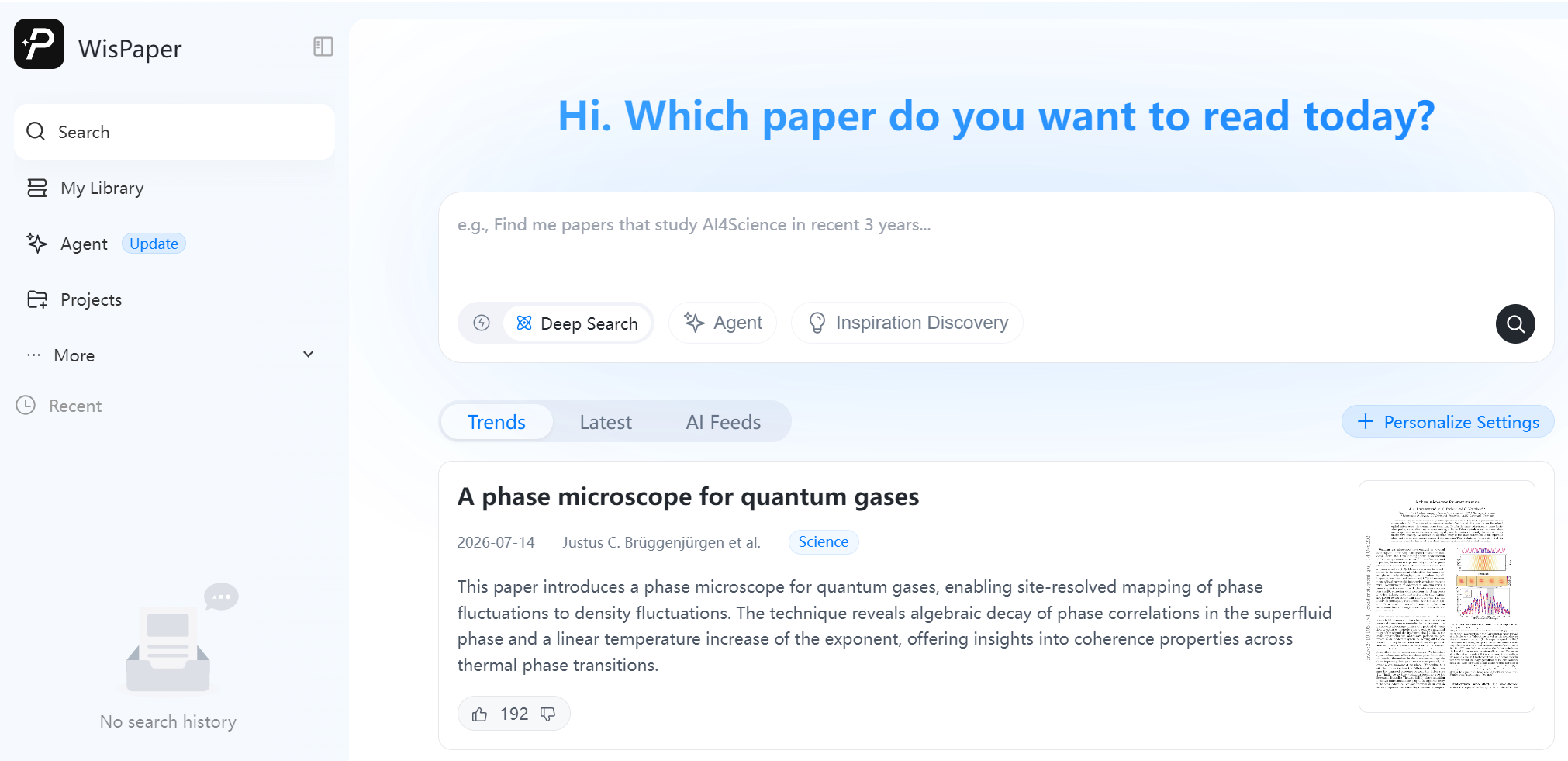
Newer tools try to bridge this by working at the level of concepts rather than exact terms. WisPaper’s Deep Search verifies what a query means before searching, so a request about interaction structure can surface graph-theoretic work even when the word graph never appears. Idea Discovery scans indexed documents for gaps between fields, and AI Feeds carry subscriptions across discipline lines. This is the approach behind AI academic agent, which treats the field boundary as searchable rather than a wall.
Work That Connects Fields
When the vocabulary problem disappears, a biologist can pull a decade of network analysis from computer science without learning to read proofs, and a computer scientist can see which biological constraints actually shape the data. The transfer stops being a translation project and becomes ordinary reading.
The papers that change a field often come from somewhere else, written in a language that field does not speak. Better search makes that gap smaller, one mistranslated term at a time.