Why AI-powered CRM stopped being optional
Let me skip the brochure version of this, because the brochure version is part of why your last CRM project probably underwhelmed.
That’s what really happened: Consumers became demanding. You have to know them the second they walk through the door, and this applies to everything: website, inbox, customer service queue at 11 pm. And while all this data on everyone keeps growing and growing, old-school CRM was quite adept at managing the pile. It wasn’t very good at giving you any direction beyond that.
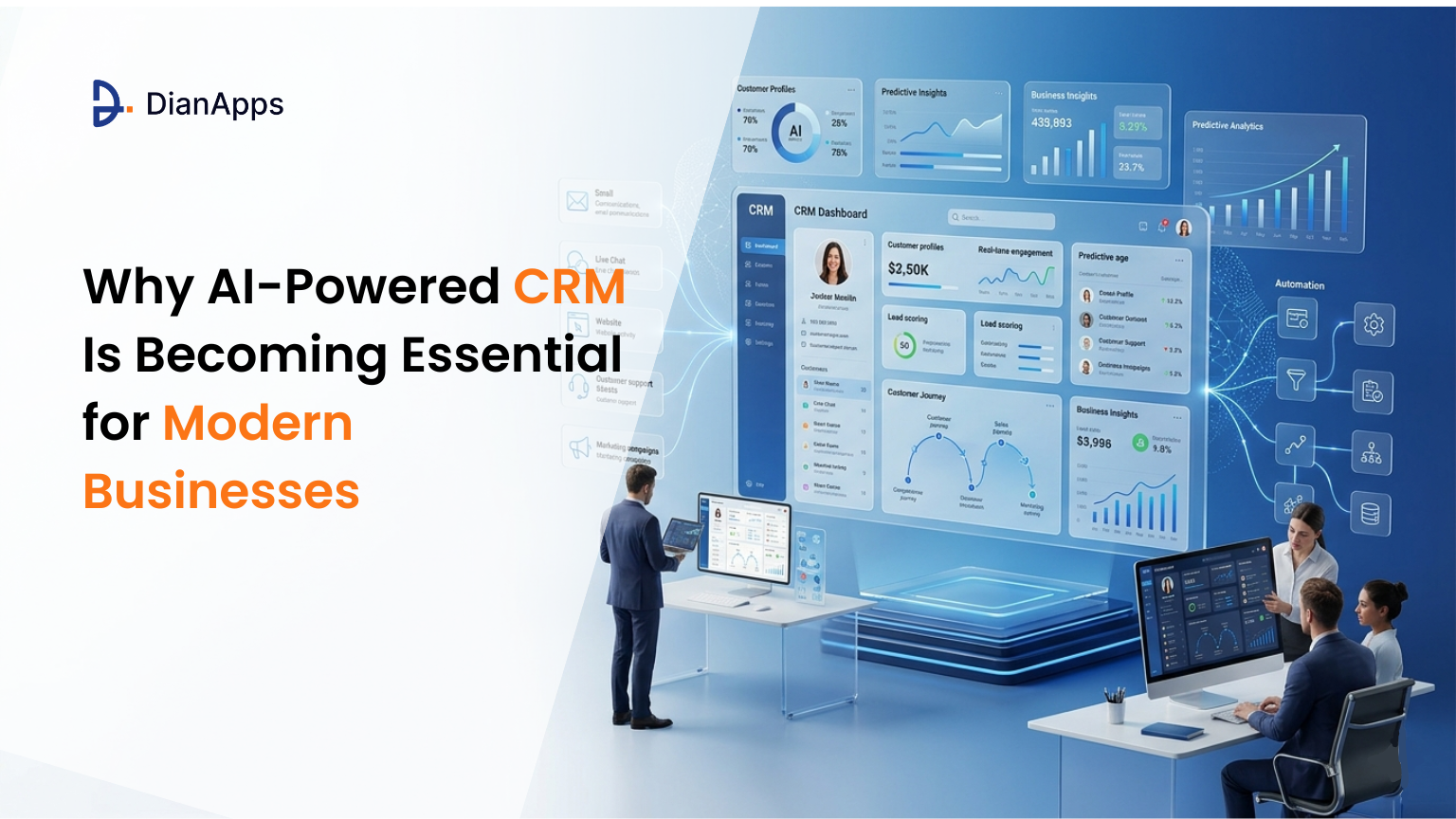
That’s the whole pitch for adding AI, once you scrape the jargon off. Not “digital transformation.” Just this: your CRM should stop being a place data goes to sit, and start telling you who’s about to buy, who’s about to walk, and what to say to either of them.
What AI-powered CRM really is, minus the hype
Take a normal CRM. Add a layer that reads the data you already have, notices patterns, makes a guess about what happens next, and tells you what it would do about it. That’s the product. The rest is packaging.
The difference shows up in small, boring moments. A rep used to scroll a list of 200 leads and pick the ones that “felt” worth a call. Now the system says: call these eleven, they’re showing signals. A manager used to hear about churn when the customer was already gone. Now there’s a flag two weeks earlier, while there’s still something to be done about it. Same data either way. Completely different outcome.
Your problem was never collecting data
You’ve got data coming out of your ears. Every click, every reply, every ticket, every order leaves a trace. Almost nobody I talk to is short on data. They’re drowning in it and calling it “reporting.”
This is the part AI is genuinely good at. It reads through a volume of information that would cost your team weeks, and hands back the handful of things actually worth reacting to. Your people climb out of the spreadsheet and get back to the three or four decisions that move the number.
Personalization, for real this time
Everybody nods along about personalization. Almost nobody pulls it off. And customers clock the difference instantly. A message built for them gets read. A blast gets archived, and after enough blasts, they stop opening anything with your name on it.
What AI-powered CRM does is read how someone actually behaves, what they looked at, what they bought, where they hesitated, and then shape the experience around that for every contact, with nobody manually steering it. The online store that recommends the thing you were obviously circling. The service company that sends you something relevant to your situation instead of its monthly all-staff newsletter. None of it is rocket science on its own. The trick is that it runs for ten thousand people at once, all day, with no one in the loop.
Letting sales chase the right things
Reps bleed hours on admin. Logging calls, updating fields, deciding who’s worth chasing today. AI quietly lifts a chunk of that off the table.
It watches the pipeline and tells you which deals are warming up, when to actually pick up the phone, and which “active” opportunities have gone cold without anyone noticing. So reps stop spreading themselves thin across forty dead leads and pour their energy into the eight that might close. Less guessing, more selling. That’s the whole idea.
Support that doesn’t make people groan
Support is where loyalty quietly lives or dies, usually inside the first ninety seconds. AI helps by dropping the customer’s full history in front of the agent before they’ve said a word, and pointing them at whatever fixed the same problem last time.
Plenty of teams now hand the routine stuff to AI assistants. Where’s my order, reset my password, the same dozen questions asked five hundred times a day, answered at any hour with no queue. And when a human does need to jump in, they’re not starting from zero. They already know the backstory, so the customer isn’t explaining it for the third time. That one thing, honestly, fixes half of what people can’t stand about contacting support.
The busywork starts handling itself
This is the payoff you feel first. So much CRM work is repetitive: follow-ups, field updates, routing leads, nudging reminders. Important, sure. Also numbing, and a quiet tax on everyone’s week.
Set it up right and most of it runs without you. The right email goes out the second someone does the thing that should trigger it. New leads land on the correct desk. A flag pops the moment a real opportunity shows up. The work still gets done. It just stops eating your team alive, which leaves them free for the part software can’t fake, which is talking to people like people.
Decisions that aren’t just vibes
Leaders need a real read on what’s happening, and the standard monthly report gives you a keyhole view at best. AI-powered CRM widens it, working through big datasets and surfacing the trends the report would’ve buried somewhere on page four.
You start to actually see what customers want, where buying habits are drifting, where something’s slipping before it slips badly. Whether the goal is holding onto customers, pushing sales up, or bleeding less marketing budget, calls made on that kind of evidence tend to age a lot better than calls made on gut feel.
Where Salesforce comes in
Salesforce’s presence was well-deserved as it took the initiative and started using AI to make relationship management more productive long before anyone else in the industry did. The platform enables teams to manage their activities, automate processes, analyze data, and ensure that all departments have a consistent story to tell.
Since the AI is integrated into the platform from the start, one does not need to assemble five individual solutions and connect them with duct tape. In addition, while growing one’s business, one can always rely on the platform’s ability to grow with it and not transform into another product to migrate away from.
Why do people bring in Salesforce consulting services
Buying the license is the easy bit. Wringing real value out of it is the actual work, which is why so many companies bring in Salesforce consulting services instead of white-knuckling it alone.
The good ones don’t turn up with a generic checklist. They start with how your business actually runs, build a CRM strategy around that, and (this is the part everyone skips) set it up so your team will genuinely use it instead of quietly drifting back to their spreadsheets. A platform is worth exactly as much as its adoption, no more. That’s usually where the outside help pays for itself, with room to spare.
What Salesforce development services are actually for
No two businesses run the same way, so the box version almost never fits clean. That’s the whole case for Salesforce development services: building the bits the standard product doesn’t.
Custom dashboards. Workflows shaped like the way you actually work. Integrations with the other systems you can’t function without. Industry features the generic build that never saw coming. A clinic might need patient-communication flows wired to its compliance rules; a retailer might need loyalty mechanics bolted onto its exact program. Salesforce development services also stitch your scattered systems into one honest view of the customer, which, incidentally, is what makes the AI worth trusting in the first place. Feed it clean, joined-up data, and it gets sharp. Feed it fragments, and all you get is confident guessing.
A few things you have to get right, or don’t bother
AI-powered CRM is not plug-and-play, and anyone who says otherwise hasn’t actually shipped one. A handful of things matter more than everything else put together.
Data quality, first and loudest, because the AI is only ever as good as what you feed it. Garbage records, garbage predictions. Then adoption, because the cleverest system alive is dead weight if your team won’t open it, which makes the training and the buy-in the job, not a footnote. You’ve also got to handle customer data as it matters and stay inside the privacy rules. And the thing is never finished. AI does its best work when somebody’s actually watching it and tuning it over time, not flipping it on and wandering off.
Where is all this going
The next round of CRM leans even harder on AI. More automation, sharper predictions, and personalization worked into more or less every step of the journey. As your market gets louder, the companies pairing clean data with capable AI and the deeply unglamorous habit of actually building relationships are going to pull away from the ones still running their CRM like a contact list with extra steps.
The honest takeaway
AI-powered CRM isn’t a someday thing anymore. It’s working right now for companies that want to know their customers better, run leaner, and stop guessing.
It personalizes at scale, swallows the repetitive work, takes some of the pain out of support, and pulls something useful out of data that would otherwise just sit there gathering dust. Pair it with the right Salesforce consulting services, shape it with Salesforce development services, and the potential stops being a slide in someone’s pitch deck and turns into something you can use on Monday morning. Customer expectations aren’t about to relax. So at this point, getting AI into your CRM is less a clever edge and more the plain cost of keeping up.