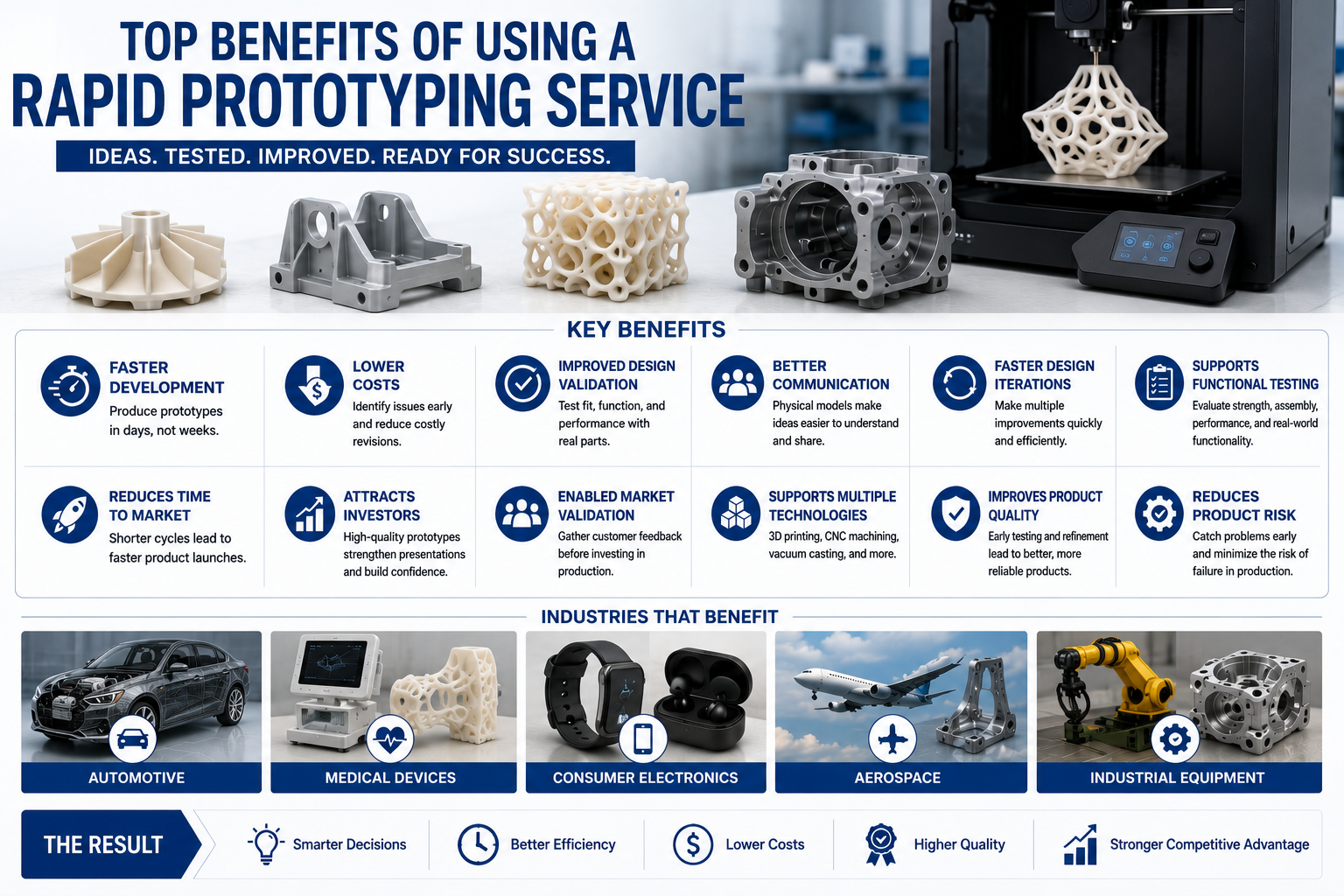
In today’s competitive manufacturing landscape, speed and innovation are critical to success. Companies are under constant pressure to develop new products faster while maintaining high standards of quality and controlling development costs. Traditional product development methods often involve lengthy design cycles and expensive revisions, making it difficult to respond quickly to changing market demands.
Rapid prototyping has transformed the way products are designed, tested, and refined. By creating physical models directly from digital designs, businesses can evaluate concepts, identify design flaws, and make improvements before moving into full-scale production. This approach minimizes risk, accelerates development, and helps companies bring better products to market in less time.
Whether you’re a startup developing a new idea or an established manufacturer improving an existing product, rapid prototyping provides a practical and cost-effective solution for turning concepts into reality.
What Is Rapid Prototyping?
Rapid prototyping is a manufacturing process used to quickly create physical models of a product using digital CAD designs. Instead of relying on traditional machining or expensive production tooling, manufacturers use advanced technologies such as 3D printing, CNC machining, vacuum casting, and other additive or subtractive manufacturing methods to produce prototypes.
These prototypes allow engineers and designers to evaluate the appearance, dimensions, functionality, and performance of a product before investing in mass production.
Rapid prototyping is widely used across industries because it shortens development cycles while improving design accuracy.
Why Rapid Prototyping Is Important in Product Development
Developing a successful product requires multiple stages of testing and refinement.
A digital design may appear perfect on a computer screen, but real-world testing often reveals issues related to fit, assembly, ergonomics, or functionality.
Rapid prototyping bridges the gap between digital concepts and physical products by allowing businesses to validate designs early in the development process.
This reduces uncertainty and enables better engineering decisions before production begins.
Top Benefits of Using a Rapid Prototyping Service
Faster Product Development
One of the biggest advantages of rapid prototyping is speed.
Instead of waiting weeks or months for traditional tooling, companies can produce functional prototypes within days.
Working with a professional rapid prototyping service enables businesses to accelerate product development, shorten design cycles, and respond quickly to customer feedback or market changes.
Faster development often results in a quicker product launch and a stronger competitive advantage.
Lower Development Costs
Design changes become increasingly expensive once production tooling has been manufactured.
Rapid prototyping allows engineers to identify problems early, when modifications are much more affordable.
This helps reduce:
- Design revision costs
- Material waste
- Tooling expenses
- Manufacturing errors
By solving problems during the prototype stage, companies avoid costly changes later in the production process.
Improved Design Validation
Digital models cannot always predict how a product will perform in real-world conditions.
Physical prototypes enable engineers to evaluate:
- Product dimensions
- Assembly compatibility
- Ergonomics
- Structural performance
- User interaction
Testing actual prototypes leads to more accurate design decisions.
Better Communication
A physical prototype is easier to understand than a computer-generated rendering.
Rapid prototypes improve communication between:
- Engineers
- Designers
- Manufacturing teams
- Investors
- Customers
- Marketing departments
Everyone can review the same physical product and provide meaningful feedback.
Faster Design Iterations
Very few products are perfect after the first design.
Rapid prototyping allows engineers to make multiple improvements throughout development.
Each iteration helps refine:
- Shape
- Size
- Functionality
- Appearance
- Performance
This continuous improvement process results in higher-quality products.
Supports Functional Testing
Many prototypes are more than visual models.
Depending on the manufacturing method and materials used, prototypes can undergo functional testing for:
- Mechanical strength
- Assembly verification
- Load testing
- User experience
- Performance evaluation
Functional testing reduces technical risks before production begins.
Reduces Time to Market
In highly competitive industries, launching products quickly can create a significant business advantage.
Rapid prototyping shortens development timelines by allowing parallel testing, faster approvals, and quicker design improvements.
The result is a faster transition from concept to commercial production.
Helps Attract Investors
Startups often need funding before moving into production.
A professionally manufactured prototype demonstrates that a product has moved beyond the concept stage.
Investors are more likely to understand and evaluate a physical prototype than a digital design alone.
High-quality prototypes improve product presentations and increase credibility.
Enables Market Validation
Businesses frequently test customer interest before investing in large-scale manufacturing.
Rapid prototypes can be used for:
- Product demonstrations
- Customer feedback
- Focus groups
- Trade exhibitions
- Sales presentations
This valuable feedback helps companies improve products before launch.
Supports Multiple Manufacturing Technologies
Rapid prototyping is not limited to one production method.
Manufacturers can choose technologies such as:
- 3D printing
- CNC machining
- Vacuum casting
- Sheet metal fabrication
- Urethane casting
Selecting the most appropriate process depends on the product’s design, material, and intended application.
Industries That Benefit from Rapid Prototyping
Automotive Industry
Automotive manufacturers use rapid prototypes to evaluate vehicle components before production.
Medical Devices
Medical companies develop prototype equipment, surgical tools, and wearable healthcare products for testing and regulatory evaluation.
Consumer Electronics
Electronic manufacturers validate product housings, smart devices, accessories, and wearable technology before commercialization.
Aerospace
Aerospace engineers use rapid prototyping to test lightweight components and optimize complex designs.
Industrial Equipment
Manufacturers evaluate machine parts, protective housings, and mechanical assemblies before full-scale production.
How Rapid Prototyping Improves Product Quality
Early Problem Detection
Design flaws can be identified before manufacturing begins.
Better User Experience
Physical testing helps improve ergonomics and product usability.
Improved Manufacturing Readiness
Optimized designs reduce production challenges later.
More Accurate Engineering Decisions
Real-world testing provides better information than digital simulations alone.
Reduced Product Risk
Thorough prototype evaluation minimizes the likelihood of manufacturing defects and product failures.
Conclusion
Rapid prototyping has become an essential part of modern product development because it enables businesses to innovate faster, reduce costs, and improve product quality. By transforming digital concepts into physical prototypes, companies can identify design issues early, validate performance, gather customer feedback, and prepare products for successful manufacturing.
Whether developing a new consumer product, industrial machine, automotive component, or medical device, rapid prototyping provides the flexibility and speed needed to stay competitive in today’s fast-moving market. Investing in professional prototyping services is not just about creating models—it’s about making smarter decisions throughout the entire product development process.
FAQs
What is rapid prototyping used for?
Rapid prototyping is used to create physical models of products for design validation, functional testing, customer feedback, and product development before mass production.
Which industries benefit the most from rapid prototyping?
Automotive, medical devices, aerospace, consumer electronics, industrial equipment, and robotics industries frequently use rapid prototyping during product development.
Does rapid prototyping reduce product development costs?
Yes. By identifying design issues early, rapid prototyping reduces expensive revisions, tooling modifications, and manufacturing errors.
Can rapid prototypes be used for functional testing?
Yes. Depending on the materials and manufacturing technology used, prototypes can be tested for strength, fit, assembly, and performance.
Why is rapid prototyping important before mass production?
It helps validate designs, improve product quality, reduce risks, accelerate development, and ensure products are ready for efficient large-scale manufacturing.