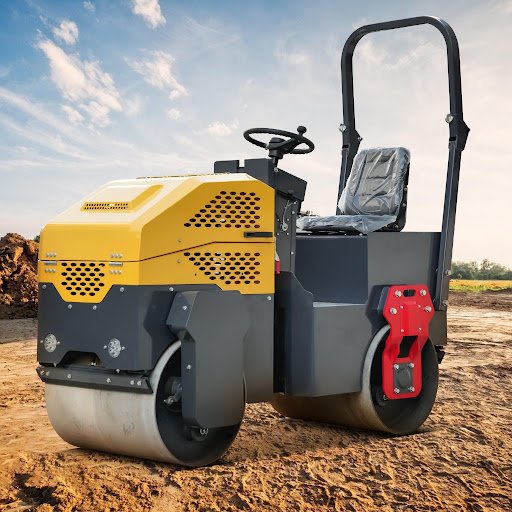
Every pavement, embankment, and prepared subgrade owes its long service life to one quiet stage of construction: compaction. The moment aggregate or asphalt hits the surface, its future performance is decided by how thoroughly it is squeezed, kneaded, or vibrated into density. That work belongs to a family of machines that has evolved far beyond the cast-iron drum of a century ago. Today’s road rollers combine hydraulic drive, precisely tuned vibration, intelligent compaction feedback, and operator ergonomics that would have been unrecognizable a generation ago.
This article maps the modern compaction landscape for engineers, contractors, and yard managers who need to understand what the equipment can do and why. It covers the main roller families, the mechanics of how each achieves density, how to match a machine to a material, and where the technology is heading. The tone is practical rather than academic, aimed at people who will actually specify, buy, or run these machines.
Why Density Decides Pavement Life
Aggregate and asphalt fail in predictable ways when they are under-compacted. Voids let water in. Water freezes, expands, and pries the matrix apart. Traffic loading exploits the weakness, and cracks propagate. Achieving specified density on the day of placement is the single most reliable predictor of how long the road, path, or foundation will last. A well-compacted base under a poorly finished surface still outperforms a beautifully paved surface over a spongy base.
Compaction is measured against target density values derived from lab tests on the specific material. Field density gauges, nuclear or non-nuclear, verify the result. What the road roller family provides is the range of tools needed to hit those targets across dozens of material types, layer thicknesses, and site conditions. Picking the wrong machine will not save the specification, no matter how skilled the operator.
The Main Families of Roller and What Each Does
Rollers divide broadly by drum type and drive style. Understanding the categories makes the rest of the equipment decisions straightforward.
Static Smooth Drum Rollers
The oldest lineage. A heavy smooth drum simply presses material by weight. Used mainly for finish passes on asphalt where any vibration would leave marks, and for compacting cohesive soils where kneading action outperforms vibration. Modern static rollers are typically the trailing machine in a paving train rather than the lead compactor.
Vibratory Smooth Drum Rollers
The workhorses of asphalt paving and granular soil compaction. An eccentric weight inside the drum spins at a defined frequency and amplitude, driving compaction energy down into the layer beneath. The right frequency-amplitude combination for a given lift depth is critical. Too much amplitude on a thin lift bounces the machine and pulverizes aggregate. Too little on a deep lift under-compacts and leaves the specified density out of reach.
Pneumatic Tire Rollers
A row of overlapping rubber tires kneads the surface, particularly effective on the intermediate passes of asphalt when the mix is still workable. The kneading action tightens the surface texture and seals it against water ingress. Pneumatic rollers also handle mixed-aggregate soils well because the tires conform to irregular ground.
Padfoot and Sheepsfoot Rollers
Drum surfaces studded with pads or feet that concentrate pressure into small points. Ideal for cohesive soils like clay, where you need to break the soil structure and force air out from below. The feet walk out of the surface as compaction rises, providing a rough visual cue of when a lift is done.
Matching the Machine to the Material
The most common specification mistake is treating all rollers as interchangeable. They are not. A modern road roller earns its cost only when the drum type, weight class, and vibration settings match the material and lift thickness in front of it. A short pairing guide clarifies the field:
- Asphalt breakdown pass: vibratory smooth drum at higher amplitude
- Asphalt intermediate pass: pneumatic tire roller for kneading
- Asphalt finish pass: static or low-amplitude vibratory smooth drum
- Granular soils and aggregate base: heavy vibratory smooth drum
- Cohesive clay soils: padfoot vibratory or static
Layer thickness matters as much as material type. Manufacturers publish compaction curves that show which amplitude and frequency work for each lift depth. Following those curves keeps the machine efficient and the pavement within specification. Ignoring them wastes fuel and can actually reduce density through over-compaction and aggregate breakdown.
The Rise of Intelligent Compaction
The most consequential change to roller technology in recent years is intelligent compaction, sometimes shortened to IC. Modern machines equip the drum with accelerometers and the cab with GPS and mapping software. The system measures the material’s response to each pass and displays a real-time density map showing exactly where more work is needed and where the layer is already at target.
The productivity gain is substantial. Rather than making a uniform number of passes across the whole surface, the operator can concentrate effort on soft spots and avoid over-rolling areas that hit density on pass three. Quality records improve because every square meter of the pavement has documented compaction data, useful for as-built records and any later warranty discussion. MMS INDUSTRIAL produces rollers across weight classes with configurations that support these intelligent compaction workflows on modern job sites.
Operator Skill Still Decides the Outcome
Technology helps, but the operator remains the decisive factor. Speed control, overlap patterns, and edge management all rely on judgment that no display fully replaces. Roller passes should overlap by roughly a third of the drum width. Speed should stay within the range specified by the manufacturer for the chosen amplitude, because faster passes reduce impacts per meter and leave density gaps. Edge compaction requires particular care to avoid pushing material off the shoulder or leaving weak lines that crack first when traffic arrives.
Formal training pays off. Experienced roller operators consistently deliver higher density in fewer passes than newcomers, saving fuel, reducing wear on the machine, and extending pavement life. On teams that rotate operators across machines, standardized training and clear pattern documentation prevent quality drift between shifts.
Where the Technology Is Heading
Two trends are reshaping the roller yard. First, hybrid and battery-electric drives are appearing in urban and tunnel applications where emissions and noise limits are strict. Battery rollers now cover a full shift of light-to-medium compaction on a single charge, and the near-silent operation extends the working day in noise-sensitive neighborhoods. Second, autonomy is arriving. Semi-autonomous rollers hold speed, pattern, and overlap under supervisor oversight, freeing the operator to focus on planning and quality checks. Fully autonomous compaction is already being trialed on long, uniform highway sections. Neither trend eliminates the need for skilled crews, but both change what a competent crew looks like.
Compaction as the Silent Foundation of Every Road
Every long-lasting pavement is built on decisions made during the compaction stage. Choose the wrong roller family and the target density will slip out of reach no matter how many passes the crew makes. Choose the right machine, run it at the correct amplitude and speed for the layer, and the road practically builds itself into specification.
Understand the material, match the drum type and weight class to the lift, respect the manufacturer’s compaction curves, and invest in operator skill. Add intelligent compaction feedback where the job scale justifies it, and factor emerging electric and semi-autonomous platforms into the fleet plan for the coming decade. Compaction is quiet work that decides loud outcomes, and the modern road roller is the tool that makes those outcomes predictable.