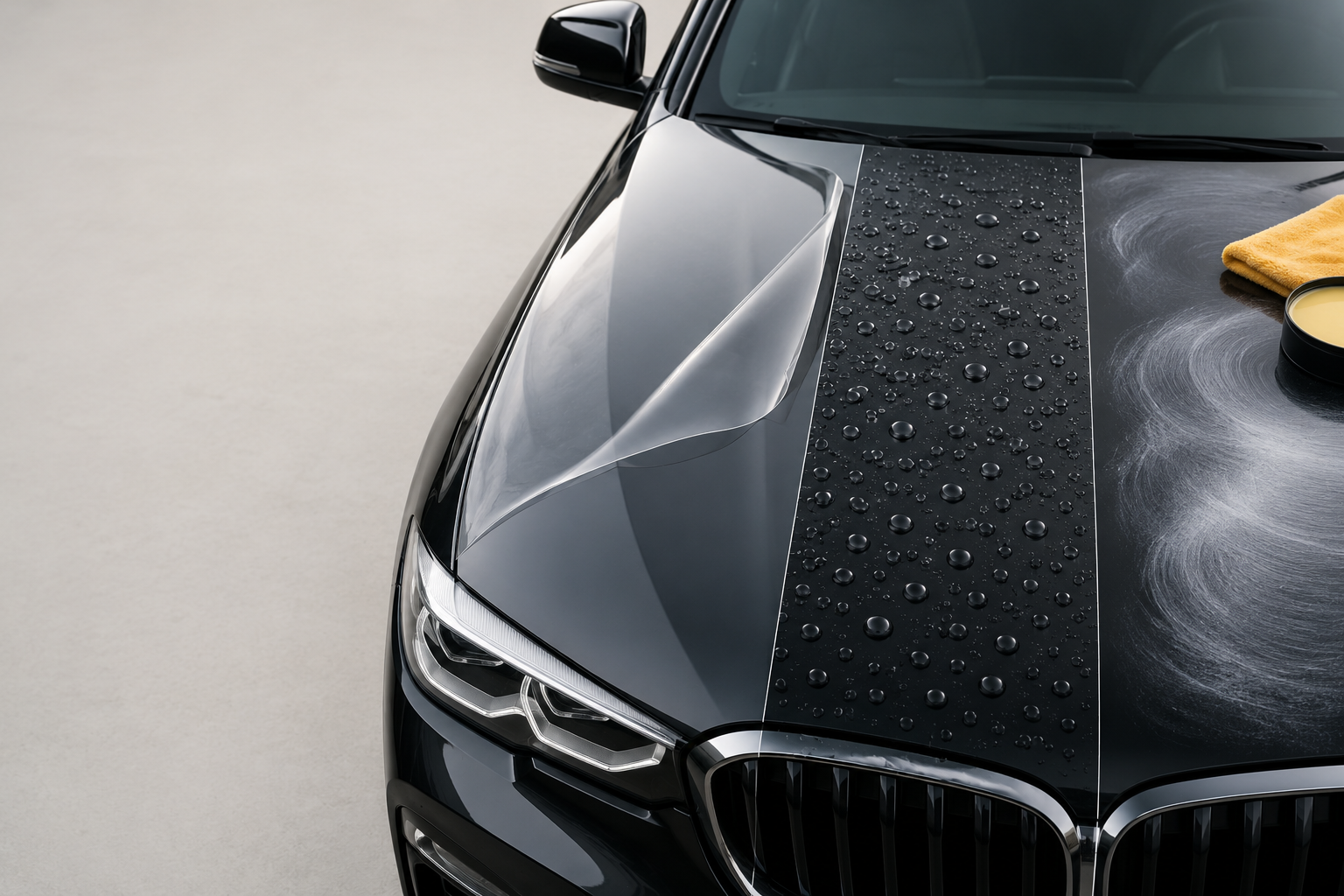
A single stone flicked up by a truck on the highway can chip a car bonnet in an instant. Gloss, water beading and a fresh coat of wax will not change that. Wax, ceramic coating and paint protection film are often compared as different levels of the same protection.
They are not. Each solves a different problem, so the useful question is not which one is best overall but which one is best at the job you need done. This comparison puts them side by side on the criteria that matter most: impact protection, scratch resistance, appearance, cleaning, lifespan and cost.
Quick Comparision
| Criteria | Paint protection film (PPF) | Ceramic coating | Wax |
| Main job | Physical barrier over the paint | Hard, slick surface layer | Basic shine and short-term protection |
| Stone chips | Strong protection | Little to none | None |
| Light scratches and swirls | Good, and self-healing films can recover | Some resistance to light marring | Minimal |
| Gloss | Good, depends on the film | High | Good but short-lived |
| Ease of cleaning | Easier with a hydrophobic topcoat | Easiest | Modest improvement |
| Typical lifespan | Often 5 to 10 years | Commonly 2 to 5 years | Weeks to a few months |
| Upfront cost | Highest, scales with coverage | Mid-range | Lowest |
| Upkeep | Regular washing and aftercare | Regular washing | Frequent reapplication |
The table gives the headline. The sections below explain why the differences exist and where the exceptions are.
Which Protects Best Against Stone Chips?
Paint is a thin, layered system of primer, colour and clear coat. Once a chip breaks through the clear coat, the edges can lift and bare metal can eventually corrode. The front of the car is most exposed. Stones thrown up by the vehicle ahead hit the bonnet, bumper, mirrors and leading edges of the guards with real force at highway speed, and freshly resurfaced roads with loose gravel make it worse.
This is where car PPF separates itself. Film is usually thermoplastic polyurethane (TPU), commonly around 0.2 mm thick, and flexible enough to absorb the energy of a small impact that would otherwise chip the paint. Ceramic coating is only a few microns thick and sits on the paint rather than cushioning it, so it cannot stop a chip. Wax cannot either.
Best option: PPF. It reduces the odds of damage rather than eliminating them, since a hard enough strike can still mark the film or the paint beneath.
Which Handles Scratches And Swirl Marks Better?
Here the picture is more balanced. Many quality films have a self-healing topcoat, so light scratches and swirl marks soften and flatten when warmed by the sun or hot water. The limits matter. A scratch that cuts through the topcoat will not heal, and the self-healing effect tends to fade as the film ages.
Ceramic coating takes a different approach. Its hardness improves resistance to the fine marring caused by washing and wiping, but it does not recover once marked and it will not stop a deeper scratch. Wax offers minimal resistance.
Best option: PPF for recoverable damage, with ceramic coating a respectable second for everyday wash marks.
Which Gives The Best Gloss And Finish?
Ceramic coating wins on finish. Applied as a liquid, it cures into a smooth, glossy surface that deepens the colour. Wax gives a warm depth that many owners like, but it fades quickly. Film appearance depends on the product and the installation. A good film is nearly invisible, while a poor one can show edges, seams or an orange-peel texture.
Matte paint is a special case. It generally needs a film made for that finish, because a gloss film would change the look of the car.
Best option: ceramic coating.
Which Is Easiest To Keep Clean?
A ceramic coating’s slick surface makes dirt release more easily, and water beads and runs off. Many films now have a hydrophobic topcoat that does something similar, though the effect varies by product. Wax improves slickness only briefly.
Neither film nor coating makes a car maintenance-free. Both still need regular washing with a pH-neutral shampoo and a clean mitt, prompt removal of bird droppings and sap, and a wide berth for abrasive brush washes. After a film installation, follow the installer’s aftercare instructions for the first few days while the film settles.
Best option: ceramic coating, narrowly.
How Long Does Each One Last?
Wax is the shortest-lived by a wide margin, as washing, heat and rain strip it away. A professionally applied ceramic coating commonly lasts two to five years with proper care, although budget products can fade within months. Quality PPF often lasts five to ten years, depending on the film, the installation and how the car is looked after.
Installation matters more than most buyers expect. A film that is poorly trimmed or applied over contaminated paint can lift at the edges, trap dirt or show visible seams. Low-grade film can yellow, crack or lose clarity, and replacing it is costly.
Best option: PPF.
How Do They Compare On Cost?
Wax is the cheapest to buy and the most expensive to keep reapplying over the long run. Ceramic coating sits in the middle. PPF has the highest upfront cost, but that cost scales with coverage. Film on the front bumper, bonnet, mirrors and leading edges of the guards costs far less than a full-body installation.
Value depends on the car and how long you will keep it. Touch-up paint hides a chip rather than restoring the finish, and a proper respray costs far more than protecting the panel in the first place. For a new or high-value car kept for years, film on the front end is often the better long-term spend. The cheapest installation quote is rarely the best value, because it often reflects cheap film, rushed preparation or both.
Best option: wax on upfront cost, PPF on long-term protection value.
Can You Combine Ppf And Ceramic Coating?
Yes. Because the two do different jobs, combining them makes sense. Film goes on the high-impact areas and ceramic coating covers the remaining painted panels. Where the film maker and installer confirm compatibility, a coating can also go over the film, once the film has fully cured, for easier cleaning and extra gloss.
The compromise is that coated panels outside the film still have no chip protection. For owners who want to compare the two approaches in more depth, Aegis Films has also published a guide to PPF vs ceramic coating covering protection, maintenance, cost and everyday use.
What To Look For If You Choose PPF
Because film quality varies widely, a few checks separate a good product from a poor one:
- Material: TPU rather than older PVC-based films.
- Topcoat: A self-healing topcoat, ideally with hydrophobic properties.
- Warranty: Who backs it (the manufacturer or only the installer), how long it runs and whether it covers yellowing, cracking, peeling and staining.
- Installer: Experience with your model, clean preparation and tidy edges.
Brands that publish specifics make comparison easier. Aegis Films is one example. Its range is TPU-based, its XG Series uses a polycarbonate and TPU blend, and its warranty terms are set out by product variant rather than as one blanket promise.
Which One Should You Choose?
Choose PPF if you regularly drive on highways or country roads, own a new or high-value car or plan to keep it for years. Film on at least the front end is the most direct way to deal with stone chips.
Choose ceramic coating if your priority is gloss and easier washing on a car that mostly sees suburban streets, and stone chips are a lesser concern.
Choose wax if you enjoy a weekend detail, or the car is older or on a short lease and a larger investment is hard to justify.
Combine them if you want chip protection where it counts and a glossy, easy-to-clean finish across the rest of the car. A film-protected front end with a coated body is a sensible setup for many owners.
Conclusion
There is no universal best product, only the best match for the risk. But on the criterion that matters most for preserving paint, physical protection, film is the only one of the three that does the job. Ceramic coating and wax improve appearance and upkeep, and they are worth choosing for those reasons. Whichever option you pick, vet the installer as carefully as the product.