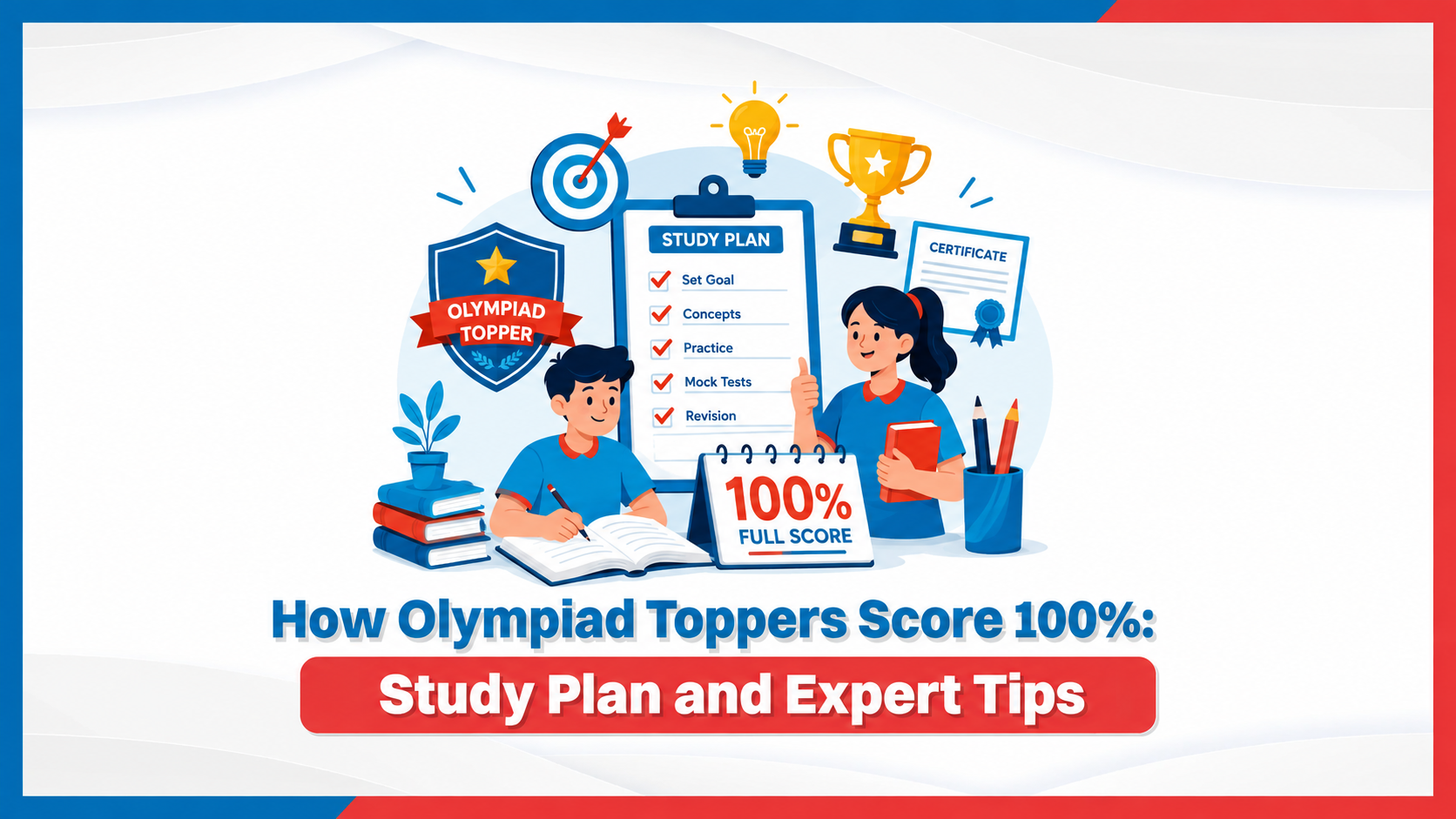
Getting a score of 100% in the Olympiad is not just a matter of luck or something unattainable for any average student. On the contrary, it can be done and can be achieved with structured Olympiad exam preparation, consistent practice, and a smart exam strategy. Every parent dreams of having their child get 100% in Olympiads such as IMO, NSO, IEO, NCO, etc., but only a few actually do so. It takes more than just talent; the way students prepare makes all the difference. Here is a quick read that will tell you what exactly Olympiad toppers do to score full marks so your child can follow the same roadmap.
What makes Olympiad Toppers different from the others?
Olympiad toppers don’t just study blindly for countless hours — they study smarter. They understand three things clearly:
The syllabus inside out – They know exactly what’s in scope and what isn’t.
The exam pattern – They’re familiar with question types, marking schemes, and time limits.
Their own weak areas – They spend more time strengthening gaps instead of repeating what they already know.
To get clarity on the syllabus, exam pattern, strengths and weaknesses, toppers do rely on the good resources available in the market, such as Oswaal One For All Olympiad books. These books provide structured chapter-wise and topic-wise practice, along with exam-level questions that help students improve their preparation and build confidence.
Best Ever Study Plan Toppers Follow
Every parent wants their child to stand out, but achieving a top rank in the Olympiad requires more than just regular school studies. Following the Olympiad topper strategy can help your child understand concepts deeply, practice consistently, and improve step by step. Here’s an Olympiad preparation roadmap to follow:
Start Early, Not Last-Minute
Toppers begin Olympiad preparation at least 2–3 months in advance, rather than squeezing it into the final week. Early preparation allows time for revision, mock tests, and correcting mistakes, something last-minute studying simply doesn’t allow.
Follow a Structured Syllabus Breakdown
Instead of studying chapter-by-chapter randomly, toppers break the syllabus into weekly targets. A typical breakdown looks like this:
- Week 1–2: Cover core concepts and NCERT/school syllabus overlap
- Week 3–4: Move to Olympiad-specific higher-order thinking (HOTS) questions from good books like Oswaal One For All Olympiad
- Week 5–6: Practice previous years’ papers and sample papers
- Final week: Full-length mock tests and revision only
This phased approach ensures no topic is left untouched and enough time remains for practice.
Use the Best Study Materials
The selection of study books by students is one of the key factors responsible for their achievement. Most high scorers rely on Olympiad-focused books, such as those published by Oswaal Books. These books are a great source of chapter-wise explanation, previous year Olympiad questions with solutions, graded practice tests, mock tests, etc.
Solve Previous Years’ Papers Regularly
Almost all high achievers say that they owe their achievement to solving past papers. This gives them insight into the pattern of questions asked, complexity, important topics, etc.
Time-based Mock Practise
One of the key recommendations of Olympiad winners is to conduct mock tests in real exam conditions (same timings, with no distractions, without stopping).
Error Analysis Over Repetition
Instead of solving 50 new questions blindly, toppers revisit their mistakes from mock tests and previous practice sessions. They maintain an error log, which could be a simple notebook, where they note down the questions they got wrong, silly mistakes, misread questions, and the correct approach. This targeted correction is often the single biggest reason toppers close the gap between 90% and 100%.
Expert Tips to Score 100% in Olympiads
Understanding the concepts from NCERT/School level topics is a must because weak foundation knowledge in school-level subjects makes Olympiad questions more difficult than they already are.
The success of your child depends on the Achievers/HOTS Section, where he/she needs to spend extra time working on HOTS and higher-order thinking questions.
The Reasoning and Logical part is never to be missed since it is the most scoring section in most Olympiads (such as IMO and NSO).
Regular revision of formulas, rules, and methods ensures that there will be no panicking in the exam.
In the last couple of weeks before the exam, practicing 3-4 full mock tests will help your child simulate exam conditions and develop endurance.
Read every question twice, as a large chunk of marks lost by near-perfect scorers comes from misreading questions, not lack of knowledge.
Small daily efforts create big results. A consistent 1-hour study routine over several weeks helps your child develop stronger concepts and better recall compared to last-minute preparation that only increases stress.
Give Your Child the Right Roadmap to Olympiad Success
It’s a common misconception that achieving 100% in an Olympiad is only for the chosen few. In reality, the outcome is achievable by anyone who follows a systematic and organized approach toward studying. The successful Olympiad candidates all have something in common: starting early, using reliable study material tailored to the latest Olympiad pattern, such as the Oswaal One For All Olympiad book, practicing consistently through mock tests, and doing honest analysis of mistakes. With the right plan and steady effort over a few weeks, a perfect score is well within reach for any dedicated student.
FAQs
Q1. How many months are needed to prepare for an Olympiad exam?
Most toppers recommend starting at least 2–3 months before the exam date, allowing enough time for concept-building, practice, and multiple revision cycles.
Q2. Which books are best for Olympiad preparation?
Books that offer chapter-wise concepts, previous years’ papers, and level-wise practice — such as those published by Oswaal Books — are widely used by top scorers since they’re aligned with the specific Olympiad syllabus and pattern.
Q3. What is the hardest section in Olympiad exams?
The Achievers Section or HOTS (Higher Order Thinking Skills) section is generally considered the toughest, as it tests application-based and reasoning skills rather than direct recall.
Q4. How important are previous years’ papers for scoring 100%?
Extremely important. Previous years’ papers help students understand question patterns, identify frequently tested concepts, and build speed and accuracy under exam-like time constraints.
Q5. Can a student score 100% without coaching classes?
Yes. Many toppers prepare through self-study using structured Olympiad books, mock tests, and consistent daily practice, without relying on formal coaching.
Q6. How can silly mistakes be reduced in Olympiad exams?
Maintaining an error log, reading questions twice before answering, and practicing under timed mock-test conditions significantly reduce careless mistakes.