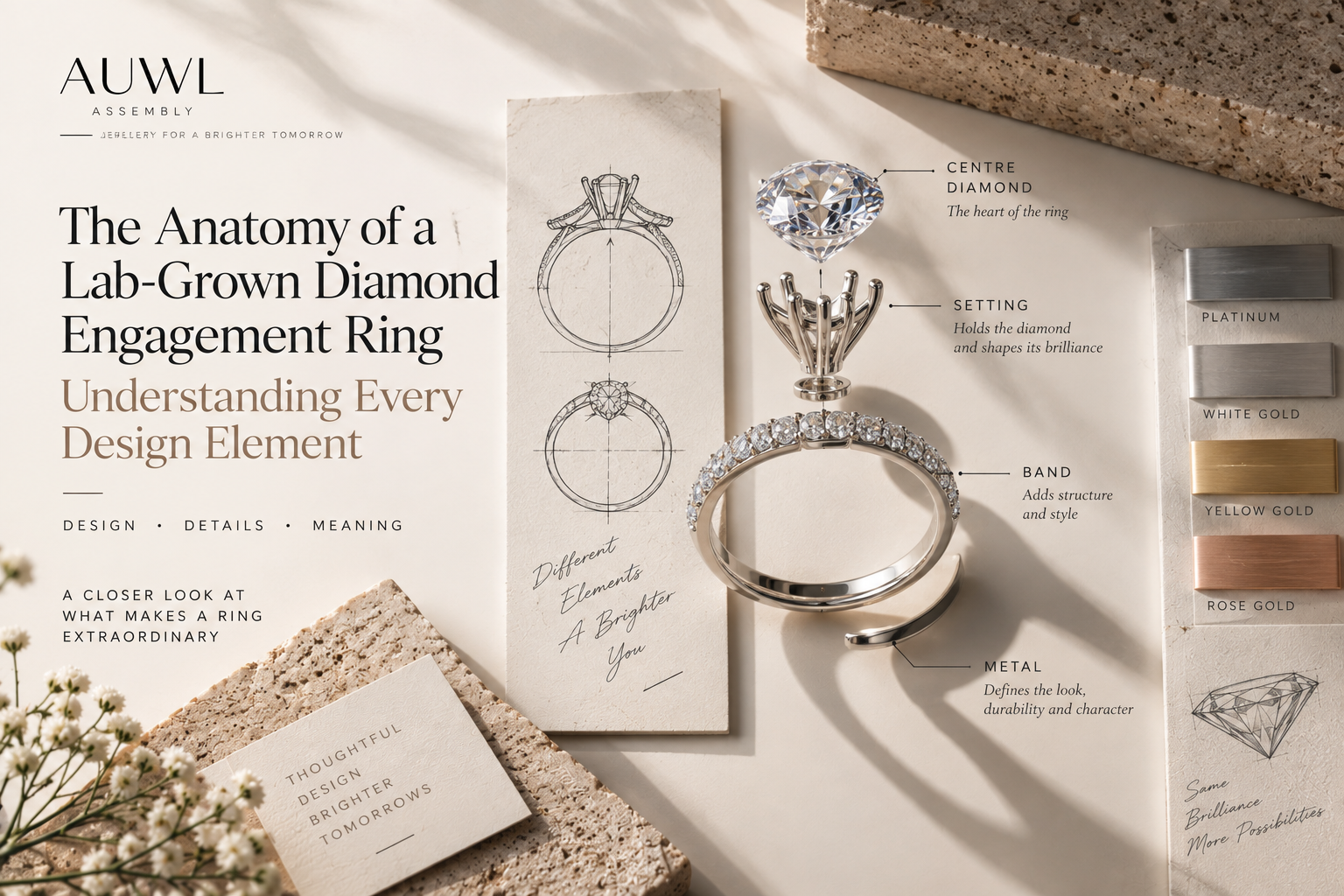
An engagement ring can look deceptively simple at first glance, yet it is actually the result of several distinct components working together. The centre diamond, setting, band, and metal each play a specific role, and understanding how these pieces relate to one another makes it far easier to appreciate why certain rings feel balanced while others feel slightly off.
Rather than treating a ring as a single object, it helps to think of it as a collection of individual design decisions, each influencing the overall character of the finished piece.
What Makes Up an Engagement Ring?
At its core, every engagement ring consists of a few essential parts: the centre stone, the setting that holds it in place, the band that wraps around the finger, and the metal used throughout. Some designs add further elements, such as accent stones or a halo, which build additional detail around this basic structure.
These components do not function independently. A change to one element, such as switching diamond shape or adjusting band width, often affects how every other part of the ring appears, which is why thoughtful ring design requires considering the piece as a whole rather than selecting each element in isolation.
Understanding the Centre Diamond
The centre diamond is typically the visual focal point of the ring, and its qualities influence nearly every other design decision that follows. Cut, clarity, colour, and carat weight all contribute to how a diamond performs optically, affecting brilliance, fire, and overall presence on the hand.
With lab-grown diamonds, these same grading characteristics apply, since lab-grown stones share the same optical and physical properties as mined diamonds. This means a well-cut lab-grown centre stone can offer the same visual performance that buyers have traditionally associated with diamond quality.
Diamond Shapes and How They Change the Design
Diamond shape has a considerable effect on the ring’s overall silhouette. Round diamonds tend to maximise brilliance due to their symmetrical faceting, while shapes like emerald or asscher cuts emphasise clarity and create a more architectural, stepped appearance.
Elongated shapes, such as oval or marquise, can visually lengthen the finger and often appear larger than round diamonds of equivalent carat weight. Shape also interacts directly with setting style, since certain settings are specifically designed to complement particular outlines.
The Role of the Ring Setting
The setting determines how the centre stone is held in place, but it also shapes how much of the diamond is visible and how light interacts with it. A more open setting exposes greater surface area to light, generally increasing brilliance, while a more enclosed setting offers additional protection at the cost of some light exposure.
Settings also establish the ring’s overall tone. A simple setting places full attention on the stone itself, while a more detailed setting introduces additional visual texture that becomes part of the ring’s identity alongside the diamond.
Understanding Prongs and How They Hold the Diamond
Prongs are the small metal claws that secure the diamond within its setting, and their number and shape affect both appearance and security. Four-prong settings expose more of the diamond and create a slightly more geometric outline, while six-prong settings offer additional security, which can suit larger or more valuable centre stones.
Prong shape also matters. Rounded prongs create a softer, more traditional look, while pointed or claw-style prongs tend to appear on more contemporary designs. Even this small detail contributes meaningfully to the ring’s overall character.
The Band and Overall Ring Structure
The band forms the structural foundation of the ring, and its width, thickness, and profile all influence comfort and appearance. A wider band tends to feel more substantial and can help visually balance a larger centre stone, while a slimmer band keeps focus more firmly on the diamond itself.
Band design can range from a plain, unembellished profile to one featuring pavé diamonds, milgrain detailing, or subtle texture. These choices affect not just appearance but also how the ring feels during everyday wear, since added detail can sometimes create a less smooth surface against the skin.
Choosing the Metal for the Design
Metal choice affects both colour and durability. Platinum offers a naturally white tone and excellent durability, though it is denser and typically more expensive. White gold provides a similar appearance at a lower cost but may require periodic replating to maintain its finish over time.
Yellow and rose gold introduce warmer tones, each interacting differently with diamond colour grade and skin tone. The metal chosen also affects how prongs and settings age over time, since some metals hold their shape and finish more consistently under daily wear.
How Different Elements Come Together
Once these individual components are understood, it becomes easier to see why certain rings feel cohesive while others feel mismatched. A ring works well when setting, band, and metal all support the centre stone’s shape and character rather than competing with it.
This is particularly visible across the growing range of lab grown diamond engagement rings available today, where designers combine these elements in varying proportions to create pieces that range from understated to elaborate, depending on how each component is balanced against the others.
Understanding Halo Settings
A halo setting surrounds the centre diamond with a ring of smaller accent stones, creating a distinct visual effect that differs meaningfully from a standard solitaire setting. Rather than isolating the centre stone, a halo integrates it into a broader cluster of sparkle.
This approach can make a centre stone appear visually larger, since the surrounding diamonds extend the area of brilliance beyond the stone’s actual edges. The effect is particularly noticeable from a slight distance, where the halo and centre stone can appear to blend into a single larger area of light.
The Role of Surrounding Diamonds
The accent diamonds within a halo are typically much smaller than the centre stone, but their placement and density significantly affect the finished look. A single, tightly set row creates a clean, defined outline, while a double halo adds further dimension and a noticeably more elaborate appearance.
Exploring lab grown diamond halo rings makes these differences easy to compare directly, since variations in halo shape, whether round, cushion, or oval, can dramatically change how the overall ring reads, even when the centre stone itself remains identical.
Ring Proportions and Overall Silhouette
Proportion ties every previous element together. The relationship between centre stone size, band width, and setting height determines whether a ring appears balanced or slightly disjointed once worn. A large centre stone on an especially slim band, for instance, can look visually unstable, while excessive band width can sometimes overwhelm a smaller stone.
Setting height also affects silhouette. A higher setting draws more attention to the stone but can catch on clothing more easily, while a lower profile sits closer to the hand and tends to suit a more low-key everyday aesthetic.
Minimalist vs Detailed Ring Designs
Minimalist designs strip the ring back to its essential elements, typically a clean setting, simple band, and understated prong style, allowing the centre diamond to stand entirely on its own. Detailed designs, by contrast, layer in additional elements such as halos, pavé, or textured banding to create a more elaborate finished piece.
Neither approach is inherently superior. The right level of detail depends on personal taste and how the various components are expected to interact with the rest of a wearer’s jewellery collection.
How Design Elements Affect Everyday Wear
Beyond appearance, these design choices carry practical implications. Higher settings and more elaborate prong arrangements can require more careful handling day to day, while lower profiles and simpler settings generally hold up better under frequent activity.
Metal choice also plays into long-term wear, as certain metals show scratches or wear patterns differently over years of daily use. Considering these factors alongside visual preference helps ensure the finished ring performs well beyond its initial appearance.
Creating a Balanced Jewellery Design
AUWL Assembly’s approach to ring design reflects this same principle of balance, considering how centre stone, setting, and band proportions interact rather than treating each element as a separate decision. A well-designed ring is ultimately the product of these components working in coordination, rather than any single element carrying the design on its own.
Understanding this relationship between parts makes it easier to evaluate any ring, regardless of style, by looking at how thoughtfully its individual elements have been brought together.
Conclusion
A lab-grown diamond engagement ring is built from several interconnected design decisions, from the centre diamond’s shape and cut through to setting style, band structure, and metal choice. Recognising how these elements influence one another offers a clearer way to understand and appreciate ring design, beyond simply reacting to a finished piece’s overall appearance. With this understanding, evaluating any engagement ring becomes a matter of recognising how thoughtfully its individual parts have been assembled into a cohesive whole.