A cooling tower seasonal maintenance checklist covers two distinct events: shutting a tower down safely for the off-season and bringing it back online without damage or delay. Skipping either step raises the risk of corrosion, scale buildup, and water treatment failures that turn into a cooling tower repair call during the first week of peak-season operation.
Facilities that follow a documented cooling tower maintenance plan at both transitions practice proactive cooling tower maintenance instead of reactive repairs, and that difference shows up directly in operational efficiency and extend equipment lifespan.
Table of Contents
- Introduction
- Why Seasonal Transitions Put Cooling Towers at Risk
- Pre-Shutdown Checklist: Preparing a Cooling Tower for the Off-Season
- Draining and Cleaning the Basin
- Inspecting the Fill Pack and Water Distribution System
- Protecting Idle Components From Corrosion
- Documenting Baseline Readings
- Startup Checklist: Bringing a Cooling Tower Back Online
- Mechanical Inspection Before Power-On
- Cooling Tower Seasonal Maintenance Checklist at a Glance
- Common Mistakes During Seasonal Transitions
- Conclusion
- Frequently Asked Questions (FAQs)
- How Often Should a Cooling Tower Be Inspected During the Off-Season?
- What Is the Biggest Risk of Skipping a Cooling Tower Seasonal Maintenance Checklist?
- Can a Cooling Tower Be Restarted Immediately After a Long Shutdown?
- How Does Drift Affect Building Occupants Near a Cooling Tower?
- Does Water Treatment Chemistry Change Between Shutdown and Startup?
Why Seasonal Transitions Put Cooling Towers at Risk
A cooling tower that sits idle for weeks or months does not simply pause. Stagnant water in the tower basin loses its treated chemistry within days, and without flow, dissolved minerals concentrate in low spots and start forming scale on heat transfer surfaces. Metal mechanical components and electrical components exposed to fluctuating temperatures corrode faster once the water is no longer circulating to carry away dissolved oxygen and stabilize surface conditions.
Idle water also creates the exact conditions bacterial growth and microbial growth need to take hold. Most evaporative cooling towers release a fine mist into the air nearby, so a system that develops biological contamination during an idle period can harbor disease causing microbes that put building occupants at risk once the tower restarts and resumes normal drift.
Most tower failures during peak season do not start at startup. They start months earlier, during a shutdown that skipped a step in the tower maintenance checklist. This gap between shutdown and the next startup is exactly where energy consumption and energy costs start climbing quietly, long before anyone notices a problem at the control panel.
Pre-Shutdown Checklist: Preparing a Cooling Tower for the Off-Season
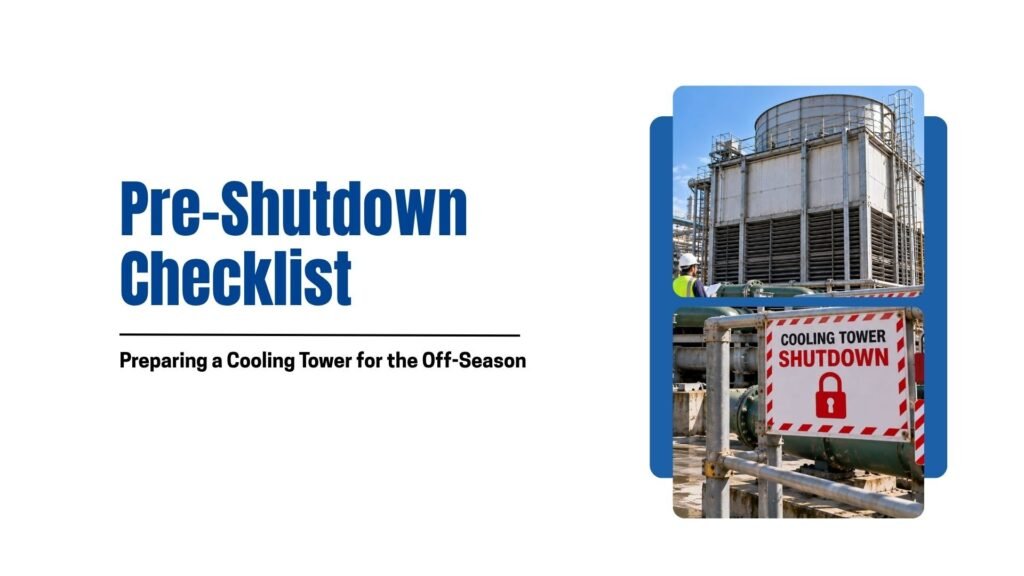
Shutting a tower down correctly protects every component in the entire system that will sit unused until the next startup. Rushing this step is the single biggest driver of costly spring repairs.
Draining and Cleaning the Basin
Standing water left in the cold water basin over an idle period accumulates sediment, algae, and mineral deposits. Total dissolved solids (TDS) in untreated standing water can climb well above normal operating range within a few weeks, since evaporation continues even when the tower is not actively cooling.
- Drain completely: Do not leave partial water in the basin, since shallow standing water concentrates minerals faster than a full basin does.
- Remove debris and sediment: Clear leaves, sludge, and scale from the basin floor before it dries and bonds to the surface.
- Inspect for cracks: Check the basin liner and structure for damage while it is empty and easy to see.
- Check the float valve and bleed water valve: A stuck float valve overfills the basin, and a fouled bleed water valve stops the system from purging concentrated minerals correctly at restart.
- Flush dead legs: Sections of piping with little or no flow, known as dead legs, hold stagnant water even after the main basin is drained, so flush them separately to prevent them from seeding biological growth at startup.
Inspecting the Fill Pack and Water Distribution System
The fill pack, also called fill material, is where the tower does most of its actual heat exchange work, which also makes it the most common place for scale and algae to build up during an idle period. Check the spray nozzles in the water distribution system for clogging or misalignment, since uneven water distribution across the fill pack reduces cooling capacity even when every other component is working correctly.
Tower drift eliminators deserve the same attention. Eliminators that are cracked, warped, or missing sections allow excessive drift, which wastes treated water and increases the amount of mist carried into the surrounding air.
Protecting Idle Components From Corrosion
Fan blades, motor bearings, and gearboxes need protection from moisture and temperature swings during an idle period. Check the fan blade hub for missing balancing weights, since a fan that loses balance during storage will show excessive vibration the moment it is powered back on.
Apply a light coat of corrosion-inhibiting lubricant, such as a petroleum-based rust preventive, to fan shaft bearings and exposed shafts to keep oxidation from taking hold. Check mounting bolts and oil plugs for looseness or oil leaks, since a slow leak that goes unnoticed during shutdown often shows up as a bigger gearbox problem by the time the tower restarts.
Documenting Baseline Readings
Record vibration levels, motor amperage, and water flow rates before shutdown. Vibration readings in particular give a clear numeric baseline, since motor bearings or fan shaft bearings that develop wear during storage will show a measurable increase in vibration amplitude at the same measurement point.
These readings give the startup crew something concrete to compare against during the next tower inspection, so any change shows up immediately instead of going unnoticed for weeks.
Startup Checklist: Bringing a Cooling Tower Back Online
Startup after an idle period carries its own risks. Components in the cooling system that sat still for months do not always respond the way they did before shutdown, so a mechanical inspection before power-on catches problems while they are still cheap to fix.
Mechanical Inspection Before Power-On
Before energizing any motor, a hands-on check prevents damage that automated startup would otherwise cause. This step takes about an hour and can save a full motor replacement.
- Check fan blades and rotate by hand: Confirm free movement and look again for missing balancing weights before starting the motor, since a stuck or unbalanced fan under power can burn out the motor in seconds.
- Verify motor alignment: Misalignment that develops during an idle period puts uneven strain on motor bearings and shortens equipment life.
- Check belt tension and alignment: Belts that loosened during storage need retensioning before the first run, since a slack belt slips and generates heat instead of transferring power efficiently.
- Inspect gearbox oil and oil plugs: Look for discoloration, a milky appearance, or moisture contamination, all of which signal the oil needs changing before startup rather than after a gear failure.
- Look for visible leaks: Check gaskets, oil plugs, and piping connections for visible leaks before the system is under full water pressure.
Cooling Tower Seasonal Maintenance Checklist at a Glance
The table below lines up shutdown and startup tasks side by side so facility teams can see what happens at each transition, when to do it, and what happens if the step gets skipped.
| Task | Shutdown or Startup | Timing | Why It Matters | Risk If Skipped |
| Basin draining and cleaning | Shutdown | Before idle period begins | Prevents sediment and algae buildup in the tower basin | Hardened scale, longer cleaning later |
| Fill pack and drift eliminator inspection | Shutdown | Same visit as basin cleaning | Confirms water distribution and drift control | Excessive drift, reduced heat transfer |
| Fan blade and bearing protection | Shutdown | Same day as basin cleaning | Protects fan shaft bearings and motor bearings | Rust, seized bearings, imbalance |
| Baseline readings recorded | Shutdown | Final day of operation | Gives startup crew a comparison point | Undetected performance drift |
| Mechanical inspection | Startup | Before power-on | Catches stuck, misaligned, or leaking parts early | Motor burnout, belt failure, oil leaks |
| Water treatment reset | Startup | Immediately after refill | Controls bacterial and microbial growth from day one | Legionella risk, scale formation |
| Gradual load testing | Startup | First 48 hours of operation | Confirms performance before full load | Undetected fouling or fan issues |
Common Mistakes During Seasonal Transitions
Most seasonal cooling tower problems trace back to a handful of repeated mistakes rather than one-off equipment failures.
- Skipping the basin drain because the tower “looks fine”: Visual inspection alone misses sediment settled at the bottom of the cold water basin.
- Powering on fans without checking fan blades first: Missing balancing weights or a bent blade cause excessive vibration the moment the fan spins up, and this is the fastest way to damage a motor that sat idle for months.
- Reusing old water treatment chemicals without retesting: Chemical concentrations shift during storage, so dosing based on last season’s numbers is unreliable and risks biological contamination.
- Ignoring dead legs in the piping: Sections with no flow during shutdown keep stagnant water in the system even after the main basin is drained.
- Jumping straight to full load at startup: Skipping the gradual ramp-up hides fouling, motor alignment issues, or oil leaks until the tower is already under full production demand.
Conclusion
A cooling tower maintenance checklist protects equipment at both ends of an idle period, not just at restart. Draining and protecting the tower basin at shutdown, followed by a careful mechanical inspection and water treatment reset at startup, catches problems while they are still inexpensive to fix.
Facilities that document baseline readings and follow a consistent preventative maintenance routine avoid most of the early-season repair calls that come from skipping these steps, and they see the payoff directly in lower energy costs and extended equipment lifespan.
FAQs
How often should a cooling tower be inspected during the off-season?
A cooling tower sitting idle should get a visual tower inspection at least once a month, even during a full shutdown. This catches corrosion, pest activity, or basin damage early, before the tower sits untouched for the entire off-season and problems compound into a larger repair.
What is the biggest risk of skipping a cooling tower seasonal maintenance checklist?
The biggest risk is an early-season breakdown that could have been prevented. Skipping shutdown steps like basin draining lets sediment harden, and skipping startup steps like checking fan blades risks motor damage the moment the tower powers on.
Can a cooling tower be restarted immediately after a long shutdown?
No. A gradual ramp-up over the first 48 hours lets facility teams catch fouling, fan speed issues, or water chemistry problems before the tower reaches full production load, where those same problems become harder and more expensive to fix.
How does drift affect building occupants near a cooling tower?
Tower drift eliminators control how much fine mist escapes into the air nearby. When eliminators are damaged or missing, excessive drift increases the chance that microbial growth in the water reaches building occupants, which is why eliminator condition gets checked at every seasonal transition.
Does water treatment chemistry change between shutdown and startup?
Yes. Water sitting in a drained or idle system does not need active biocide dosing, but startup requires a fresh treatment plan at full operating concentration, since stagnant residue and new makeup water both need testing before the system reaches stable cycles of concentration.