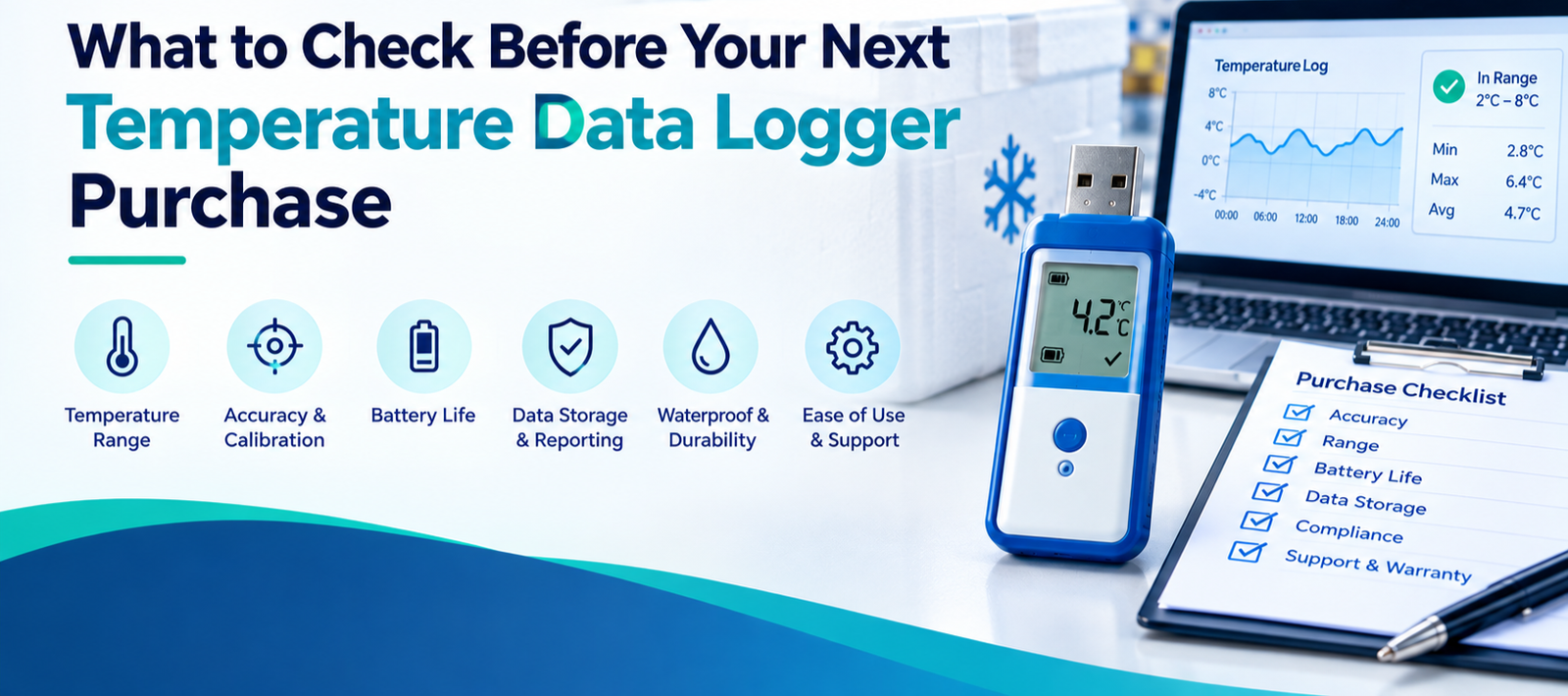
Buying a temperature data logger looks simple on paper — pick a range, pick a price, order in bulk. In practice, the wrong choice can mean failed audits, disputed claims after a spoiled shipment, or a compliance gap nobody notices until an inspector asks for records that don’t exist. Before your next purchase, here’s what actually deserves scrutiny.
Start With Your Actual Temperature Range, Not a Generic One
The single most common mistake is buying a logger rated for a broad range “just in case,” when the shipment only ever needs 2–8°C monitoring, or conversely, buying a narrow-range logger for a route that occasionally sees ambient extremes during transfers. Match the logger’s calibrated range to the real conditions your product will face, including the handling stages outside the primary transport leg — tarmac time, warehouse staging, last-mile delivery — where excursions are most likely to actually happen.
Accuracy and Resolution Matter More Than the Spec Sheet Suggests
Two loggers can both claim “±0.5°C accuracy” and still behave differently in practice, depending on sensor placement, response time, and how frequently they sample. For sensitive pharmaceutical or biological shipments, ask specifically about response time — how quickly the sensor reflects an actual temperature change — since a slow-responding logger can miss a brief but damaging excursion entirely.
Battery Life and Recording Duration
Match the logger’s rated battery life and recording duration to your actual shipment length, with margin for delays. A logger rated for exactly the length of a scheduled transit leaves zero buffer if customs holds a shipment for two extra days, which is a common and predictable failure point rather than a rare edge case.
Single-Use vs Reusable: Get the Economics Right
Single-use loggers make sense for one-way international shipments where recovery isn’t realistic, while reusable loggers are more cost-effective for closed-loop domestic routes where the same packaging and logger return to origin. Calculating the real cost per shipment — not just the unit price — often changes which option actually makes financial sense at volume.
Data Retrieval: How Will You Actually Read the Results?
Consider how the data will be accessed at the receiving end. USB loggers require a computer and often specific software at every checkpoint, which isn’t always practical for a receiving dock with limited IT access. Bluetooth and app-based readout can simplify this significantly, but only if everyone in your chain — including third-party logistics partners — actually has compatible devices and knows how to use them.
Check Compliance Requirements Before You Buy, Not After
If you’re shipping pharmaceuticals, vaccines, or other regulated goods, your logger needs to meet specific documentation standards — traceable calibration certificates, audit-ready data export formats, and in many cases 21 CFR Part 11 compliant reporting if you’re dealing with U.S. regulatory submissions. Buying a logger first and discovering it doesn’t meet your regulator’s documentation requirements afterward is an expensive and entirely avoidable mistake.
Calibration Traceability
Every logger should come with a calibration certificate traceable to a recognised standard, and you should know upfront how often recalibration is required and what that process involves. A logger that can’t demonstrate calibration traceability is effectively unusable for regulated shipments, regardless of how good its raw specifications look.
Consider the Full Lifecycle Cost
Beyond the purchase price, factor in calibration or recalibration costs, software licensing if required, replacement battery costs for reusable units, and how disposal or return logistics work for single-use loggers at scale. A cheaper unit price can quickly become the more expensive option once these ongoing costs are added up across hundreds or thousands of shipments a year.
Ask for Real-World Validation Data
Reputable manufacturers should be able to provide validation study data showing how their loggers perform under real transport conditions — vibration, humidity extremes, and handling stress — not just laboratory bench results. This is one of the more reliable ways to separate genuinely field-tested equipment from units that only look good on a spec sheet.
Environmental Sealing and Physical Durability
Beyond the sensor itself, check the logger’s physical rating — how well it’s sealed against moisture, dust, and rough handling during transit. A logger with excellent sensor accuracy is worthless if the housing cracks during loading or the display fails after exposure to condensation, which happens more often than buyers expect when shipments move through humid climates or between temperature zones. Look for an IP rating appropriate to your shipping conditions, not just a general claim of ruggedness.
Alarm and Alert Functionality
Some loggers include a visible or audible alarm that triggers the moment a reading moves outside the acceptable range, which can prompt an immediate check at a receiving dock rather than waiting for the full dataset to be downloaded and reviewed later. For shipments where a fast response to an excursion could still save the product — repositioning stock, adjusting storage conditions on arrival — this feature can be genuinely valuable rather than a nice-to-have.
Software Compatibility With Your Existing Systems
If your organisation already uses a quality management system or a specific data format for compliance records, check whether the logger’s reporting software can export in a compatible format before you buy, rather than discovering after the fact that you’re manually re-entering data from one system into another. This is a small detail that becomes a significant ongoing time cost once you’re processing dozens or hundreds of shipments a month.
Supplier Support and Turnaround on Replacement Units
Ask how quickly a supplier can turn around replacement units if a logger fails or is damaged, and whether they offer any loaner or expedited replacement option for urgent shipments. A supplier with no clear answer to this question is telling you, indirectly, what to expect if something goes wrong mid-shipment and you need a fast resolution.
Where to Look for Guidance
Because the right logger depends heavily on your specific product, route, and regulatory environment, it’s worth comparing options directly rather than defaulting to whatever a single supplier pushes hardest. Manufacturers such as TempNote publish detailed specifications across their temperature data logger range, which is a useful starting point for comparing accuracy, battery life, and compliance documentation side by side before committing to a bulk order — and their broader data logger lineup covers single-use, reusable, and Bluetooth-enabled options worth benchmarking against.
Getting this decision right upfront saves far more than it costs — a logger that fails to catch an excursion, or documentation that doesn’t satisfy an auditor, ends up costing considerably more than the few dollars saved on a cheaper unit.