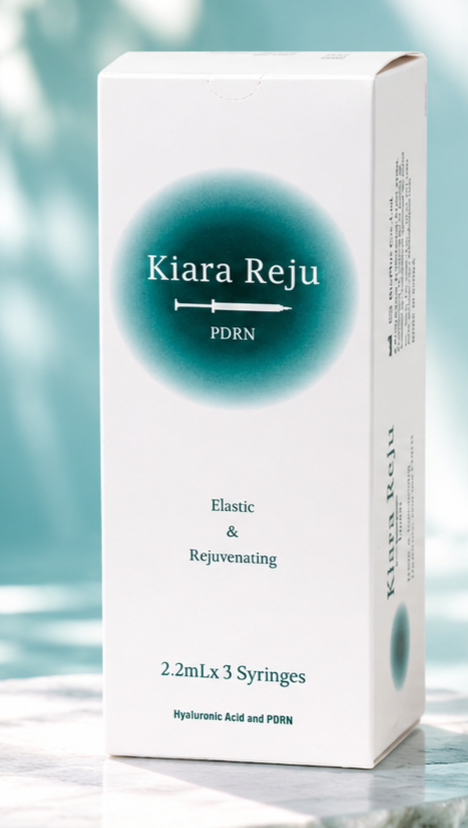
Kiara Reju is interesting because its product identity is built around a combination, rather than a single fashionable ingredient. Hyaluronic acid, PDRN and niacinamide represent different areas of skincare and biological research. Understanding their separate roles explains the logic of the formulation more clearly than describing it as a general rejuvenation solution.
For someone comparing Kiara Reju, the central question is what this combination is intended to offer within the skin quality category. The discussion is about hydration, the appearance of fine texture and the scientific interest in nucleotide based ingredients. This differs from adding structural volume with a conventional contouring filler.
The three ingredient identity
JDBIO describes Kiara Reju PDRN as a skin booster based on PDRN, hyaluronic acid and niacinamide. Its listed presentation contains three 2.2 mL syringes. That combination is the most useful product specific starting point: it tells the reader that the formulation brings together a familiar water binding polymer, a DNA derived ingredient and a form of vitamin B3. [1]
The phrase skin booster is a broad market category, not one standardized formula. Products sold under that description can contain different types of HA, nucleotides, amino acids or other components. Kiara Reju’s appeal should therefore be explained through its actual ingredient combination rather than through assumptions about everything called a booster.
The ingredients also do not have identical jobs. HA contributes material properties related to water and hydration. PDRN is studied for biological signaling and tissue responses. Niacinamide has a substantial topical skincare research history. Treating all three as interchangeable “collagen ingredients” makes the formula harder to understand, not easier.
Hyaluronic acid and the hydrated appearance
Hyaluronic acid is a polysaccharide naturally present in the extracellular environment. Its chemical structure attracts water, making it relevant to tissue hydration and the properties of water rich gels. In aesthetic products, the same ingredient family can appear in very different physical forms, from fluid preparations to firmer crosslinked fillers.
That physical form matters. A product intended for skin quality is judged differently from a product selected for contour projection. With the former, readers are usually interested in fine texture, suppleness and a less dry looking surface. With the latter, they are considering the position and amount of visible volume.
Research with a noncrosslinked HA preparation has measured hydration and facial skin quality outcomes against saline. The study by Duteil and colleagues investigated M-HA10, rather than Kiara Reju. It gives useful context for why HA is discussed in skin quality, without supplying a ready made percentage improvement for this different formula. [2]
PDRN and the interest in cellular responses
PDRN stands for polydeoxyribonucleotide. It refers to DNA derived nucleotide chains. These materials are studied in relation to cell behavior, tissue responses and repair biology. They are not living stem cells, and the name does not mean that a product edits a person’s genetic code.
Research has explored several explanations for PDRN activity, including nucleotide availability and adenosine related signaling. In a laboratory study, Shin and colleagues examined PDRN in human keratinocytes and fibroblasts. They found changes in proliferation and signaling, with different responses in the two cell types. That is an interesting biological result because the epidermis and dermis contain cells with different functions. [3]
PDRN adds a nucleotide based component to Kiara Reju’s HA focused hydration rationale. A cell culture result, however, is not a direct measurement of how much a person’s face will change after a particular product.
Niacinamide brings a different skincare background
Niacinamide is a form of vitamin B3. In topical skincare research, it has been investigated for effects on visible uneven tone, fine lines and other aspects of aging skin appearance. The study by Bissett and colleagues is one example of controlled research examining a niacinamide containing topical formulation over time. [4]
This background helps explain why niacinamide is familiar to readers who already use skincare. Its topical research concerns several aspects of complexion, while HA is most immediately associated with hydration. Together with PDRN, it gives Kiara Reju a recognizable multi-ingredient position.
Route and formulation still matter. A study of a topical cream does not establish the same outcome for a different professional preparation. The useful product explanation is therefore about complementary ingredient roles, not a claim that combining three familiar ingredients automatically adds their published results together.
How the components fit together
The simplest way to understand Kiara Reju is to separate the role of each component before considering the complete formulation. This avoids reducing every ingredient to the same generic promise.
| Component | Main area of interest | Relevance to the formula |
|---|---|---|
| Hyaluronic acid | Water binding and hydrated material properties | Hydration and skin quality positioning |
| PDRN | Nucleotide related cellular responses | A biological research dimension |
| Niacinamide | Vitamin B3 and topical complexion research | A familiar skin appearance ingredient |
| Complete formulation | Interaction of ingredients and vehicle | The actual professional product experience |
A formula is not merely a shopping list. Concentration, molecular characteristics and the vehicle influence how ingredients behave together. The combination is a reason to be interested in Kiara Reju, while performance belongs to the finished formulation. This is the same principle that explains why two creams with HA can feel very different on the skin.
Skin quality compared with facial volume
Someone seeking a fresher complexion may describe fine lines, a crepey appearance or skin that looks tired under makeup. Someone seeking contour change may describe a hollow region or a lack of projection. These concerns can coexist, but they are not the same target.
Kiara Reju is presented within the skin quality category. Its combination of HA, PDRN and niacinamide distinguishes it from a conventional contouring gel. A high level of projection is not the obvious measure of success for a product chosen because the reader is interested in hydration and fine texture.
What to notice beyond an immediate glow
A newly moisturized surface, studio lighting or temporary post-procedure changes can all affect a photograph. For skin quality, useful observations are more specific: how fine texture looks under consistent lighting, how dry areas appear and whether the intended change remains noticeable in ordinary conditions.
It also helps to separate different concerns. A reduction in dry looking fine lines is not the same as a change in pigmentation. A smoother appearance is not proof of a measured increase in collagen. These distinctions make the product discussion more informative because they describe the actual feature someone wants to improve.
For practices explaining the product, simple language works best. HA relates to hydration, PDRN to nucleotide research and niacinamide to familiar complexion science. This gives clients a useful framework without suggesting that one syringe provides every possible form of skin rejuvenation.
Product format and practical value
The three syringe, 2.2 mL presentation gives Kiara Reju a defined commercial format. When comparing kiara reju PDRN offers, that supplied quantity is more useful than a headline price detached from the box contents. The total package volume describes stock; it does not determine a universal treatment plan. [1]
Value is also about product fit. A practice interested in a combination formula may compare it with HA focused or nucleotide focused alternatives. The relevant distinction is the intended role of the complete product, followed by price and supply format, rather than the assumption that the longest ingredient list is automatically best.
Frequently asked questions
Is Kiara Reju only a PDRN product?
No. Its listed identity combines PDRN with hyaluronic acid and niacinamide. That is why explaining only the nucleotide component misses an important part of the product. The hydration related and complexion related ingredients help distinguish the formulation from a product built around one component alone.
Is PDRN the same thing as live stem cells?
No. PDRN is a DNA derived nucleotide material. It does not contain living stem cells simply because it is discussed in regenerative research. Understanding this keeps the ingredient’s identity clear and makes its scientific role easier to explain without exaggerated language.
Are PDRN and PN identical terms?
They are related nucleotide terms, but they should not be used as if every product has the same molecular characteristics. Chain size, processing and formulation can differ. A comparison between products should therefore consider the actual material and finished formulation rather than treating the initials as universal equivalents. [5]
Is it intended to provide strong contour projection?
Kiara Reju is presented as a skin booster. Its formulation is positioned around skin quality rather than the structural support associated with a contouring gel. Readers looking for a change in facial shape are describing a different objective from those seeking a more hydrated looking complexion.
Does combining ingredients guarantee a better result?
No single rule makes a combination superior. Ingredients may have complementary roles, but the formulation determines how they function together. The useful advantage to discuss is the product’s specific design and intended goal, rather than assuming that three components always outperform one.
What should a client say during a consultation?
Describe whether the main concern is dryness, fine texture, uneven appearance or a change in facial shape. Give examples from ordinary conditions, such as how the skin looks under makeup or in daylight. That helps turn a broad request for rejuvenation into a more useful product conversation.
Explore a formula with distinct ingredient roles
Kiara Reju’s core appeal is easy to explain when each ingredient keeps its own role. Practices comparing professional aesthetic products can consider this combination alongside HA focused and nucleotide focused options. Begin with the skin quality objective, then compare the supplied format and current offer to choose a product that fits the intended professional range.
References
1. JDBIO. Kiara Reju PDRN. Official product presentation. Accessed October 14, 2026.
2. Duteil L, et al. The Effects of a Non-crossed-linked Hyaluronic Acid Gel on the Aging Signs of the Face versus Normal Saline. Journal of Clinical and Aesthetic Dermatology. 2023;16(2):29–36.
3. Shin SM, Baek EJ, Kim KH, Kim KJ, Park EJ. Polydeoxyribonucleotide exerts opposing effects on ERK activity in human skin keratinocytes and fibroblasts. Molecular Medicine Reports. 2023;28:148.
4. Bissett DL, Oblong JE, Berge CA. Niacinamide: A B vitamin that improves aging facial skin appearance. Dermatologic Surgery. 2005;31(7 Pt 2):860–865.
5. Squadrito F, Bitto A, Irrera N, et al. Pharmacological Activity and Clinical Use of PDRN. Frontiers in Pharmacology. 2017;8:224. Conflict of interest corrigendum published 2022;13:1073510.