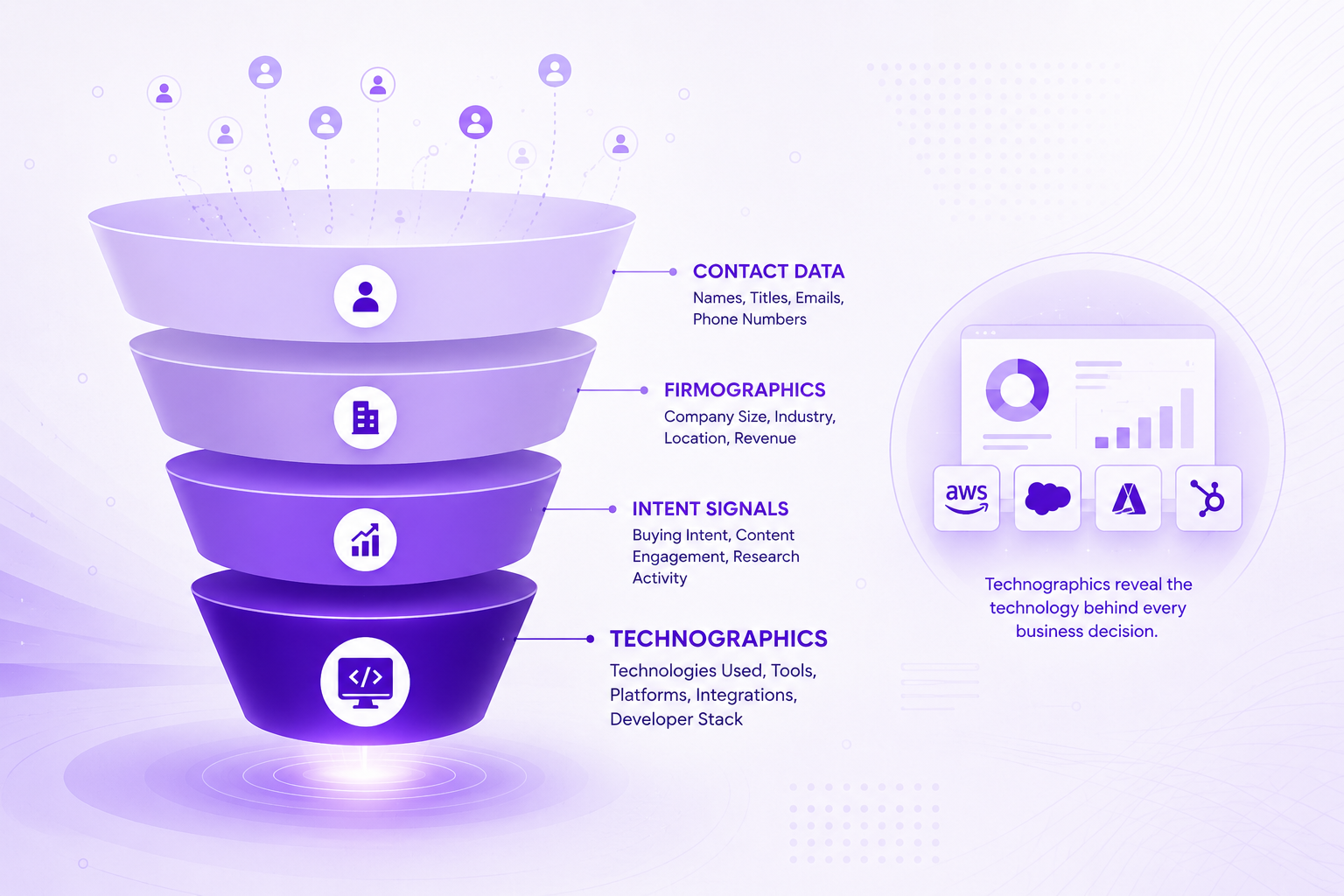
Technographics can increase your average sales revenue by 25%. You can identify your prospect’s legacy systems, track contract renewal cycles, and map backend infrastructure dependencies.
Technographic data shows what technologies a company uses and how its systems are structured, and its adoption is growing as GTM teams shift toward more data-driven targeting. Technographics extends firmographic data with technology-level attributes, enabling more precise segmentation, account prioritization, and GTM execution.
When you understand these technical gaps, your strategy becomes more targeted and execution-focused. Every outreach attempt now has a legitimate business case. You are no longer shouting into the void; you are solving real problems for your future customers.
Here are some of the top technographic data providers to consider in 2026, and what they bring to your workflow.
1. Demand Curve Marketing
If you’re looking for low-latency data refreshes, Demand Curve Marketing (DCM) provides technographic data as part of a GTM (Go-to-Market) architecture. Instead of giving you an extensive list, it builds account-level intelligence using ICP mapping, technographic segmentation, and intent signals.
With DCM, your team operates from a prioritized, actionable dataset rather than unfiltered lead dumps. The platform brings together a 360-degree account topology of your ICP by combining contact data, firmographics, technographics, and intent signals.
Pros
- Massive Vendor Intelligence: Tracks 30,000+ technologies across hardware, cloud, and legacy systems, not just web-based JS libraries.
- High-Fidelity Accuracy: Uses a hybrid AI + Human-in-the-loop verification process to ensure near-zero data decay.
- Agentic Orchestration: Features the GTM Canvas to automate multi-channel workflows based on specific tech-stack triggers.
- Unlimited Access: Operates on a no-credit-limit model, allowing for full TAM (Total Addressable Market) exploration without per-lead costs.
Cons
- High-Touch Onboarding: Not a “plug-and-play” self-service tool; requires strategic alignment and setup with an account manager.
- Consultative Lead Time: Initial delivery takes longer than an instant export because of the mandatory pre-delivery verification.
2. BuiltWith
BuiltWith is a web profiling tool that helps you understand the technology stack behind a company’s website. It gives you everything from CMS platforms and analytics tools to e-commerce systems and ad tech. It provides a massive, searchable database of technology adoption patterns across the global market.
Pros
- Granular Web-Stack Detection: Good at identifying HTML frameworks, JavaScript libraries, and pixel-based tracking tools.
- Massive Historical Index: Offers deep historical data on how long a website has used a specific technology, which is ideal for long-term TAM analysis.
- Simple Deployment: A “plug-and-play” tool with a browser extension and API that requires zero onboarding time for immediate data exports.
Cons
- Limited to Public-Facing Tech: Visibility is restricted to what is detectable on a website; it cannot identify backend infrastructure, internal ERPs, or deep cloud-security stacks.
- No Integrated Contact Intelligence: Since it is a profiling tool rather than a revenue intelligence platform, it requires additional tools to operationalize data for sales and marketing
3. Slintel
Slintel merges deep-stack intelligence with buyer intent. This allows you to identify high-value accounts based on their current technology footprint and statistical likelihood to switch vendors. It sharpens your competitive displacement strategies, using a massive technographic database to inform the precision of your sales pitch.
Pros
- Massive Technology Tracking: Monitors extensive adoption patterns and installation growth across global markets.
- Integrated Intent Signals: Correlates technographic data with digital footprints to provide clear propensity scores for active buyers.
- Strong for Competitive Targeting: Simplifies displacement strategies by identifying exactly which competitors are currently embedded in an account’s stack.
Cons
- Industry Variation: Coverage depth for specific technologies can vary by sector or geographic region.
- Onboarding Requirements: Requires initial configuration to align the intent signals with your specific ICP.
4. HG Insights
HG Insights serves as your enterprise-grade technographic data provider by merging deep-stack intelligence with predictive analytics. By mapping out IT spend and infrastructure, it provides a massive technographic database for your strategic forecasting. This transparency allows you to identify a prospect’s technology usage and overall investment capacity.
Pros
- High-Fidelity IT Stack and Spend Intelligence: Provides deep visibility into budget allocation and the total cost of ownership (TCO) of a prospect’s technology.
- Advanced Predictive Modeling: Uses a massive technographic database to forecast future buying patterns and infrastructure shifts.
- Strong for Enterprise GTM Strategy: Ideal for high-level account scoring and prioritizing large-scale digital transformation opportunities.
Cons
- Premium Pricing Structure: The cost for this level of technographic data is typically aligned with large-scale enterprise budgets.
- Complexity for Rapid Outreach: The data is optimized for high-level strategy and may require additional filtering for day-to-day SDR execution.
5. Clearbit
Clearbit operates by injecting firmographic and technographic attributes directly into existing records via API. They ensure that your technographic database remains clean, enriched, and actionable without manual intervention.
It is a staple for RevOps teams requiring seamless CRM and marketing automation integrations. These connections allow you to maintain scalable, automated workflows with ease.
Pros
- Real-Time API-Based Enrichment: Instantly appends technographic data to inbound leads, allowing for immediate routing and personalized automated responses.
- Seamless GTM Integrations: Offers massive compatibility with top-tier CRMs and marketing automation platforms for frictionless data flow.
- Developer-Friendly Infrastructure: Known for clean documentation and a robust API that allows technical teams to build custom data triggers.
Cons
- Limited Standalone Depth: While excellent for enrichment, it may lack the massive historical depth found in a specialized technographic database.
- Requires Existing Data: Functions best when enriching an existing record rather than acting as a standalone tool for cold account discovery.
6. Apollo.io
Apollo operates as a unified sales intelligence platform. It integrates contact data and technographic data with engagement tools. Your teams can filter prospects by technology attributes in one UI. It helps your GTM teams consolidate data sourcing and outreach.
Pros
- Integrated Prospecting + Engagement Workflows: Seamlessly move accounts from a technographic database directly into automated email and calling sequences.
- Streamlined Filtering Capabilities: Offers a massive range of filters to identify prospects based on both broad and niche tech-stack signatures.
- Cost-Effective for Growing Teams: Provides a robust feature set at a price point that is highly accessible for mid-market and high-growth startups.
Cons
- Moderate Technographic Depth: While broad, its technographic data may lack the deep infrastructure or backend visibility of more specialized providers.
- Lacks Human-in-the-Loop Verification: Relies primarily on automated scraping, which can lead to occasional inaccuracies compared to hybrid-verified platforms.
7. Datanyze
Datanyze is a specialized technographic data provider that focuses on delivering high-utility intelligence for your SMB and mid-market targeting. The platform allows your GTM teams to identify and segment high-propensity accounts based on their active technology footprints.
It is particularly effective for lead generation within niche markets where targeting specific, non-enterprise tools or platforms is the primary objective for displacement or partnership.
Pros
- Streamlined Technographic Segmentation: Offers a user-friendly way to filter a technographic database by specific software installations and web-tech layers.
- Intuitive Interface: Built for rapid adoption, allowing sales reps to pull data and identify prospects without a steep learning curve.
- Effective for Niche Targeting: Provides strong visibility into the technology adoption patterns of smaller, high-growth companies.
Cons
- Limited Enterprise-Scale Capabilities: While suitable for the mid-market, it may lack the deep-stack technographic data required for complex, global enterprise accounts.
- Reduced Data Refresh Frequency: Depending on the tier, some technology signatures may not reflect real-time migrations as quickly as premium, hybrid-verified sources.
Final Thoughts
Now the question isn’t whether you should use technographic data. It’s how deeply you want to operationalize it. Some providers give you surface-level visibility into tech stacks. Others go further, helping you build account prioritization models, competitive positioning, and timing strategies around that data.
The right choice depends on how you want to use technographics. As a reference point, or as a core driver of your GTM strategy. Because the real value of technographics isn’t in knowing what tools a company uses, it’s in knowing what to do with that insight.
Choosing the right customer intelligence companies can make all the difference in how effectively you target, engage, and convert the right accounts.