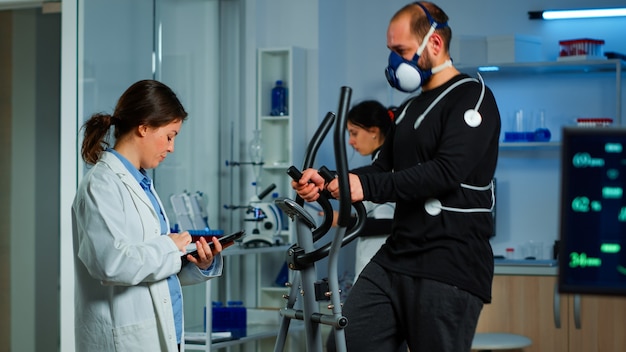
Funny thing about fitness in Singapore. You and your gym buddy can follow the exact same programme for three months straight. Same trainer, same schedule, same protein shake afterwards. Come week twelve, one of you looks like a completely different person. Leaner, stronger, visibly changed. The other? Barely any difference from day one. And that second person almost always blames themselves. Not disciplined enough. Didn’t push hard enough. Should have eaten cleaner.
Nine times out of ten, though, discipline had absolutely nothing to do with it. Their genetics responded differently. Simple as that.
That’s what a genetic DNA test actually answers. Not some vague ancestry chart. Specific information about how YOUR body responds to certain training types, how quickly it recovers, what fuel it processes well, and where your real injury risks sit.
Your Muscles Have a Preference Written in DNA
There’s a gene called ACTN3 that researchers call the “speed gene.” Studied across more than twenty thousand subjects in published meta-analyses. The pattern is remarkably consistent.
People with two R copies excel at explosive power. Sprinting, heavy lifting, and jump training. Their fast-twitch fibres produce alpha-actinin-3, a protein built for rapid force generation. Two X copies? Zero alpha-actinin-3 production. Fibres lean oxidative. Endurance suits them far better. Long runs, cycling, sustained moderate effort.
One review found that among Olympic power athletes, essentially none carried the XX genotype. That alone tells you how much this gene influences training direction.
Been grinding heavy squats three days a week, watching your partner progress while you stall? Might be sitting in your DNA. A genetic DNA test reveals this before another frustrated three months pass.
The ACE gene follows similar logic. Multiple meta-analyses show II carriers have a significant endurance association. DD carriers lean strength and power. Different genetic profiles, different optimal paths.
Recovery Isn’t Mental Toughness. It’s Biological.
Where fitness advice in Singapore falls apart for many people. Everyone discusses progressive overload. Nobody asks whether your body can recover from what you’re putting it through.
The IL6 gene shapes how your body handles post-exercise inflammation. Every session creates controlled damage for adaptation. But inflammatory clearing varies enormously. Some resolve it in twenty-four hours. Others carry elevated inflammation two to three days after identical work.
Second group training five days a week because the programme said to? They’re not building anything. They’re accumulating damage faster than their body can clear it. And they’re wondering why they feel progressively worse despite following every instruction to the letter.
MTHFR affects methylation, your cellular repair machinery. Impaired variants mean slower recovery, greater oxidative damage over time, and worse sleep after demanding sessions. A genetic DNA test catches this. Fitness apps never will.
COL5A1 variants have been linked in published research to tendon and ligament injury susceptibility, particularly Achilles and ACL issues. Strongest evidence currently from Caucasian populations, with Asian data still developing. Practitioners in Singapore’s multi-ethnic context may still consider this valuable for injury risk profiling.
What You Eat Should Match Your Genes
A genetic DNA test covers nutrition alongside exercise because those two aren’t separate.
FTO variants influence appetite regulation and fat storage. Some carriers find caloric deficits painfully slow. Not poor discipline. Biology is fighting an energy deficit harder than average. Adjusting macronutrient ratios often outperforms simply cutting calories further.
CYP1A2 governs caffeine metabolism. Slow metabolisers are common across Asian populations. That pre-workout gives your partner clean energy? Might spike your heart rate and wreck your sleep. A genetic DNA test tells you which group you belong to before months of trial and error.
VDR variants affecting vitamin D absorption deserve attention in Singapore, specifically. Office jobs, MRT commutes, and air-conditioned environments all day. UV exposure already minimal. If genetics further impair processing, standard supplement doses may not suffice during heavy training phases.
Where Singapore Residents Can Get Tested
Genetic fitness panels available through clinical practitioners, functional medicine clinics, and direct-to-consumer platforms locally. Quality varies between providers. Look for panels covering ACTN3, ACE, COL5A1, IL6, MTHFR, FTO, and CYP1A2 at a minimum for a useful profile.
Results need professional interpretation. A genetic DNA test produces raw data. Turning that into programming, recovery protocols, and nutritional strategy requires someone understanding both genomics and exercise science. A report alone isn’t a training plan.
Conclusion
Most people in Singapore are serious about fitness training on incomplete information without realising it. A genetic DNA test fills gaps that no programme or trainer detects. Reveals whether your body suits power or endurance, how much recovery you genuinely need, which nutrients your biology handles well, and where injury risks sit. Doesn’t replace hard work. Make certain it points in the direction your body responds to. For anyone consistent without expected results, that redirect might be the only missing piece.