Ice is far more than a simple cooling agent in café service — it’s a fundamental ingredient that shapes how beverages taste, look, and feel to the customer. A watered-down iced latte or a smoothie diluted by fast-melting ice can quietly erode customer satisfaction and, over time, your café’s reputation. Getting ice right matters more than most operators initially realize.
Yet selecting the right industrial ice machine is rarely straightforward. Café operators routinely wrestle with questions about how much ice they actually need, which machine type suits their menu, and how to fit commercial-grade equipment into a kitchen that was never designed with extra square footage in mind. Budget pressures add another layer of complexity, making it tempting to settle for a machine that checks only some of the boxes.
This guide cuts through that confusion. Whether you’re opening a new café or upgrading aging equipment, you’ll find a clear framework here for evaluating your specific needs, understanding the differences between machine types, identifying the features that deliver consistent ice quality, and following a practical selection process that accounts for both upfront costs and long-term value. The goal is simple: help you walk away with a machine that works as hard as your team does.
Understanding Your Café’s Ice Needs and Challenges
Before comparing machine models or chasing specifications, the most productive starting point is an honest look at how your café actually uses ice. Operators who skip this step often end up with equipment that’s either overwhelmed during the lunch rush or running half-empty most of the day — both scenarios cost money in different ways.
Assessing Daily Ice Production Requirements
A reliable baseline estimate starts with your menu and your customer count. As a general rule, a café serving cold beverages can expect to use roughly 1.5 to 2 pounds of ice per drink, depending on cup size and how much ice each recipe calls for. Multiply that by your average daily drink orders, then add 20–30% to account for peak periods, spillage, and warmer seasonal months. If your café serves 150 iced drinks on a busy summer afternoon, you’re looking at a machine that needs to produce at least 350–400 pounds of ice per day — not just on paper, but consistently under real operating conditions. Reviewing your point-of-sale data by hour and by season gives you the most accurate picture, far better than guesswork.
Why Ice Quality Matters for Café Beverages
Not all ice performs the same in a cup. Soft, cloudy ice melts quickly, diluting an iced latte within minutes and compromising the flavor profile your baristas work hard to achieve. Hard, clear ice — produced through slower, more controlled freezing — holds its shape longer, keeps drinks colder, and delivers a noticeably better customer experience. For blended drinks and smoothies, uniform ice density also protects blender equipment from uneven wear. In a competitive café market, these details accumulate into something customers feel even when they can’t quite name it: a drink that tastes right from the first sip to the last.
Exploring Types of Industrial Ice Machines for Cafés
Choosing the right machine type is where many café operators make their first significant misstep. The commercial ice equipment market offers several distinct categories, each engineered with different priorities in mind. Understanding what separates them — and which fits your specific service model — saves you from costly regrets down the line.
Square Ice Machines: Benefits and Use Cases
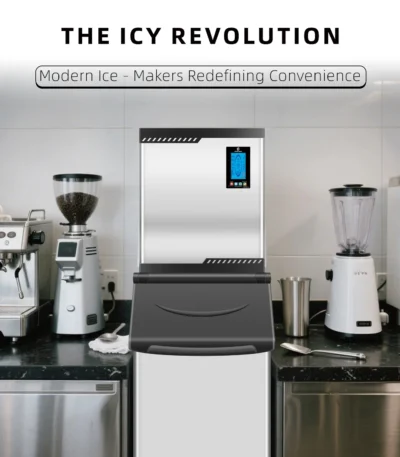
Square ice machines produce dense, uniform cubes with a slower melt rate than most alternatives. That slower melt is the key advantage: a square cube sitting in an iced Americano or cold brew stays solid longer, preserving the drink’s intended flavor concentration rather than gradually watering it down. For cafés positioning themselves at the premium end of the market — specialty coffee bars, brunch spots, or venues serving craft cocktails alongside their espresso menu — square ice signals quality in a way customers notice. Brands like Smartool have developed square ice machines with compact footprints specifically suited to café environments, making it easier to access this ice format without sacrificing counter space. These machines also tend to be space-efficient, with many models designed to fit under counters without sacrificing meaningful output. If your menu leans heavily on presentation-forward beverages, square ice is worth the investment.
Commercial Ice Makers vs. Bulk Ice Solutions
Standard commercial ice makers cover the broadest range of café needs. They come in modular, self-contained, and undercounter configurations, producing crescent, nugget, or cube ice at varying daily capacities. Nugget ice, in particular, has become popular in cafés that serve blended drinks and iced teas, since its chewable texture and high surface area chill beverages rapidly. Bulk ice solutions — large-capacity systems typically producing hundreds of pounds per day — make more sense for high-volume operations like hotel cafés, airport locations, or venues running multiple service points simultaneously. For a single-location neighborhood café, a well-matched commercial ice maker almost always delivers better value than oversized bulk equipment that strains your utility bills and floor space without a proportional return in service capacity.
Key Features to Ensure Consistent Quality and Save Space
Once you’ve identified your ice type and daily volume requirements, the next step is evaluating the specific features that determine whether a machine will actually perform reliably in a working café environment. Two machines with identical production ratings on paper can deliver dramatically different results in practice, depending on how they’re built and what technology they use to maintain ice quality over time.
Space-Saving Designs and Installation Flexibility
Café kitchens are rarely generous with floor space, which makes form factor one of the most practical considerations in your selection. Undercounter models slide neatly beneath prep stations or bar counters, keeping production close to the point of use without claiming valuable standing room. Countertop units work well for lower-volume needs or secondary service stations. Freestanding modular systems offer the highest output but require dedicated floor space and adequate ventilation clearance — typically six to twelve inches on each side. Before committing to any model, measure your available footprint carefully and account for door swing, drainage access, and proximity to water lines. A machine that fits beautifully in a showroom but blocks a critical workflow path in your kitchen will frustrate your team every single shift.
Technology for Maintaining Ice Purity and Hardness
The internal systems that govern ice quality are easy to overlook when comparing machines, but they’re what separate consistent performers from unreliable ones. Built-in water filtration removes minerals and impurities that cause cloudy, soft ice — a direct investment in the flavor integrity of every beverage you serve. Precise electronic freezing controls maintain consistent temperature cycles, producing uniform density across each batch rather than variable results that spike during peak hours. Air filtration systems prevent dust and grease particles from contaminating the ice bin, which matters significantly in a café environment where cooking and steaming happen nearby. When evaluating models, prioritize machines with accessible filter housings and straightforward cleaning cycles, since features you can actually maintain regularly will protect ice quality far more effectively than sophisticated technology that gets neglected because it’s too complicated to service quickly during a busy week.
Practical Steps to Choose the Right Industrial Ice Machine
Knowing what you need and understanding the available options only gets you halfway there. The gap between good intentions and a smart purchase closes when you follow a structured selection process that keeps your actual operating conditions — not a salesperson’s pitch — at the center of every decision.
Step-by-Step Selection Process
Start by pulling your POS data and mapping ice consumption across different dayparts and seasons. Bring your baristas and kitchen staff into this conversation — the people making drinks every day often have sharper instincts about ice shortfalls and quality issues than the numbers alone reveal. Once you have a clear production target, build your shortlist around machines that meet that number under real-world conditions, not just optimal lab ratings. Manufacturers typically test output at 70°F ambient temperature and 50°F water input; if your kitchen runs hotter, actual production will fall short of the spec sheet. Ask vendors directly how their machines perform in warmer environments before committing.
Next, verify installation requirements against your actual kitchen layout. Confirm water line placement, drainage slope, electrical capacity, and ventilation clearance before you finalize any model. Then evaluate vendor support seriously — a responsive service network and a meaningful warranty (look for at least two years on parts and labor) can determine whether a breakdown becomes a minor inconvenience or a multi-day service crisis. If a vendor offers a trial period or a showroom demo with your actual menu items, take it.
Comparing Costs and ROI for Café Operations
Purchase price is only the opening number in a longer equation. Energy consumption, water usage, filter replacement, and periodic professional servicing all accumulate into a true cost of ownership that can vary significantly between models with similar upfront prices. An energy-efficient machine rated for lower kilowatt-hour consumption may cost more to buy but pay back that difference within 18 to 24 months through reduced utility bills. Similarly, a machine with a higher-capacity storage bin reduces how often staff must manage ice levels during peak service, translating into measurable labor savings over time. Map these variables against your projected daily volume and service hours to build a realistic ROI picture — one that justifies the investment not just on day one, but across three to five years of operation.
Installation and Maintenance Tips for Long-Term Success
Proper installation sets the foundation for everything that follows. Position your machine on a level surface with adequate ventilation clearance, confirm the water line pressure falls within the manufacturer’s specified range, and ensure drainage slopes correctly away from the unit to prevent standing water. Once operational, establish a weekly cleaning routine: wipe down the exterior, inspect the ice bin for buildup, and check water filters for signs of saturation. Most manufacturers recommend a full descaling cycle every three to six months, depending on your local water hardness. Common issues like reduced ice output or cloudy cubes typically trace back to clogged filters or mineral scale on the evaporator — both are straightforward fixes when caught early. Keeping a simple maintenance log helps you spot patterns before they escalate into costly repairs.
Making the Right Ice Machine Investment for Your Café
Choosing the right industrial ice machine is one of those decisions that quietly shapes your café’s daily performance in ways that compound over time. The framework laid out in this guide gives you a reliable path through what can otherwise feel like an overwhelming process: start by honestly assessing how much ice your operation actually needs, understand which machine type aligns with your menu and service model, prioritize the features that protect ice quality and fit your physical space, follow a structured selection process grounded in real operating conditions rather than spec-sheet optimism, and commit to the installation and maintenance habits that keep your investment performing at its best.
None of these steps require specialized technical knowledge — they require the same practical thinking you apply to every other operational decision in your café. The difference is that getting this one right pays dividends in every drink you serve, every shift you run, and every customer who comes back because their iced latte tasted exactly as good as it should.
Now it’s time to put this guide to work. Pull your sales data, walk your kitchen, talk to your staff, and start building a shortlist of machines that genuinely match your needs. The right industrial ice machine isn’t the most expensive one or the most feature-loaded — it’s the one that fits your café and works reliably day after day. That’s the machine worth investing in.