Anybody buying a laptop compares a datasheet. Processor, memory, display panel, battery capacity, weight, port count. The numbers are standardized enough that two products can be ranked on the same fields, and nobody expects to make the decision from a photograph.
Furniture is bought almost entirely the other way round. Quotes for commercial restaurant tables arrive with a name, a finish, a size and a price, and the buyer chooses on appearance because appearance is the only variable that varies visibly. The information needed to do it properly exists. It simply never appears unless somebody asks.
The Fields That Should Be on Every Quote
Start with what a table datasheet would contain if the category had one.
Top material and thickness. Edge profile and edge material. Substrate, and whether it is moisture-resistant. Base type, base footprint in inches, and base weight. Column diameter where applicable. Leveling adjustment range. Total weight. Load rating, and whether that rating is tested or calculated.
None of those is exotic and every manufacturer knows all of them. They are absent from quotes because buyers have never made them a condition of quoting.
Why the Base Footprint Matters More Than the Top
Take one field and follow it through, because it demonstrates the whole argument.
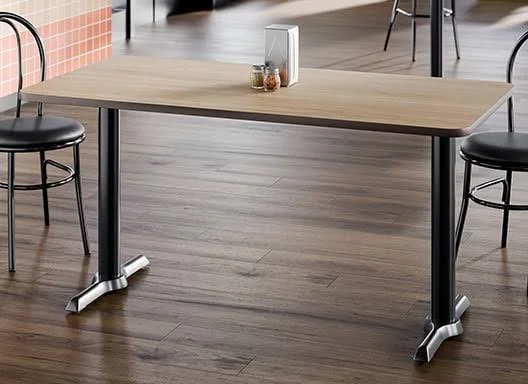
Base footprint is the diameter or dimensions of the plate on the floor. It determines whether the table tips when somebody leans on the edge, whether it rocks under normal use, and whether a wheelchair user can get their footplates underneath.
A buyer comparing two thirty-inch round tables with identical tops has no way of knowing that one has an eighteen-inch base and the other a twenty-two. That difference decides whether the table is stable in service. It is one number, available on request, and almost nobody asks for it.
The same applies to base weight. Two column bases of identical diameter can differ by fifteen pounds, and the heavier one is the one that stays put when a guest leans on the edge to stand up. Neither figure appears on a quote and both are known at the factory.
The Standards Layer Supplies the Test Method
There is an established way to answer the stability question and it is not a matter of opinion.
The desk and table products standard published by BIFMA covers stability and structural performance for tables used in commercial, institutional, restaurant and cafeteria settings, including a stability tip test. A product either was evaluated against it or was not.
Those standards are developed under the accreditation framework coordinated by ANSI, which is what makes results from different manufacturers comparable. That comparability is exactly what a hardware datasheet provides and what furniture quotes currently do not.
Treat the Finish as a Specification, Not a Color
The second field where furniture quoting fails is finish, and the failure is expensive.
Hardware buyers do not accept a display described as bright. They expect a nit figure. Furniture buyers routinely accept a finish described as durable, with no coating thickness, no pre-treatment, no cure schedule and no chemical resistance data.
The consequence shows up in year two, when daily sanitizer at working concentration has dulled a coating that was never specified against it. Asking for coating thickness and a chemical resistance statement takes one line in an email and eliminates the most common cause of early disappointment.
Edge material deserves the same treatment. The edge is the first part of a table to fail, because it takes every knock from a chair and every pass of a cloth. A quoted edge described only as bullnose says nothing about what it is made of or how it is bonded.
The Field Nobody Publishes and Everybody Needs
There is one specification that matters enormously and appears nowhere.
Model continuity. How long will this product remain available, in this finish, at this size? That determines whether a damaged table in year four is a small order or a decision about the whole room.
No datasheet convention exists for it, which is why it has to be asked directly and confirmed in writing. Suppliers who deal with hotel groups answer it routinely. Suppliers who deal only with independents are frequently surprised to be asked.
What a Comparable Quote Looks Like
For a buyer who wants two quotes that can actually be ranked:
- Top material, thickness and substrate, with moisture resistance stated
- Edge profile and edge material, since this is the first thing to fail
- Base type, footprint dimensions in inches, and base weight
- Leveling adjustment range, and whether adjusters are field-replaceable
- Test report number covering stability and structural performance
- Coating thickness, pre-treatment and chemical resistance statement
- Model continuity commitment, with a stated period
The Objection From the Supply Side
It is worth being fair about why this information is missing, because it is usually not evasion.
Most furniture buyers have never asked for any of it. A supplier who has answered these questions a hundred times keeps the answers to hand. One who has never been asked has to go back to a factory in another time zone, and the request looks like an obstacle rather than a normal part of purchasing.
That changes the moment buyers start asking as a matter of routine. The information exists at the factory in every case. What is missing is a convention for passing it along.
Why This Comparison Is Worth Building
The reason to treat furniture like hardware is that the decision has the same shape and a longer horizon.
A laptop is replaced in four years and a table is expected to last ten. The consequences of choosing badly persist longer, cost more to correct, and are visible to every guest in the room for the entire period.
A buyer who requests seven fields converts a choice between two photographs into a choice between two specifications. That takes one email and about a day of waiting, and it is the difference between buying a table and buying a picture of one.