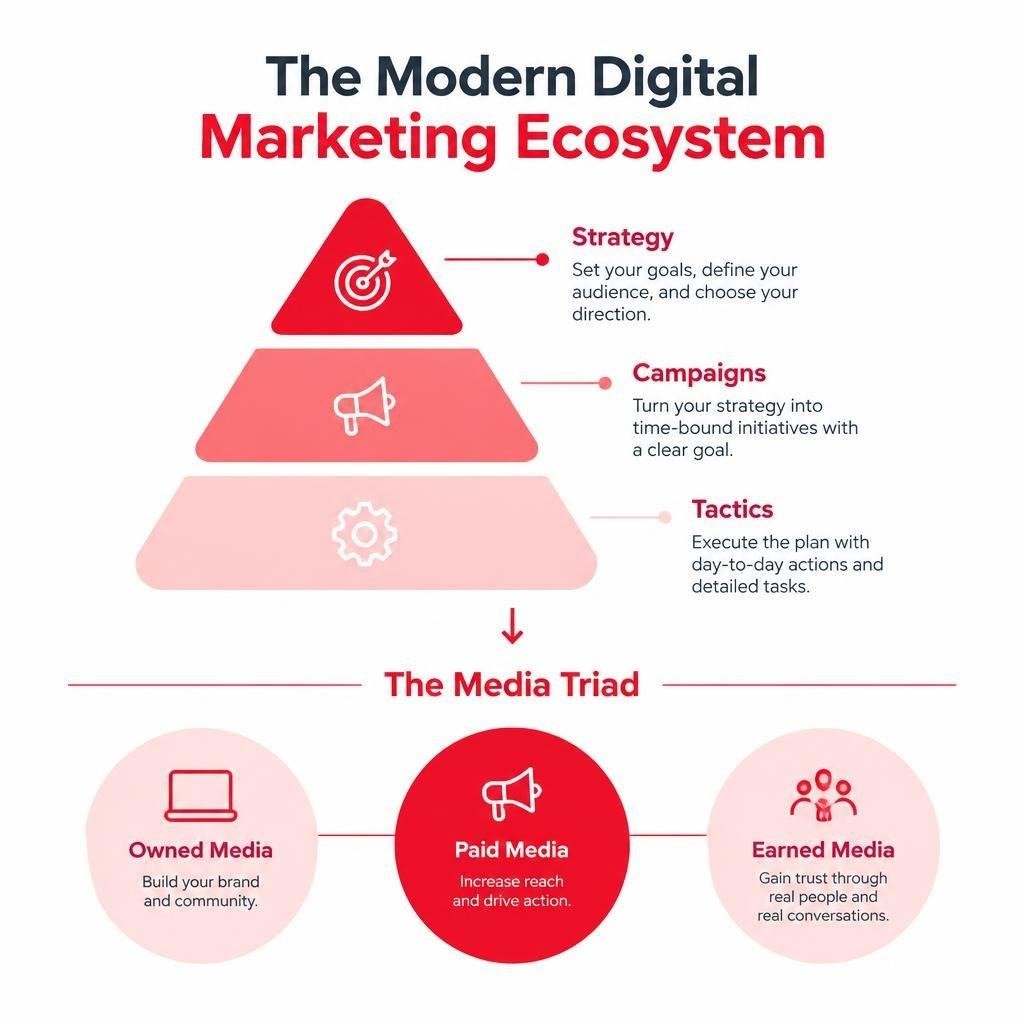
Defining Strategic Frameworks, Tactics, and the Media Triad
To build a lasting business, you must first distinguish between the “what,” the “why,” and the “how.” Many small businesses fall into the trap of jumping straight into tactics—posting on Instagram or running a quick ad—without a underlying strategy.
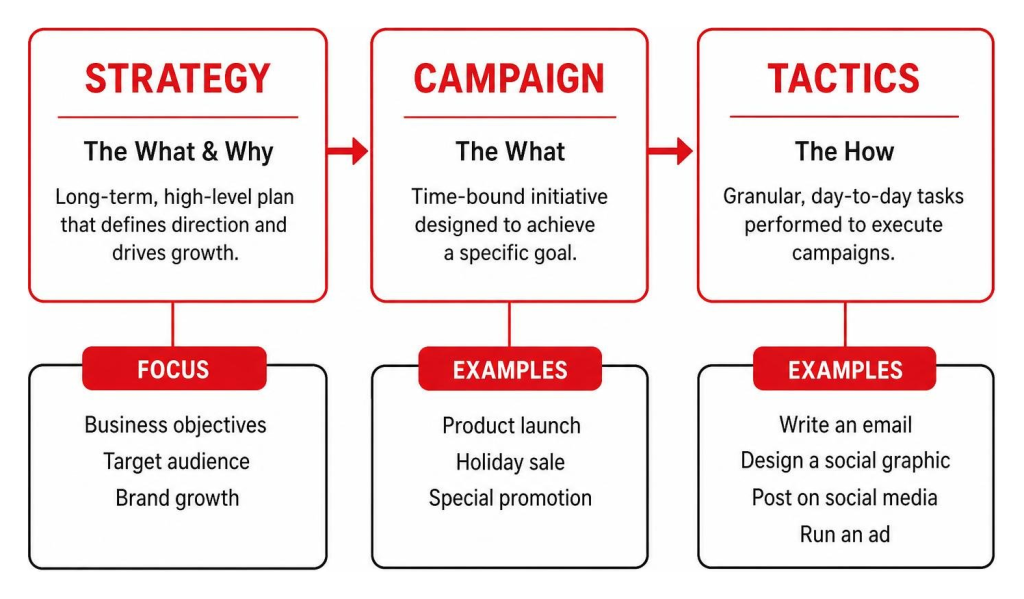
A digital marketing strategy is your long-term, high-level plan. It defines your business objectives, identifies your target audience, and sets the direction for your brand’s growth over the coming months or years. A campaign, by contrast, is a time-bound initiative designed to achieve a specific goal, such as a product launch or a holiday sale. Tactics are the granular, day-to-day tasks you perform to execute those campaigns, such as writing a specific email or designing a social media graphic.
The Core Components of Sustainable Digital Marketing Strategies
An effective strategy rests on four pillars:
- Defined Goals: Use the SMART framework (Specific, Measurable, Achievable, Relevant, Time-bound). Instead of “getting more traffic,” aim for “increasing organic website traffic by 20% over the next six months.”
- Audience Segmentation: You cannot sell to everyone. Build detailed buyer personas that include demographics, pain points, and digital habits.
- Value Proposition: Clearly articulate why a customer should choose you over a competitor. This needs to be front-and-center on your website and in your ad copy.
- Resource Planning: Be realistic about your budget and team capacity. A strategy that requires 40 hours of content creation per week is useless if you only have five hours available.
Orchestrating Owned, Earned, and Paid Media
Your success depends on how you balance your media types:
- Owned Media: This is your digital real estate—your website, email list, and blog. You have total control here.
- Earned Media: This is the “word-of-mouth” of the digital age, including reviews, social media mentions, and organic search rankings. It is the most credible form of marketing but the hardest to manufacture.
- Paid Media: This includes PPC ads and sponsored content. It provides the immediate “fuel” to jumpstart your visibility while your organic (owned and earned) efforts gain traction.
When these three work together, they create a reinforcing cycle: your paid ads drive traffic to your owned website, which encourages earned reviews, which in turn improves your search rankings.
Proven Digital Marketing Strategies for Small Business Growth
Growth is not about doing everything; it is about doing the right things at the right time. For many, the complexity of managing these moving parts requires expert guidance. Working with a full-funnel growth agency can provide the technical infrastructure and data analysis needed to ensure that every dollar spent contributes directly to your bottom line.
Search Engine Optimization and Agentic Search Optimization
SEO is no longer just about keywords. Today, we must consider Agentic Search Optimization (ASO). As AI agents become more common, they are increasingly browsing, synthesizing, and citing web content to answer user queries. To succeed, your site must provide clear, structured data and authoritative content that AI models can easily “read” and trust. Focus on answering specific user questions clearly, as this is how you become the source cited by an AI assistant.
Content Marketing and Automated Email Lifecycle Sequences
Content is the engine of your digital presence. It should be educational, not just promotional. When you provide value—through guides, videos, or tools—you build trust.
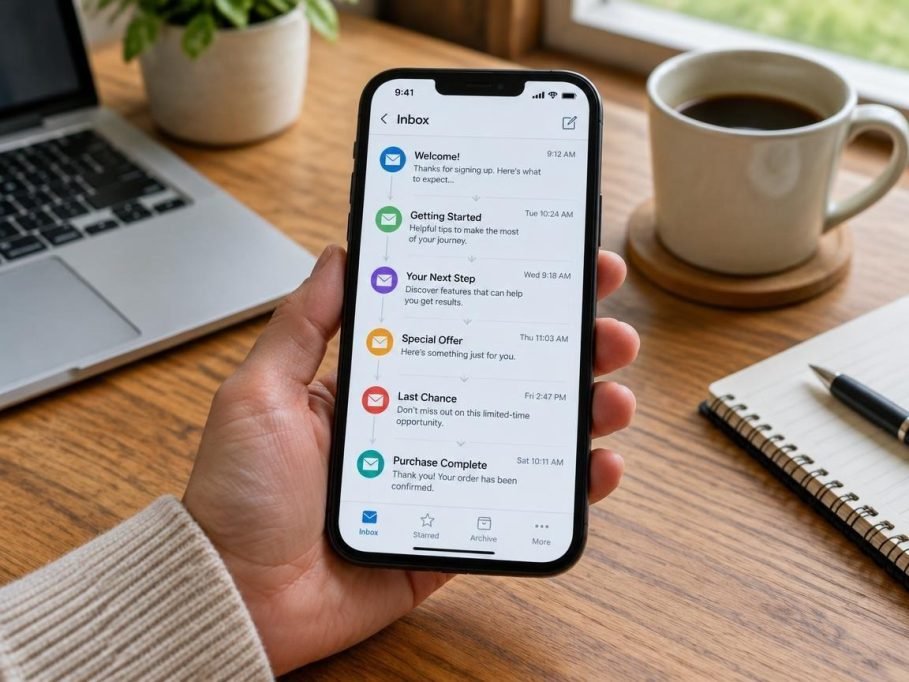
Combine this with email automation. When a visitor downloads a lead magnet, they shouldn’t just receive a generic “thank you.” They should enter an automated nurture sequence that provides progressively more value, eventually leading them to a purchase decision. This lifecycle marketing ensures you stay top-of-mind without manual intervention.
High-Impact Digital Marketing Strategies Across Social Channels
Social media is often misunderstood as a place to sell, but it is actually a place to connect. Developing a robust social media strategy allows you to show the human side of your brand. Nano-influencers (those with 1,000 to 10,000 followers) often provide higher engagement rates than celebrities because their audiences are highly niche and trusting. Use short-form video to show your product in action, and prioritize community engagement over vanity metrics like follower counts.
Targeted Pay-Per-Click and Performance Advertising
Paid search and social ads allow for surgical precision. You can target users based on their location, interests, and even their past behavior on your site (retargeting). The key to performance advertising is constant iteration: test different headlines, visuals, and landing pages to see what drives the highest conversion rate at the lowest cost.
Step-by-Step Blueprint for Strategy Implementation
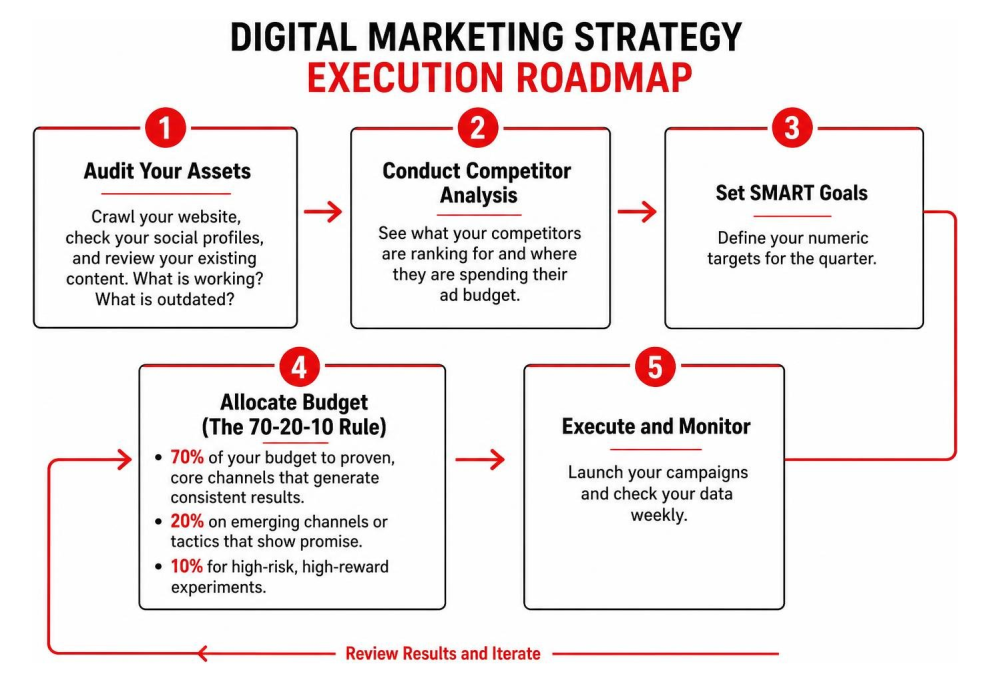
Execution is where most strategies fail. Follow this sequential roadmap to stay on track:
- Audit Your Assets: Crawl your website, check your social profiles, and review your existing content. What is working? What is outdated?
- Conduct Competitor Analysis: See what your competitors are ranking for and where they are spending their ad budget.
- Set SMART Goals: Define your numeric targets for the quarter.
- Allocate Budget (The 70-20-10 Rule): Allocate 70% of your budget to proven, core channels that generate consistent results. Spend 20% on emerging channels or tactics that show promise. Reserve 10% for high-risk, high-reward experiments.
- Execute and Monitor: Launch your campaigns and check your data weekly.
Measuring Performance and Digital Marketing ROI
You cannot manage what you do not measure. Your dashboard should focus on the metrics that impact revenue, not just “vanity metrics.”
- Customer Acquisition Cost (CAC): How much do you spend to gain one new customer?
- Customer Lifetime Value (LTV): How much is a customer worth to you over the duration of your relationship?
- Conversion Rate: What percentage of visitors take the action you want them to take?
By tracking these through tools like Google Analytics 4, you can move from intuition-based decision-making to data-driven growth.
Frequently Asked Questions About Digital Marketing
What is the difference between a marketing strategy and a tactic?
A strategy is your overarching plan to achieve a long-term goal (e.g., “becoming the leading local provider of organic pet food”). A tactic is the specific action you take today to support that (e.g., “running a Facebook ad campaign targeting local dog owners”).
How should small businesses allocate their marketing budget?
We recommend the 70-20-10 rule. It provides stability through proven channels while allowing enough flexibility to innovate and find new growth opportunities.
What is Agentic Search Optimization (ASO)?
ASO is the practice of optimizing your content so that autonomous AI agents (like those found in modern search engines) can easily find, understand, and cite your brand as a primary source of information.
Conclusion
Digital marketing is not a “set it and forget it” task. It is a process of continuous testing, learning, and refinement. The most successful small businesses are those that remain strategically agile—they listen to their data, they pivot when necessary, and they never lose sight of the human needs of their customers. By building a foundation based on clear goals and intentional channel selection, you can move away from the noise and start building a digital presence that stands the test of time.