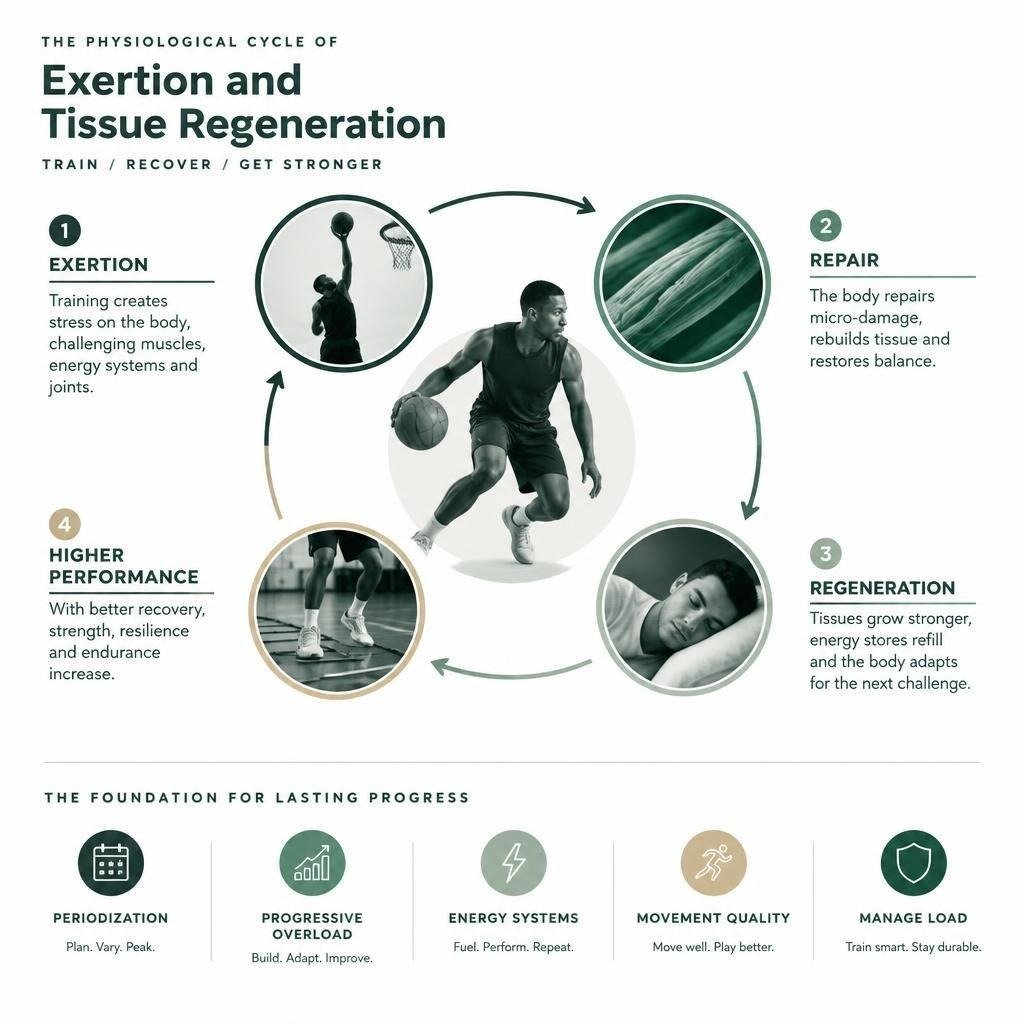
Athletes push their limits daily. To reach peak performance, training hard is only half the battle. The other half is smart recovery. As we approach late 2026, the science of athletic optimization has transformed. We now understand that advanced fitness and recovery programs are key.
This guide explores how to truly optimize an athlete’s health. We will cover the core principles of modern training. We’ll also dive into cutting-edge methods for systemic restoration. These methods, often rooted in science driven recovery, are vital for peak output.
Finally, we’ll discuss how to tailor these regimens. This guide aims to help every athlete achieve lasting success and long-term durability.
The Core Pillars of Modern Fitness and Recovery Programs
To truly optimize athletic performance, especially in dynamic sports like basketball, we must build upon foundational principles. Our approach integrates scientifically validated concepts such as training periodization, progressive overload, and understanding energy systems. We prioritize movement quality and manage mechanical load effectively, recognizing that multi-directional movement is paramount for on-court agility and injury prevention.
Training periodization involves systematically varying training volume, intensity, and exercise selection over specific cycles to maximize adaptation and minimize overtraining. This strategic planning ensures that athletes, from youth players to seasoned professionals, peak at the right moments, whether for a championship game or a crucial tryout. Progressive overload, the gradual increase in stress placed on the body, is essential for continuous improvement in strength, power, and endurance. Without it, the body adapts and plateaus.
Understanding the dominant energy systems used in basketball—primarily the anaerobic and ATP-PC systems for explosive bursts and the aerobic system for sustained effort—allows us to tailor conditioning to mimic game demands. This ensures athletes possess the stamina for a full game and the quickness for critical plays. Crucially, we emphasize movement quality, ensuring that every drill and exercise reinforces proper biomechanics, reducing injury risk and enhancing efficiency in multi-directional movements like defensive slides, cuts, and jumps. Managing mechanical load carefully prevents overuse injuries, striking a balance between challenging the body and allowing for adequate recovery.
Periodized Strength and Conditioning Protocols
Our strength and conditioning protocols are meticulously periodized to elicit specific physiological adaptations. For basketball players, this often means cycles focusing on hypertrophy (muscle growth) in the off-season, transitioning to force production and power development as the competitive season approaches. We understand that strength isn’t just about lifting heavy; it’s about applying that strength effectively on the court.
Developing a robust kinetic chain, where force is efficiently transferred from the ground up through the body, is vital for shooting accuracy, powerful jumps, and explosive drives. A strong core stability, often overlooked, acts as the central link in this chain, providing the foundation for all athletic movements. Our programs incorporate exercises that challenge the core in all planes of motion, ensuring stability during rapid changes of direction, contested rebounds, and powerful finishes at the rim. This comprehensive approach ensures that strength gains translate directly to improved on-court performance and resilience.
Movement Screening and Biomechanical Efficiency
Before any intensive training begins, we conduct thorough movement screening. This process allows us to identify existing joint mobility restrictions, assess neuromuscular control, and pinpoint any biomechanical inefficiencies that could predispose an athlete to injury or hinder performance. For a basketball player, this might involve evaluating ankle dorsiflexion, hip internal rotation, or shoulder stability—all critical for jumping, landing, shooting, and defensive stance.
By understanding an athlete’s unique movement patterns, we can implement targeted corrective exercise strategies. These exercises are designed to restore optimal joint mobility, enhance neuromuscular control, and improve overall movement literacy. The goal is not just injury mitigation but also to unlock an athlete’s full athletic potential by ensuring their body moves as efficiently and powerfully as possible. This proactive approach helps prevent common basketball injuries such as ankle sprains, knee issues, and back pain, keeping athletes on the court and performing at their best.
Advanced Methodologies in Systemic Restoration and Longevity
Beyond the training itself, the ability to recover and adapt is what truly separates good athletes from great ones. Our advanced methodologies in systemic restoration focus on accelerating metabolic clearance, optimizing the nervous system, and promoting cellular repair and tissue regeneration. We aim to shift the body into a parasympathetic tone, the “rest and digest” state, which is crucial for deep recovery and adaptation. This holistic approach ensures not just short-term performance gains but also long-term athletic longevity.
Metabolic clearance involves efficiently removing waste products like lactic acid from the muscles, which accumulate during intense exercise. Techniques and strategies that aid this process reduce muscle soreness and accelerate recovery. Optimizing the nervous system means balancing the sympathetic (fight-or-flight) and parasympathetic (rest-and-recover) branches. Chronic sympathetic dominance can lead to overtraining and burnout, so we employ methods to enhance parasympathetic tone, promoting relaxation and healing. These advanced strategies contribute to superior cellular repair and tissue regeneration, allowing muscles, tendons, and ligaments to rebuild stronger and more resilient.
Structuring Fitness and Recovery Programs for Peak Athletic Output
Effective recovery isn’t an afterthought; it’s an integral part of the training cycle. We meticulously structure fitness and recovery programs by carefully managing training volume and employing sophisticated load monitoring techniques. Tools like heart rate variability (HRV) analysis provide objective insights into an athlete’s readiness to train and their nervous system’s recovery status. A low HRV can indicate accumulated fatigue or stress, signaling the need for lighter training or increased recovery.
Optimizing sleep architecture is another cornerstone of our approach. We recognize that deep, restorative sleep is where the majority of growth hormone release and protein synthesis occurs, essential for muscle repair and adaptation. We educate athletes on sleep hygiene and monitor sleep patterns to ensure they are getting adequate, high-quality rest. By integrating these elements, we create a comprehensive system that supports peak athletic output while safeguarding against overtraining and promoting long-term health.
Key Recovery Biomarkers:
- Heart Rate Variability (HRV)
- Resting Heart Rate (RHR)
- Sleep Quality and Duration
- Subjective Feelings of Fatigue (e.g., daily readiness questionnaires)
- Creatine Kinase (CK) levels (indicator of muscle damage)
- Cortisol levels (stress hormone)
- Testosterone-to-Cortisol Ratio (T:C ratio)
- Blood Lactate levels (post-exercise)
Evaluating Active vs Passive Modalities in Fitness and Recovery Programs
When it comes to recovery, we utilize both active and passive modalities, each serving distinct purposes. Active recovery involves low-intensity exercise that helps increase blood flow, remove metabolic waste, and maintain flexibility without adding significant stress. Passive recovery, on the other hand, focuses on minimizing energy expenditure and maximizing physiological restoration.
Modality Type Examples Primary Benefits Best Use Cases Active Dynamic mobility, light cycling/swimming, foam rolling, yoga Increased blood flow, metabolic waste removal, improved flexibility, reduced muscle soreness Post-game/training, pre-habilitation, light training days Passive Cryotherapy (ice baths), massage, myofascial release, contrast therapy, sleep, nutrition, compression garments Reduced inflammation, pain relief, nervous system relaxation, tissue repair, psychological recovery Post-intense training, injury management, chronic fatigue Myofascial release techniques, often involving foam rollers or specialized tools, target tight fascia and muscle knots, improving tissue extensibility. Contrast therapy, alternating between hot and cold exposure, can enhance circulation and reduce inflammation. Dynamic mobility drills prepare the body for movement and improve range of motion. Cryotherapy, such as ice baths, is highly effective at reducing inflammation and muscle soreness post-intense activity. Our programs strategically integrate these methods to ensure comprehensive recovery, allowing athletes to return to training and competition feeling refreshed and ready.
Customizing Regimens Across Training Stages and Skill Levels
A one-size-fits-all approach to fitness and recovery simply doesn’t work. We meticulously customize regimens based on an athlete’s individual work capacity, training age, volume tolerances, and overall fatigue management needs. This personalized strategy is crucial for ensuring performance sustainability and preventing burnout or injury, especially for basketball players whose demands vary significantly based on their level and role.
For instance, a young developmental athlete will have a vastly different training and recovery profile than an elite professional. Their bodies are still maturing, their movement patterns are still being refined, and their capacity to handle high volumes of stress is lower. Conversely, an advanced performer requires precise load management and sophisticated recovery techniques to maintain peak performance through a demanding season. Our customization considers these factors, adapting training intensity, duration, and recovery interventions to match the athlete’s current stage and goals.
Foundational Training for Developmental Athletes
For developmental athletes, particularly young basketball players, our focus is on building a robust foundation. This begins with mastering motor control and establishing a solid technical baseline for fundamental basketball skills like shooting form, dribbling mechanics, and defensive footwork. Before we push for intensity, we ensure efficiency and correctness of movement.
Developing an aerobic base is also critical, providing the endurance needed for sustained play and faster recovery between sprints. We emphasize movement literacy, teaching athletes how to move their bodies efficiently and safely in various planes, which is crucial for navigating the chaotic environment of a basketball court. Beyond physical skills, we instill positive habit formation around training, nutrition, and recovery, setting them up for long-term athletic and personal success. This foundational phase is about creating resilient, adaptable athletes who can progress safely and effectively.
High-Intensity Demands for Advanced and Elite Performers
For advanced and elite performers, the training shifts to optimizing the nuances of athletic output. Our programs emphasize improving the rate of force development—how quickly an athlete can generate force—and explosive power, which translates directly to higher jumps, faster first steps, and more powerful finishes. This is achieved through advanced plyometrics, Olympic lifts, and speed training, all tailored to the specific demands of basketball.
Managing central fatigue becomes paramount, as these athletes often operate at the physiological edge. We employ sophisticated monitoring techniques to track nervous system recovery and adjust training loads to prevent overreaching. Sport-specific conditioning is integrated to ensure that their physical prowess directly translates to in-game situations, whether it’s conditioning for a full-court press or the repeated sprints of a fast break. Our goal is to enhance their ability to perform at peak levels consistently throughout a demanding season, allowing them to dominate on the court when it matters most.
Frequently Asked Questions About Athletic Recovery Protocols
How frequently should active recovery sessions be scheduled?
The ideal session frequency for active recovery largely depends on the athlete’s training load and individual recovery needs. Generally, we recommend incorporating light aerobic work or dynamic mobility sessions on rest days or immediately after intense training sessions. For basketball players, this could mean a 20-30 minute session of light cycling, swimming, or joint decompression exercises 2-3 times per week, or even daily for shorter durations. The key is intensity modulation; these sessions should be low-impact and low-stress, focusing on increasing blood flow and reducing muscle stiffness without causing further fatigue. They are designed to aid recovery, not to be another workout.
What biomarkers best indicate physical overtraining?
Identifying physical overtraining requires a holistic approach, but several biomarkers can provide objective insights. A persistently elevated resting heart rate (RHR) is a common early indicator. Athletes experiencing chronic fatigue, despite adequate rest, often exhibit signs of overtraining. Sleep disruption, such as difficulty falling asleep or staying asleep, even when exhausted, is another critical sign. Furthermore, an imbalance in the autonomic nervous system, often detected through significant drops in heart rate variability (HRV), strongly suggests that the body is struggling to recover. Monitoring these physiological markers, alongside subjective feedback, helps us intervene early to prevent full-blown overtraining syndrome.
How does sleep architecture impact functional muscle repair?
Sleep architecture, specifically the quality and duration of different sleep stages, profoundly impacts functional muscle repair and overall athletic performance. Slow-wave sleep (deep sleep) is particularly crucial, as it’s during this phase that the body releases the majority of its daily growth hormone. This hormone is essential for tissue repair, muscle growth (protein synthesis), and fat metabolism. Poor sleep architecture—characterized by fragmented sleep or insufficient time in slow-wave and REM sleep—can impair these processes, leading to slower recovery, reduced muscle adaptation, and increased injury risk. Beyond physical repair, quality sleep also plays a vital role in cognitive restoration, enhancing decision-making and reaction time, which are critical attributes for any basketball player.
Conclusion
In the dynamic world of elite athletics, particularly in a demanding sport like basketball, optimizing health is a continuous journey. Our comprehensive approach to advanced fitness and recovery programs is designed to cultivate holistic performance, ensuring not just peak output but also long-term durability and athletic longevity. By meticulously integrating periodized training, precise movement screening, and cutting-edge systemic restoration methodologies, we empower athletes to push their boundaries safely and effectively.
From foundational motor control for developmental players to the high-intensity demands of professional athletes, our customized regimens adapt to every stage and skill level. We understand that true success on the court, or in any athletic endeavor, stems from a harmonious balance between exertion and regeneration. By prioritizing smart training, proactive injury prevention, and routine optimization through science-backed recovery protocols, we equip athletes with the resilience and sustained excellence needed to achieve their highest potential for years to come.