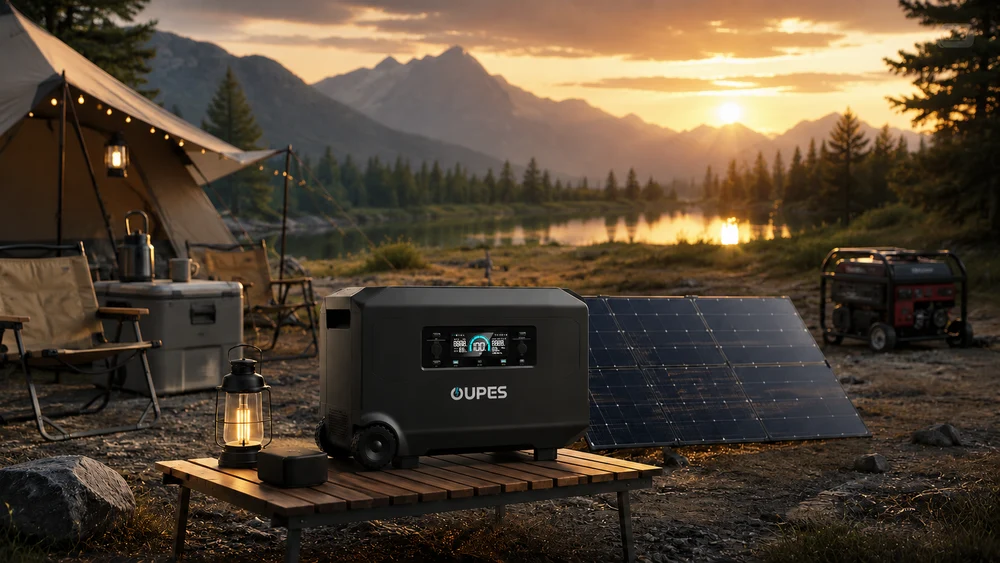
Power outages don’t send a warning text first. Neither does the moment you glance down and realize your phone’s sitting at 12% halfway through a camping trip with zero outlets around. That’s usually the exact moment people start looking into backup power — and two names keep coming up: portable solar generators, and home battery backup systems. On paper they sound almost the same. A lot of buyers treat them as interchangeable, actually. They’re not, and getting it wrong tends to go one of two ways — paying for capacity that never gets used, or ending up with something too small right when the lights go out.
So here’s the real comparison: how each one works day to day, where they actually diverge, and which one makes more sense depending on what you’re dealing with.
What Is a Portable Solar Generator?
Strip it down to the basics, and a portable solar generator setup is essentially a battery-powered power station paired with solar panels you can carry. Pack the whole thing up, chase the sunlight wherever it’s strongest, plug in, charge, done. Battery packs in this category usually run from a few hundred watt-hours up toward a few kilowatt-hours, and most come with inverters built in — so household outlets and USB devices get powered directly, no extra gear needed.
Flexibility’s the whole selling point here. Camping, tailgates, a job site with no grid access, an RV — wherever you’re headed, the unit comes too, soaking up daylight along the way. Cloudy skies throw a wrench in things, sure, and most compact portable units are sized for small appliances and electronics rather than a full household load — though larger portable models exist specifically to bridge that gap, which the comparison below gets into.
What Is a Home Battery Backup System?
A battery backup system goes a different route entirely. Think bigger, fixed battery units installed somewhere in the house — wired straight into the electrical panel in some setups, or standing alone powering a few specific circuits in others. Rooftop solar charges a lot of them, though plenty just pull from the grid and wait for the next outage to do their job.
Since nothing about these needs to be carried, capacity stops being the limiting factor it is with portable units. A fridge, lighting, a handful of outlets, sometimes a home’s entire set of essential circuits — all of it can keep running for hours, occasionally days, depending on how big the system is and what’s actually drawing power at the time.
Worth being precise here, though: “home battery backup” actually covers two different kinds of product, and mixing them up leads to the wrong expectations. One is a permanently installed whole-home battery, wired into the electrical panel by a licensed electrician and generally sized to cover most or all of a home’s circuits. The other is a larger portable power station — something like the OUPES Mega 2 Pro, at 2,048 Wh — that’s still a carryable unit, not a fixed installation, but is built with higher capacity and home-relevant outlets specifically so it can cover selected circuits during an outage rather than a whole house. The two get marketed under similar language, but they’re not the same category, and this article keeps that distinction going forward.
Key Differences at a Glance
- Mobility — portable power stations can be moved between locations, while permanently installed home battery systems remain fixed in place.
- Capacity and output — both vary by model. Permanently installed systems can be sized for larger household loads, while larger portable units can also support selected household circuits when correctly configured.
- Installation — portable units generally require no permanent installation. Fixed home battery systems typically require professional electrical installation.
- Charging — portable units may use compatible portable solar panels or AC charging; permanently installed systems may charge from rooftop solar, the grid, or other supported sources.
- Best suited for — portable units suit travel, outdoor activities, and selected home-backup loads. Permanently installed systems are better suited to integrated household backup, depending on system size and configuration.
Capacity and Power Output
Most people make their decision right here. Smaller portable units have limited storage compared with systems designed for larger household loads. They’re often suitable for charging devices, keeping a mini-fridge running, and powering lights or a laptop over a weekend. Larger portable units offer more capacity and output. For example, the OUPES Guardian 6000 V2 can support selected household circuits and some compatible 240 V loads, such as a well pump, when correctly configured. However, the loads it can support and the duration of backup depend on its specifications and the household’s energy use. A permanently installed system sized for the property may be more suitable for broader, extended whole-house backup.
Home battery systems don’t face that trade-off. Size them to match the household’s actual draw, stack extra battery units if needed, and runtime stretches a lot further. Anyone who’s watched a fridge full of groceries spoil during a long outage already understands why that extra headroom isn’t optional — it’s the entire reason to buy one in the first place.
Portability vs. Permanence
Go anywhere, or stay ready — that’s really the trade. A portable unit’s strength doubles as its ceiling: carry it wherever, but size and weight cap what it can hold and how long it lasts. A home system gives that mobility up completely, in exchange for being there, fully charged, the instant the grid drops, with nothing left to set up.
Neither wins outright. It’s a question of what actually matters more — power that moves with you, or power that’s simply always on standby.
Installation and Setup
Portable solar generators barely qualify as “setup” at all. Unfold the panels, plug in the cable, and charging starts. No electrician on the phone, no permit paperwork, no waiting around.
A permanently installed whole-home system asks for more. Wiring into a panel generally means a licensed electrician, and depending on where you live, a permit and inspection might follow too. More hassle going in, yes — but what you get back is a system that switches on by itself, rather than something you have to scramble to set up mid-outage. A larger portable unit used for home backup skips all of that — still no installation required, just higher capacity than a camping-sized model.
Cost Considerations
Portable units sit at the lower end of the price range, generally, and scale up with battery size and panel wattage. A small unit meant for weekend trips and charging devices costs a fraction of a larger model built to run bigger appliances.
Higher-capacity home-backup options run more overall — a larger portable unit costs more mainly because of its battery size, while a permanently installed system adds professional installation labor on top of that. What the extra spend buys is real runtime and, for a lot of households, actual peace of mind through longer outages. Whether it’s worth paying is mostly a local question: how often does power actually go out where you live, and what’s really at stake if it stays off for days instead of hours?
Which One Fits Your Situation?
Campers, travelers, or anyone just wanting phones and small electronics charged through a short outage — that crowd is usually better off with a portable solar generator, sized for mobility rather than keeping a whole house running. A kit like the OUPES Exodus 700 paired with a 240W solar panel covers that casual, on-the-go use fine, without the cost or commitment a full home install demands.
Frequent or extended outages change the calculation. If specific loads — such as a fridge, medical equipment, or a home office setup — need backup power, a larger portable power station like the OUPES Mega 2 Pro may be suitable for selected loads. Its base battery capacity is 2,048 Wh, so actual runtime depends on the connected equipment’s energy consumption and the unit’s output limits. It remains a portable power station, not a permanently installed home battery system, and its base capacity does not guarantee whole-house or multi-day coverage. For larger loads or compatible 240 V equipment, the OUPES Guardian 6000 V2 offers another portable option when correctly configured. A permanently installed home battery system may be more suitable for households requiring broader, integrated backup.
Can You Use Both Together?
Nothing says it has to be an either-or decision. Plenty of households run a portable solar generator for travel, job sites, or short outages, while a larger home battery system handles whole-house coverage in the background. One covers mobility and quick gaps; the other covers the longer, bigger scenarios. Together, they end up covering a lot more than either one would alone.
Either direction comes back to the same question in the end: how much power, and where. Pin that down first, and the choice between portable and home battery backup mostly makes itself.
Frequently Asked Questions
Can a portable solar generator power an entire house?
It depends on the model, its output, available battery capacity, and how the home’s electrical system is connected. Compact portable units generally suit individual devices and small appliances. Larger portable power stations, such as the OUPES Guardian 6000 V2, can support selected household circuits and some compatible 240 V loads when correctly configured. However, supporting selected circuits is not the same as providing whole-house backup. A permanently installed home battery system designed for the household’s electrical requirements may be more suitable for broader coverage. Consult a qualified electrician when connecting backup equipment to household circuits.
Do home battery backup systems require solar panels?
Not always. Plenty charge off rooftop solar, but others just draw from the grid and wait on standby. Pairing one with solar does add a layer of energy independence, if that’s a priority.
How long does a home battery backup system last during an outage?
Comes down to battery capacity and how much is actually drawing power at once. Stick to essentials — lighting, a fridge, a handful of outlets — and runtime stretches noticeably further than trying to cover a home’s full load.
Is a portable solar generator worth it if I already have a home backup system?
Often, yes. A portable unit handles situations a fixed system simply can’t reach — travel, outdoor work, power needed somewhere away from the house entirely.
How do I decide what capacity I actually need?
Start with a list — what absolutely has to stay powered, and roughly how many hours a day each thing runs. Portable units get rated in watt-hours; home systems usually in kilowatt-hours. Match that number to the real daily load instead of guessing, and that’s what keeps you from either overpaying or coming up short when it actually counts.