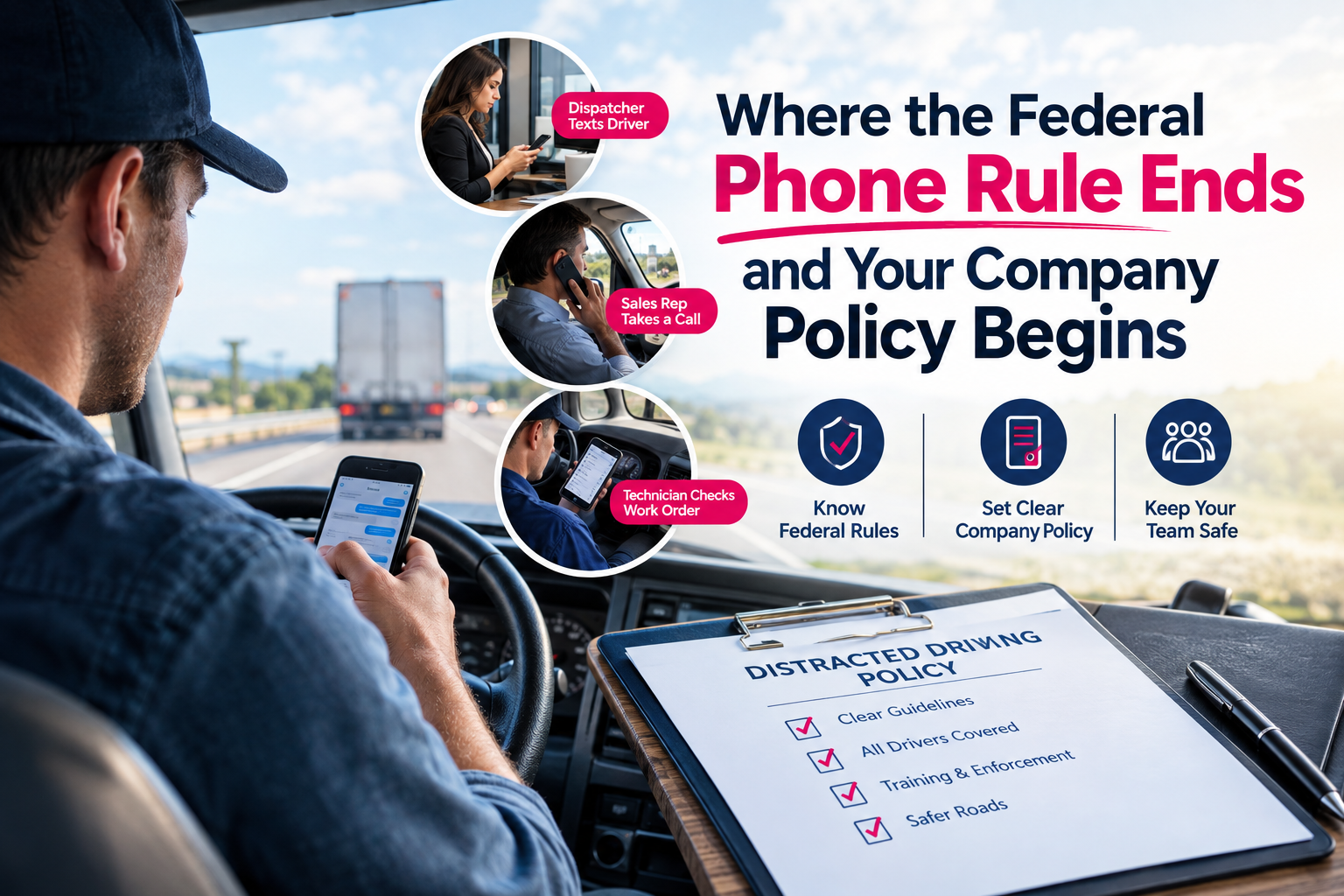
A dispatcher texts a driver about a delivery window. A sales rep takes a client’s call while merging onto the interstate. A technician glances at a work order on a phone wedged near the dash. None of these people is trying to be reckless, and whether any of it breaks a rule depends on who is driving, what they are driving, which state they are in, and what the employer has put in writing.
That last piece is the one a company controls. Distraction is a documented factor in serious crashes, not a hypothetical one. NHTSA reports that 3,208 people died in 2024 in crashes involving a distracted driver, about 8% of all traffic deaths, and that police reports cited cellphone activity in 14% of distraction-affected fatal crashes. The agency also cautions that distraction is likely undercounted, since it depends on police reports and on what drivers admit. A broader 2019 estimate based on naturalistic driving data put distraction in 29% of all crashes.
A vague reminder to stay off the phone does not close that gap. A distracted driving policy with clear lines can.
What the federal rule actually covers
FMCSA’s rules for commercial motor vehicle (CMV) drivers do two separate things. Under 49 CFR 392.80, drivers may not text while driving. Under 392.82, they may not use a hand-held mobile phone. FMCSA defines hand-held use as holding a phone to make a call, dialing by pressing more than one button, or reaching for a phone in a way that takes the driver out of a seated, belted position. Hands-free use is allowed when the phone is close enough to operate while belted in. “Driving” includes sitting in traffic or at a red light, but not being safely parked off the highway, and both rules carve out an exception for contacting law enforcement or emergency services.
Two details matter to employers. First, both rules also bar motor carriers from allowing or requiring the behavior. FMCSA has cited civil penalties of up to $2,750 for drivers and up to $11,000 for employers, figures that are adjusted for inflation over time. Second, the rules apply to CMV drivers as FMCSA defines them. A vehicle outside that definition, or an employee’s personal car used for a work errand, is not covered by these federal provisions.
The rule does not require a carrier to keep a written phone policy. But when FMCSA finalized it, the agency said carriers should have policies or practices that make clear they do not allow or require hand-held use, and it declined to limit carrier responsibility to cases where the carrier knowingly allowed it.
Where state law and OSHA come in
State laws vary. The Governors Highway Safety Association reports that 33 states and D.C. ban hand-held phone use for all drivers, and that no state bans all cellphone use for all drivers. A company with routes in several states is working with a patchwork.
OSHA has no standalone distracted-driving standard, but since its 2010 initiative it has said employers should have a clear, enforced policy against texting while driving. It has also said an employer can be in violation if, by policy or practice, it requires texting, rewards it, or structures work so that texting becomes a practical necessity. That last point is where dispatch habits deserve a hard look. (This is general information, not legal advice.)
The gaps a company policy has to fill
The federal floor leaves several questions to the employer:
- Who is covered. CMV drivers, but also sales reps, technicians, and anyone driving a personal vehicle on company business.
- Hands-free use. Federal rules allow it. The National Safety Council recommends banning both hand-held and hands-free use for all employees, citing cognitive distraction that remains even when hands stay on the wheel. Some companies adopt that standard; others allow limited hands-free calls. Either way, the choice should be deliberate.
- Work-created pressure. Dispatch messages, ETA check-ins, and app-based work orders can make phone use feel like part of the job.
- Setup tasks. Programming navigation or selecting a playlist counts as phone use if it happens while moving.
- Off-the-clock driving. Most policies govern company vehicles and business driving, and simply encourage the same habits elsewhere.
Phone rules are also one part of broader driving safety, so it helps to write them alongside fatigue, speed, and impairment policies rather than in a separate document nobody reads.
Writing language drivers can’t misread
A workable company distracted driving policy tends to include five things:
- Scope. Name the vehicles, the employees, and the situations (company vehicle, personal vehicle on business, company-issued phone).
- Prohibited activity. List the specifics: texting, emailing, browsing, holding the phone, dialing, and reading messages while the vehicle is moving, including at red lights.
- Your hands-free position. Say plainly whether hands-free calls are allowed, limited, or prohibited.
- Exceptions. Emergency calls, and any action taken after pulling over safely.
- Consequences and acknowledgment. State the disciplinary steps and have every driver sign.
Sample language might read: “While operating a company vehicle, or any vehicle on company business, employees may not text, email, browse, or hold a phone. Set navigation and calls before moving. If a message cannot wait, stop in a safe location first.” Have counsel review the final wording, especially for multi-state operations.
Making the policy stick
A signed page in an onboarding packet rarely changes behavior. What tends to help is repetition and consistency: a short refresher at safety meetings, managers who never message drivers in motion, and a dispatch process that does not reward instant replies.
Enforcement is the harder half, since a supervisor cannot ride along on every route. For a fleet-focused walkthrough of the federal requirements and how the pieces fit together, this overview of a commercial driver phone policy is one place to start.
Technology can support that effort, with caveats. NSC notes that many phone-blocking apps and devices default to blocking only texts or allowing hands-free use, so settings deserve a close look. Trip and driving reports can inform coaching conversations. They support a policy; they do not replace one.
Then review it. Revisit the policy at least once a year, after any incident, and whenever a state your drivers cross changes its law or your fleet adds new vehicle types.
Frequently asked questions
Does FMCSA require a written cell phone policy?
No. The rule prohibits carriers from allowing or requiring hand-held phone use and texting while driving a CMV, but it does not mandate a written policy. FMCSA did indicate that carriers should have policies or practices making their position clear.
Can a company ban hands-free use even though federal rules allow it?
Many employers do, and NSC recommends it. Nothing in the FMCSA rule sets a ceiling on what a company may require. Employment counsel can confirm details for your state.
Does the FMCSA rule apply to every employee who drives?
No. It applies to drivers of commercial motor vehicles as FMCSA defines them. Other employees are governed by state law and by whatever the company’s own policy says.
Conclusion
The federal phone rule sets a minimum for commercial drivers, and a good distracted driving policy for employees starts there and goes further: it defines who is covered, takes a clear position on hands-free use, removes work pressure to answer messages, and gets reviewed on a schedule. Vehicle-level tools such as My Drive Guardian, which focuses on in-vehicle alcohol detection, ignition protection, location, and driving reports rather than phone monitoring, can complement that written policy. The policy itself still has to come first.