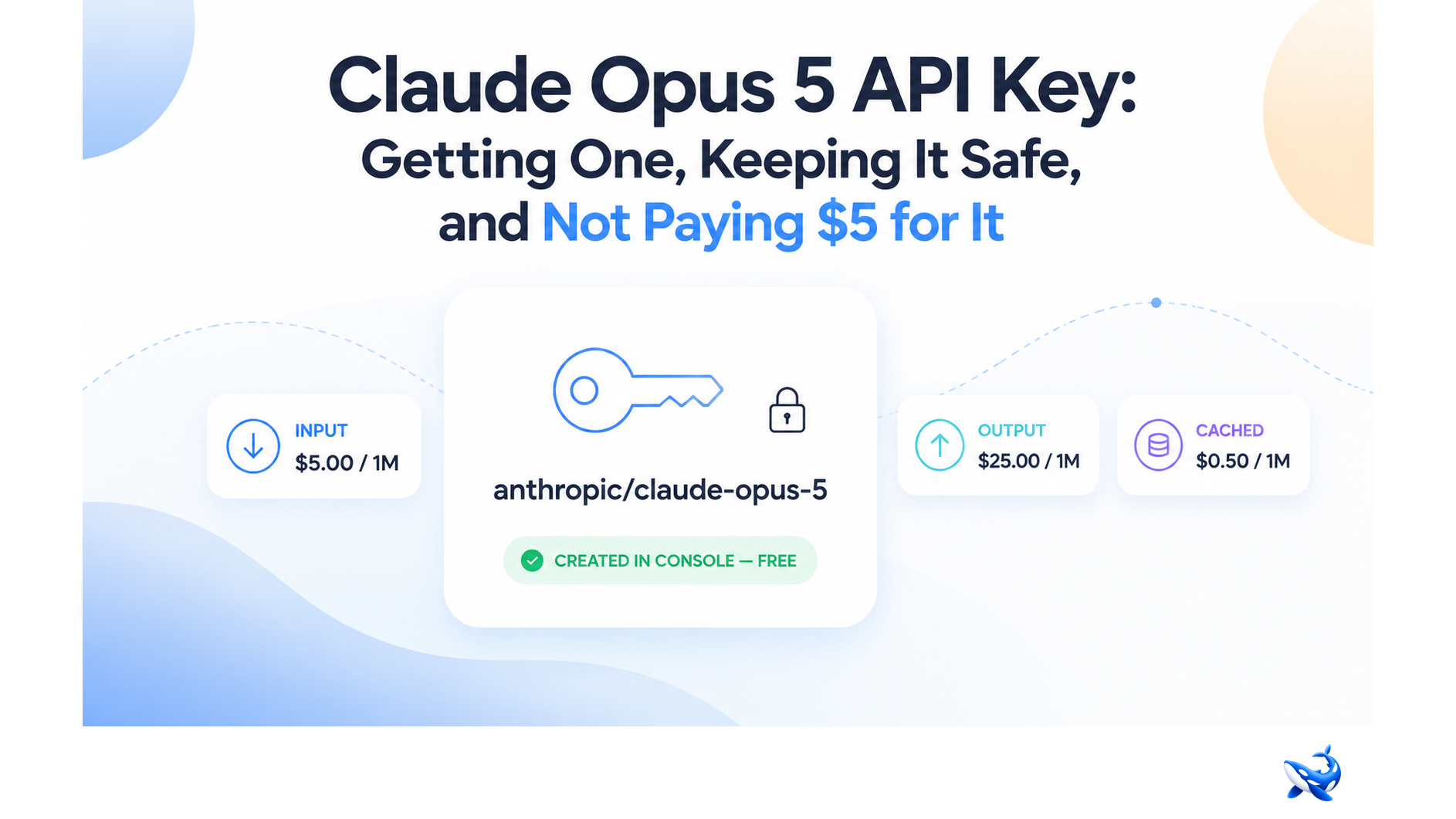
Claude Opus 5 API access begins with an API key, and the key is the cheapest part of the model — it is free. You generate it yourself in Anthropic’s developer console in a couple of minutes; nobody needs to sell you one, and anyone who does is selling a string of characters you could have created at no cost. What the key lets you do is what costs money: input tokens at $5.00 per million, output tokens at $25.00 per million, and cached input at $0.50 per million, all set out on Claude Opus 5, which carries the live rate card. This article covers where the key comes from, what one key can actually do, how to keep it safe, and why the number to watch is your bill rather than the key itself.
The confusion is understandable. “Claude Opus 5 API key” sounds like something you obtain, and the internet is eager to sell you that something: access bundles, “setup services,” gatekept invite tiers. None of it maps onto how the API actually works. A key is a credential, not an entitlement — you mint it, you guard it, and you pay for the tokens it spends. Keep those three ideas separate and most of the advice floating around the topic quietly becomes unnecessary.
Where the key actually comes from
Anthropic issues keys through its own developer console, and there is no reseller step and no paid “activation.” You create an account, add a billing method, and generate the key yourself. The console shows it to you once: you give it a name (something like prod-opus), copy the value into a secret store or environment variable, and never see the full string again. That is the entire transaction.
Two details are worth noting while you’re there. First, the key is account-level, not model-level — the same credential reaches every Claude model on Anthropic’s API, so you will not be minting a new key when a model you care about ships. Second, there is no free API tier. Anthropic’s legitimate zero-cost paths are trial credits, the playground, and bundled platform credits; the API itself is metered, so a key in hand does not mean zero spend.
What one key unlocks
With that key stored in an environment variable, the OpenAI-SDK-compatible surface Anthropic publishes for the whole Claude family accepts anthropic/claude-opus-5 as the model ID. One key is enough to call every Claude model, from the cheap workhorse to the flagship — no separate key per model.
What sits behind that ID is worth being precise about. Per the independent numbers on Artificial Analysis’ live board (checked 2026-08-22), the context window is 1,000,000 tokens and the Intelligence Index reads 63.05, first out of the 185 models it tracks. The reasoning is “Adaptive Reasoning,” a vendor feature with effort levels from medium up to max; on the same independent index, the effort dial moves the score from 63.05 at max down through 62.52 at xhigh and 61.48 at high to 58.64 at medium — so the configuration you ship is as much a pricing decision as it is a quality one. And the weights are closed: there is no self-hosting, which makes the API — and therefore the key — the real product boundary.
Key hygiene basics
The rules here are the boring kind that prevent expensive incidents, and they apply to this key exactly as they apply to any other.
• Keep it in an environment variable or a secret store. Your application reads the key from CLAUDE_API_KEY at runtime; the key itself never appears in source code.
• Never hardcode it, and never commit it. A key pasted into a repository is a key you are publishing. Add your key files to ignore lists before your first commit, not after the first leak alert.
• Scope by project. Use one named key per project or per environment. When a contractor leaves or a service is retired, you revoke one key instead of rotating credentials for everything at once.
• Treat it as a live credential, not a token of membership. If a string leaks into a log, a chat paste, or a support ticket, revoke and reissue it immediately. Anthropic displays the value only once for a reason.
None of this is model-specific, and that is the point: the moment your key handling is solid, the model behind the key stops being the operational risk.
The cost attached to using it
The published rate card, verified 2026-08-18 against Anthropic’s list and passed through unchanged by OrcaRouter, looks like this:
| Token type | Price per 1M tokens | Source |
| Input | $5.00 | Anthropic list (OrcaRouter, verified 2026-08-18) |
| Output | $25.00 | Anthropic list (OrcaRouter, verified 2026-08-18) |
| Cached input | $0.50 | Anthropic list — an 80% reduction (OrcaRouter, verified 2026-08-18) |
The headline numbers are only half the story. Claude Opus 5 is a reasoning model, and reasoning tokens bill as output, so a task that makes the model think long will cost far more per completed unit of work than the per-million input price suggests. On Artificial Analysis’ Intelligence Index, the model runs at $2.34 per task [independent], and a full index evaluation burns about 100 million output tokens and costs $3,836.05, against roughly 72 million for the median model in that tier [independent]. Median output speed is 61.8 tokens per second [independent] — slower than several cheaper models, which is consistent with a flagship tuned for answer quality rather than latency.
That is the honest version of “not paying $5 for it.” You do not pay $5 for the key — the key is free — and you do not have to pay $5 for every million input tokens either, because cache hits drop input to $0.50 per million. What you will pay is whatever the model genuinely spends thinking on your workload, and that number is best forecast in tasks, not tokens.
The one-key-for-many-models angle
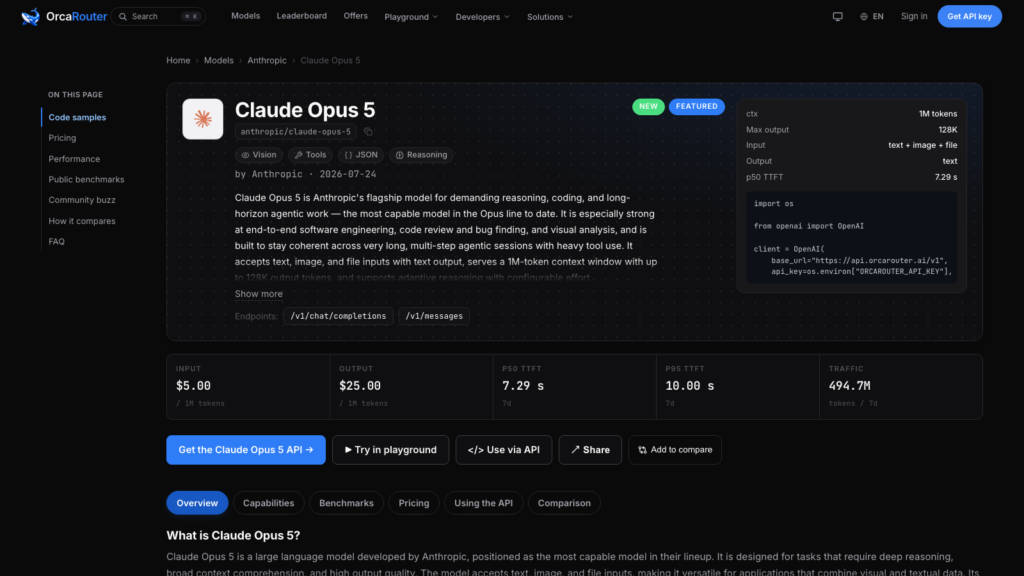
Because the key is a credential and not a contract with a single vendor, you are not locked into a single spending path. Anthropic’s own API is one option; routing through a platform is another. A router like OrcaRouter accepts that same anthropic/claude-opus-5 key and uses it across the more than 200 models in its catalog, passing through each vendor’s list price at 0% markup and routing around a vendor error automatically with failover.
The practical result is that you never buy a separate key per vendor again. One credential reaches the flagship when a task is hard and a cheap model when it is routine, and the list price you see is the list price you pay — a vendor price change reaches you the day it happens rather than the quarter after. On OrcaRouter’s own telemetry over the seven days ending 2026-08-22, Opus 5 carried 491.5 million tokens with a p50 time-to-first-token of 7.34 seconds — a high-quality, deliberate model, best pointed at work where its thinking pays for itself. If most of your traffic is retrieval, extraction, or classification, that is the wrong tool for the key: route those calls at a fraction of the cost and save the flagship for the tasks that earn it.
The takeaway
The key is free, it comes from Anthropic’s console in minutes, and nothing about it needs a middleman. What needs attention is the other two things the phrase “API key” gets tangled up with: hygiene and cost. Keep the key in environment variables, scope it per project, and treat leaks as emergencies. Then forecast the bill in completed tasks, lean on the $0.50 cached-input rate for repeated context, and — if you want one key that also reaches 200+ other models at list price with automatic failover — route it through OrcaRouter. If you want cheap, you do not need a cheap key. You need to use an expensive one carefully.
Sourcing note: key issuance, account-level behavior, Adaptive Reasoning effort levels, closed weights, and the absence of a free API tier are Anthropic’s own published facts. Rate card figures ($5.00 / $25.00 / $0.50) were verified by OrcaRouter against Anthropic’s list on 2026-08-18. Intelligence Index (63.05, #1 of 185), context window (1M), per-task cost ($2.34), full-index cost ($3,836.05 on ~100M output tokens), and output speed (61.8 tok/s) are from Artificial Analysis’ live model page, checked 2026-08-22. Catalog size, 0% markup, failover, and the 491.5M tokens / 7.34s p50 figures are OrcaRouter’s own claims and telemetry, checked 2026-08-22. Vendor pricing changes without notice.