Abstract
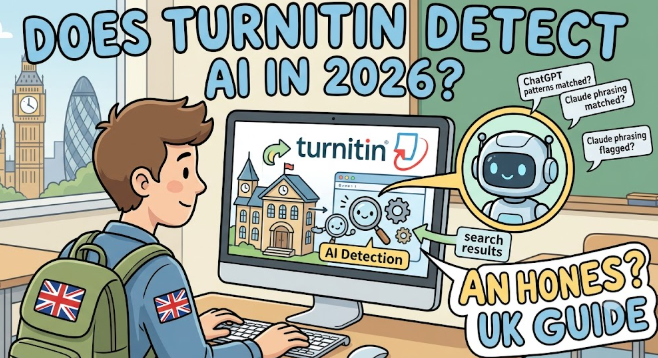
Yes, Turnitin actively detects AI in 2026. It has an AI writing checker that identifies statistical patterns in essays typical of AI models such as ChatGPT, Claude, and Gemini. Nevertheless, the tool is only an estimate with documented false positives, which remain a major challenge in UK higher education. This guide explains how it works, what it means, and how to maintain academic integrity through ethical writing and academic mentorship, as noted in resources like The Academic Papers UK.
- Turnitin’s AI writing indicator estimates the proportion of text resembling AI-generated writing; it is separate from the similarity (plagiarism) score.
- The AI score is a probability flag for review, not proof of misconduct; a percentage alone does not prove cheating.
- UK universities treat unauthorised AI use as academic misconduct; specific rules vary by institution, so check yours.
- A documented draft and version history is the strongest protection against a false accusation.
AI in 2026 is a game changer. One click can keep you well-updated but has some drawbacks as well. In academic writing and research, professors and supervisors use Turnitin to detect similarities and AI patterns in students’ writing. However, the tool only produces estimates, so human assistance and guidance are essential. Students who are facing a deadline and trying to understand what these tools can and cannot do should consider seeking assignment help to understand the major differences in the writing process.
As institutions establish stringent academic honesty policies and Turnitin’s algorithms are updated constantly, it is important to know how these tools measure your work to help ensure that your degree remains safe. This detailed blog explains how Turnitin’s AI detector works in 2026, its similarities to similarity scores, what constitutes academic dishonesty for UK universities, and how to protect against false accusations.
What Turnitin’s AI Indicator Actually Measures
The AI writing indicator is not going to search the internet for text that is similar to what you have written, as traditional plagiarism scanning capabilities do. Rather, it utilises natural language processing (NLP) to begin to comprehend the underlying structure of your writing.
How the AI Score Is Produced
Turnitin divides the document that you submit into small pieces, or chunks (typically 250-word pieces). It then calculates two key statistical properties:
- Perplexity: The degree of unpredictability of the words in a sentence. Large Language Models (LLMs) choose words based on the mathematics of probability, with low perplexity values meaning these models are highly predictable and generate highly predictable text. In comparison, human writing is much more complicated and diverse.
- Burstiness: The amount of variation in sentence length and structure. People always combine short, choppy sentences with more complex sentences containing multiple clauses. AI models will generate sentences that are even, predictable, and uniform.
If the perplexity and burstiness of a series of sentences keep dropping, and the dropiness is consistent across the series, Turnitin identifies those parts (colours them cyan for standard AI generation, and purple for AI paraphrasing/rephrasing) and calculates an overall AI Writing Indicator score.
The False-Positive Problem: Why Turnitin Is not Infallible
Turnitin’s AI detector may be wrong, even as it is constantly updated. Students should always consult their official university handbooks regarding AI usage, as automated detection systems often fail to distinguish between highly structured human prose and machine-generated text.
Key point: A 20% or 30% AI flag does not necessarily mean that plagiarism has occurred. This is an automated alert for further review, NOT a final decision. The false positive occurs most frequently when:
Non-native speakers write in formal prose:
- Research indicates that academic writing by non-native speakers tends to have fairly predictable patterns, which means that they are much more likely to have a false positive.
- Low perplexity: Writing is overly formulaic, such as a standard scientific report, a literature review with repetition of language, or a structured law essay.
- Heavy editing or paraphrasing tools are used: Using tools such as Grammarly or QuillBot to edit or paraphrase running human text can result in a loss of natural text variation, which can lead to detection.
AI Score vs Similarity Score: What is the Difference?
| Feature | Similarity Score | AI Writing Indicator |
| Primary Focus | Traditional plagiarism & source matching | Synthetic pattern & linguistic analysis |
| How It Operates | Matches text strings against online databases, journals, and submitted papers | Evaluates sentence unpredictability (perplexity) and variation (burstiness) using NLP models |
| What It Highlights | Direct quotes, uncited text, paraphrased passages, bib entries | Smooth, highly predictable, or rhythmically uniform sentence structures |
| Sources Checked | Billions of web pages, academic journals, books, student repositories | No external sources; analyses internal writing style patterns |
| Primary Academic Risk | Poor referencing, failure to attribute sources, verbatim copy-pasting | Unauthorised AI usage, automated rephrasing, false authorship |
| Marker Interpretation | Highlights where text was taken from | Prompts human review to determine if content is machine-generated |
Decoding Your Turnitin AI Score Meaning
To understand the Turnitin AI score meaning, it is important to understand how markers interpret these metrics in conjunction with one another:
- Low Similarity + High AI Score: The text in your essay is not found in any online sources or published paper, but the writing style is similar to that of the statistical footprint left by text generated by AI.
- High Similarity + Low AI Score: Your essay has a high percentage of text similarity with the sources that have been indexed (direct quotation, common bibliography entries, or standard law citations) but does not show AI signature in the prose and content.
- High Similarity + High AI Score: Text appears similar to what is found in the database and shows the presence of artificial writing structures, which are typically signs of a source being copied and then run through an AI rephraser or spinning program.
What UK Universities Count as Academic Misconduct in 2026
To answer the fundamental question “Is using AI academic misconduct?”, a review of the definition of academic integrity for 2026 within UK higher education frameworks is required. Using generative AI to produce work you present as your own is usually not classed as plagiarism in the traditional sense; plagiarism actually means passing off another person’s work as yours. Instead, most UK institutions categorise unauthorised AI use under a separate heading, commonly termed Academic Misconduct, Unauthorised Use of AI, Breach of Assessment Regulations, or False Authorship.
The definitions and penalties vary between institutions; always check your own university’s assessment regulations and any module-specific guidance before using AI tools in any capacity.
| PERMITTED / AID | GREY AREA | STRICTLY FORBIDDEN |
| • Brainstorming essay topics | • Grammar & spell checking | • Submitting AI-generated prose |
| • Explaining difficult concepts | • Rephrasing awkward sentences | • Automated spinning/paraphrasing |
| • Literature search assistance | • Code debugging (subject-specific permissions) | • Buying essays / Contract cheating |
| • Structuring initial outlines |
How Students Get Falsely Flagged (And How to Protect Yourself)
Turnitin’s writing indicator uses NLP to analyse the nature of writing, and does not rely on the same source matching that is the basis of plagiarism and similarity checking. Its results are therefore statistical probabilities, not certainties. Clean, formal, human-writing is a frequent source of false flags, because low perplexity and low burstiness are exactly what the tools look for.
Natural patterns are, of course, what will be produced by non-native writers of structured academic prose, by writers working on highly formulaic genres such as lab reports or legal briefs, or by writers creating revised versions of their drafts using automated editing software. Due to these constraints, it is understood that high AI scores are not a reason for failure in UK institutions.
The one best way to prevent a false positive is an uninterrupted digital audit trail. When you write in the cloud (Google Docs, Microsoft Word, etc.), there is a history of what you have created, edited, and deleted in your document over time, usually marked by a timestamp. When a mark or panel calls your work into question, a step-by-step version history of your document proves that the document changed naturally over a period of 15 hours. This digital record will be enhanced by archived planning resources, including unedited outlines, annotated research PDFs, hand-written brainstorms, and unedited reference export files. These archived planning resources will support the digital record and provide incontrovertible evidence of genuine scholarship.
- Maintain a Documented Version History
One of the best ways to avoid false positives is to have proof of editing history.
- Use cloud-based programs like Google Documents or Microsoft Word (with cloud save enabled) to create assignments at all times. Cloud platforms record changes, timestamps, and the addition of characters.
- A panel of academics could not possibly argue that this essay was pasted from an AI generator, since the exact version history over 20 hours is provided in a detailed format, showing the steps taken in the organic, sentence-by-sentence writing process.
- Save Preliminary Research Materials
Maintain a folder specifically for your initial brainstorming for assignments, reading logs, annotated PDFs of readings, and export files of your citations from a citation management program (e.g., Zotero or Mendeley). A strong representation of where and how you found and integrated your sources will be evident.
- Avoid Automated Spinning Tools
There is a class of tools that claim to remove the detection signals, such as “AI humanisers” or “bypassers”. Turnitin actually narrowed its detection models to look for signatures of both bypassers and paraphrasers, so using them tends to increase, not reduce, the risk of both AI and similarity flags.
The Safe Route: Bypassing Detection Risks Completely
Automated systems can detect unpolished human writing, and when misconduct is treated harshly, as it is at universities, using dubious tools or copying and pasting a text is a risk that is not worth taking for your degree. The only sure, risk-free way to pass university integrity exams is with 100% original, human-written academic writing. If you need personalised model answers, research information, or full writing assistance, then you can avoid any ambiguity caused by algorithms by working with professional human academics. A reputable assignment help service that guarantees original, human-written work can provide model answers and research support written by subject specialists, keeping your submission authentic and free of AI-generated patterns.
Conclusion
Does Turnitin detect AI in 2026? The company is actively looking for AI patterns in submissions, but it does not judge whether a submission is wrong; it merely suggests the probability that it contains machine-generated content. Keeping your digital draft history clear, avoiding automated spinning software, and knowing your institution’s specific requirements are the best ways to ensure you submit your work with complete confidence.
FAQs
Does Turnitin detect ChatGPT and other AI?
Turnitin actively identifies text written by ChatGPT, Claude, and Gemini as well as other large language models through structural and statistical characteristics of the text. Instead of using a database to determine whether it is synthetic writing, it uses natural language processing to evaluate metrics such as perplexity, burstiness, etc., and determine whether it is synthetic writing or not. It also identifies when the content is AI-generated or has been rephrased using AI.
How accurate is Turnitin’s AI detector?
According to Turnitin, it is aiming for an overall detection rate of approximately 85% for unedited AI-generated content with a low number of false positives. But Turnitin’s AI detection accuracy decreases significantly from 80% to 20%–60% when students edit, paraphrase, and mix AI-generated text with their own writing. Therefore, the actual effects of its use in real-life situations greatly depend on how the input material is prepared.
What is the difference between AI and Similarity scores?
The similarity score compares the text exactly to published journals, web pages, and previous student work to detect plagiarism. The AI score, on the other hand, investigates the internal flow of sentences and determines the likelihood that a computer wrote the text. A high similarity score may suggest unattributed copying, while a high AI score suggests possible AI authorship; the two are measured and read separately.
Can the AI detector produce false positives?
Yes. False positives often occur in highly structured technical writing, formal prose by non-native speakers, or text subjected to aggressive automated grammar correction. These flags should be treated as indicators for review, not proof of misconduct.
Is using AI to write an essay cheating?
Using AI to write any type of prose as your own is considered academic dishonesty and plagiarism at universities. Under faculty guidance, however, generative AI can be used to help brainstorm ideas for topics, outline initial papers or ideas, or clarify complex concepts. Students are typically expected to compose the text themselves and include an official disclosure of the use of AI if asked to.