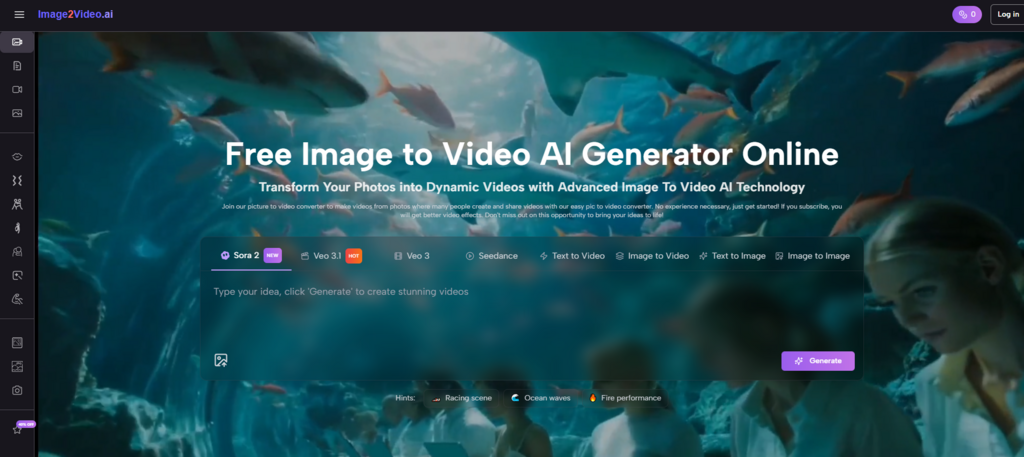
There is a long-standing assumption in video production that motion must be assembled layer by layer. Clips are arranged, transitions are added, and timing is adjusted manually. What becomes clear when experimenting with Image to Video AI is that this assumption is beginning to shift.
Motion is no longer something you build—it is something you request.
Why Traditional Assembly Based Workflows Feel Heavy
Manual workflows offer precision, but they also introduce complexity.
Multiple Steps Before Seeing Results
Typical processes involve:
- preparing assets
- building sequences
- rendering output
This delays feedback.
Technical Knowledge Remains A Barrier
Even simple animations require familiarity with tools and workflows.
How Generative Systems Change The Process
Instead of assembling motion, you define it.
Prompt Driven Motion Generation Logic
Language Becomes The Primary Interface
Descriptions guide:
- camera movement
- environmental behavior
- overall tone
The system translates these into motion.
Image Acts As A Stable Framework
The input image ensures:
- consistency in composition
- alignment of generated frames
- structural coherence
Model Choice Influences Output Characteristics
Different models affect:
- realism versus stylization
- motion fluidity
- interpretative accuracy
These variations can be observed across outputs.
The Simplified Workflow Structure
The process is intentionally reduced.
Three Step Process Based On Official Flow
Step 1 Upload Image Input
Provide a base image in supported formats.
Step 2 Describe Motion And Style
Use natural language to define movement and atmosphere.
Step 3 Generate Video Output
Wait for processing and download the final result.
No timeline editing or manual adjustments are required.
Comparing Two Creation Approaches Side By Side
| Workflow Element | Generative Approach | Editing Approach |
| Input Type | Image + Prompt | Video Clips |
| Process | AI Generation | Manual Assembly |
| Time Required | Low | High |
| Control Level | Medium | High |
| Learning Curve | Low | High |
This comparison highlights structural differences rather than superiority.
Where This Workflow Feels Most Effective
Marketing And Social Content Production
Fast turnaround is often more valuable than perfect precision.
Concept Development And Prototyping
Creators can:
- visualize ideas quickly
- iterate without heavy setup
- refine direction based on results
Creative Experimentation Scenarios
Multiple variations can be explored without committing to a single version.
Observed Constraints In Real Use
Results Depend On Prompt Quality
Clear and specific descriptions lead to better outputs.
Occasional Motion Inconsistencies
Some generated sequences may appear slightly unnatural.
Iteration Is Expected Part Of Workflow
Refinement typically requires multiple attempts.
These characteristics are common in generative systems.
How Photo To Video Changes Creative Thinking
The concept of Photo to Video removes several steps:
- no manual animation
- no sequence construction
- no frame-by-frame control
Instead, motion is generated from intent.
What This Means For Future Creative Processes
Shift Toward Direction Based Creation
Creators increasingly:
- describe outcomes
- guide systems
- refine through iteration
Acceleration Of Idea Cycles
Faster workflows enable:
- rapid experimentation
- quicker feedback loops
- broader creative exploration
Why This Transition Matters
The significance is not just speed, but accessibility.
More creators can:
- produce motion content
- test ideas quickly
- participate without technical expertise
This does not replace traditional tools, but it introduces a new starting point for creative work—one where motion is generated rather than constructed.