When you install rooftop solar, you are solving a specific problem: reducing your monthly electricity bill. But most homeowners do not realise until after installation that their solar system can do more than just reduce costs — it can actively earn money back through a mechanism called net metering.
Net metering is not a bonus or an optional feature. It is the core financial engine behind why grid-connected residential solar makes such strong economic sense in India. Without it, any surplus electricity your panels generate during the day would simply be wasted. With it, every unit your system sends to the grid is banked as a credit against your bill.
This guide explains exactly how net metering works in India, how the billing mechanism translates into real savings, what the rules look like in Karnataka and Telangana specifically, and what has changed in 2025–26 that every solar homeowner or prospective buyer should know about.
What Is Net Metering?
Net metering is a billing mechanism that allows solar panel owners to send excess electricity back to the grid and receive credits against future electricity consumption.
Think of it like a bank account for electricity. During sunny afternoons, your solar panels generate more electricity than you use, so the extra power gets deposited into the grid. At night, or when sunlight is low, you generate less electricity and withdraw power from the grid. Your electricity meter tracks both and calculates the final bill based on the difference.
The word “net” is the key. This system supports a billing model where you pay only for the net energy consumed — that is, electricity imported minus electricity exported. If you exported more than you imported in a given month, your bill for that month can be zero or close to zero.
Net metering applies only to on-grid solar systems — systems that are connected to the electricity grid. Off-grid and fully standalone systems do not use net metering.
How Net Metering Works Step by Step
Step 1: Your Panels Generate Electricity
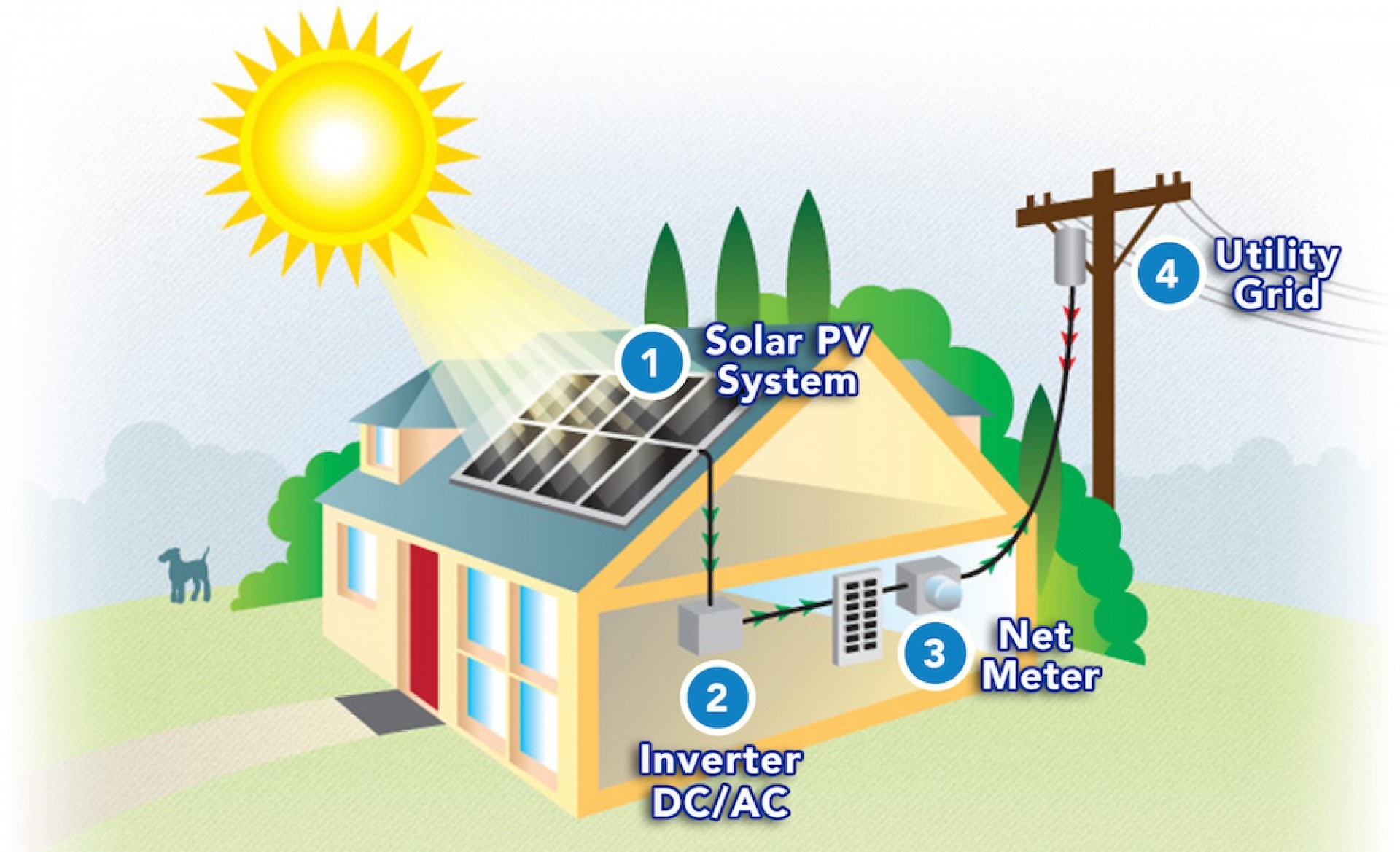
From sunrise to sunset, your rooftop solar panels generate DC electricity which your inverter converts to AC power usable by your home. Power generation is maximum during peak sun hours — a 4 to 8 hour window when the panels receive direct sunlight. During this period, your panels are likely generating more power than your home is consuming, especially if you are out during the day.
Step 2: Your Home Uses What It Needs First
The electricity your solar system generates is first used by your home. Any excess is fed into the grid. So your appliances, fans, lights, and air conditioning run on solar power first. Only after your home’s demand is met does the surplus flow outward.
Step 3: Surplus Flows to the Grid and Gets Credited
When your panels produce more than your home needs, the surplus travels through your bidirectional net meter into the electricity grid. The electricity company then credits your account, reducing your next bill. These credits are recorded by the net meter in real time.
Step 4: You Draw From the Grid at Night Using Your Credits
At night, when your panels are not generating, your home draws electricity from the grid as usual. But instead of paying full price for this electricity, your meter subtracts the units you exported during the day from the units you are importing now. Homeowners can use these credits to purchase electricity when their energy demand exceeds what the panels can provide.
Step 5: At the End of the Billing Cycle, You Pay Only the Net Difference
At the end of the billing cycle, you are charged only for the net electricity used — that is, electricity consumed minus electricity exported. If you exported more than you consumed, your bill is zero, and the surplus credits carry forward to the next month.
A Real Numbers Example: What Net Metering Looks Like on Your Bill
Here is a worked example to make the mechanism concrete.
Imagine a household in Bangalore with a 5 kW solar system:
- Monthly household consumption from grid: 400 units
- Monthly solar generation: 500 units
- Home consumes 350 units directly from solar during the day
- Surplus exported to grid: 150 units
- Units drawn from grid at night: 50 units
Without net metering, you would pay for all 400 units you consumed. With net metering:
- Credits from export: 150 units
- Grid import: 50 units
- Net units billed: 50 minus 150 = net credit of 100 units
In a scenario where monthly consumption is 400 units and solar generates 350 units, you pay for only 50 units instead of 400 — an 87.5% bill reduction. For a household that generates more than it consumes in a given month, the bill can effectively reach only the fixed charges set by your DISCOM — typically a few hundred rupees — rather than thousands.
What Is a Bidirectional Net Meter — and Who Installs It?
To enable net metering, your existing single-direction electricity meter needs to be replaced with a bidirectional meter. Net metering uses a bidirectional meter that tracks both the energy you consume from the utility and the energy you supply to it.
This meter is not something you purchase yourself. The DISCOM installs and tests the net meter at the consumer’s premises after approving your solar installation. The cost of the meter and its installation is typically borne by the consumer and varies by state — usually between ₹1,500 and ₹5,000 as a one-time charge.
Your solar installer handles the net metering application process on your behalf, submitting the necessary documentation to your DISCOM and coordinating the inspection and meter installation.
Net Metering Rules in India: The National Framework
Net metering in India is governed at the central level by the Ministry of Power and the Ministry of New and Renewable Energy (MNRE), with implementation details determined by individual state electricity regulatory commissions and DISCOMs.
General capacity limits at the national level allow net metering for residential systems up to 10 kW. Monthly credits carry over on an annual settlement basis, and any surplus at year-end may be paid in cash or donated to the electricity company depending on state policy.
Net metering policies in India vary across states but generally fall into three categories: gross metering where all generated power is sold to the grid at a fixed feed-in tariff; net billing where monetary credits are provided for exports at a rate that may differ from the retail tariff; and traditional net metering where only the net consumption is billed — the most popular model for residential consumers.
Net Metering in Karnataka (BESCOM): What Bangalore Homeowners Need to Know
For homeowners in Bangalore and the surrounding areas served by BESCOM, the net metering framework is one of the most mature and well-implemented in India.
Karnataka, Maharashtra, and Gujarat lead in mature policies with smooth processing and settlement of dues.
Key specifics for Karnataka in 2026:
- Residential net metering is available for systems up to 1 MW — far beyond any individual home installation
- Credits are settled on an annual basis aligned to the financial year
- Surplus credits at the annual settlement date are either compensated at a feed-in tariff rate or adjusted per current BESCOM policy
- Karnataka has introduced Virtual Net Metering (VNM), which allows housing societies and institutions to share one solar plant’s output across multiple consumer accounts, with a minimum system size of 5 kW
For individual villa and bungalow owners, the standard net metering model applies. The net meter application is submitted by your installer to BESCOM after installation, and DISCOMs are legally required to complete the connection within 30 working days under the Electricity Rights of Consumers Rules. If your DISCOM delays beyond this, you can file a complaint directly on the PM Surya Ghar portal’s grievance section.
Net Metering in Telangana (TSSPDCL / TSNPDCL): What Hyderabad Homeowners Need to Know
For homeowners in Hyderabad and surrounding areas, net metering is managed through TSSPDCL (Telangana Southern Power Distribution Company) for most of Hyderabad, and TSNPDCL for northern and other regions of Telangana.
Key specifics for Telangana in 2026:
- Telangana processes net metering applications and incentive payments within 30 days of claim submission
- Net metering capacity limit is 1 MW for residential and commercial consumers
- Annual settlement of surplus credits applies, with compensation at applicable feed-in tariff rates
- The subsidy process runs in parallel with the net metering application for consumers using the PM Surya Ghar scheme
Hyderabad homeowners benefit from a relatively fast processing environment — TSSPDCL has been among the more proactive DISCOMs in Karnataka and Telangana in implementing PM Surya Ghar-linked net metering applications.
An Important 2026 Policy Signal: Why You Should Install Solar Now
The draft National Electricity Policy 2026 signals a future shift: for new consumers with systems above 5 kW, net metering may be replaced by gross metering — where all solar generation is sold to the grid at a fixed feed-in tariff — or storage-integrated systems. Existing net metering consumers will be grandfathered, meaning those already connected will keep their current net metering benefits.
This is a significant policy signal. Under gross metering, you sell all your solar generation to the grid at a government-set tariff rate — which is typically lower than the retail electricity rate you currently save against under net metering. For most homeowners, net metering is the more financially advantageous arrangement.
The implication is straightforward: homeowners who install solar and get connected under net metering before any policy change takes effect will lock in the current net metering benefits for the life of their system. Those who wait may find themselves on less favourable terms.
Net Metering vs Net Billing vs Gross Metering: What Is the Difference?
These three terms come up regularly in solar conversations and are often confused.
Net Metering
You are credited in energy units (kWh) for every unit you export. These credits offset your consumption at the full retail electricity rate. This is the most beneficial model for residential consumers because the credit value equals the retail rate you would otherwise pay.
Net Billing
Net billing differs from net metering by providing monetary credits instead of energy credits. The energy you export is sold to the utility at a predetermined feed-in tariff rate, which may be lower than the retail electricity price. You pay for your full consumption and receive a separate payment or credit for exports — but at a rate that may be 30–50% lower than what you pay per unit.
Gross Metering
All electricity your panels generate — including what your home uses directly — is fed into the grid and sold at the feed-in tariff rate. You separately purchase all your electricity at retail rates. This model generally makes solar less financially attractive for homeowners because the sell rate is lower than the buy rate.
For residential solar in India in 2026, traditional net metering remains the dominant and most beneficial framework for individual homeowners.
How to Apply for Net Metering: The Process
The net metering application is a part of the overall solar installation process — it is not a separate undertaking you manage independently.
Step 1: Choose an MNRE-Empanelled Installer
Only installations by MNRE-approved vendors are eligible for the PM Surya Ghar subsidy and the associated net metering application. Submit a duly signed application form to the local DISCOM along with necessary documents such as proof of roof rights, identity proof, and a recent electricity bill. Your installer handles this on your behalf.
Step 2: DISCOM Site Inspection
A Junior Engineer from the DISCOM conducts a site visit to assess the feasibility of the solar installation. This typically happens within 15–30 working days of application.
Step 3: System Installation and Documentation
After approval, the solar system is installed as per approved specifications. Installation certificates, property papers, and other required documents are submitted to the DISCOM.
Step 4: Net Meter Installation by DISCOM
The DISCOM installs and tests the net meter at the consumer’s premises. From this point, every unit you export is tracked and credited automatically.
Step 5: Start Earning Credits
Once the net meter is live, the system is fully operational. Your monthly electricity bill will reflect both your grid import and your solar export, with billing calculated on the net difference.
The timeline from application to net meter installation is typically 2–12 weeks depending on the state and completeness of documentation. Experienced installers expedite this through proper application handling.
What Happens to Surplus Credits at the End of the Year?
Across most Indian states, net metering credits roll forward month to month within the financial year. If at the end of the annual settlement period you have unused surplus credits — meaning you exported more than you consumed across the whole year — the treatment of that surplus varies by state:
- In some states, the surplus is compensated at a feed-in tariff rate in cash
- In others, the surplus credits lapse at year-end
- In Kerala, the settlement period runs from April to March, with any excess energy at the end of the period treated as lapsed
For Karnataka and Telangana, consult the current BESCOM or TSSPDCL guidelines for the specific treatment of annual surplus. The practical implication for system sizing is that you should aim to size your solar system so that your annual generation closely matches your annual consumption — avoiding large persistent surpluses that may not be fully compensated.
Does Net Metering Work With a Hybrid Solar System?
Yes. A hybrid solar system — one that includes battery storage — can also be configured for net metering. In this setup, the battery is charged first during the day, and only after the battery is full does surplus power flow to the grid for net metering credits.
The advantage of hybrid-plus-net-metering is that you use your own stored solar energy at night (free) and only export to the grid what the battery cannot absorb. The disadvantage is that with a larger battery bank, you may export less to the grid and accumulate fewer credits — but since you are using more of your own generated electricity directly, the overall financial outcome is similar or better.
How Arkahub Handles Net Metering for Homeowners
Net metering is not something Arkahub leaves to homeowners to figure out. Every installation includes complete DISCOM coordination — the net metering application, documentation, inspection scheduling, and meter installation follow-up are all managed by the Arkahub team.
Homeowners do not need to visit any DISCOM office, track application status independently, or follow up on inspection scheduling. The process runs in parallel with the installation itself, which is why most Arkahub installations are commissioned with net metering active within 14 days.
As an MNRE-approved installer operating in Bangalore and Hyderabad, Arkahub installations are fully eligible for the PM Surya Ghar subsidy, which is processed simultaneously with the net metering application.
Get a free consultation and net metering assessment for your home →
Frequently Asked Questions
Is net metering free in India?
The net metering mechanism itself does not carry a recurring charge. There is a one-time cost for the bidirectional meter installation, typically between ₹1,500 and ₹5,000 depending on your state and DISCOM, which is usually included or managed as part of the overall solar installation cost. After that, the credit and billing mechanism operates automatically with no additional fees.
Can I earn cash from net metering in India?
In most Indian states, net metering credits are applied against your electricity bill rather than paid out as cash. Some states do pay for annual surplus generation beyond your consumption, though credit mechanisms vary by state. The more practical financial outcome for most homeowners is a dramatically reduced or near-zero monthly electricity bill rather than a direct cash payment.
What happens to net metering credits if I move house?
Net metering credits are tied to your electricity consumer account at that address, not to you personally. If you sell or vacate the property, the solar system and its associated net metering connection stay with the property. Any accumulated credits at the time of transfer would typically be handled as part of the final meter settlement with your DISCOM.
How long does net metering approval take in Bangalore?
DISCOMs are legally required to complete the net metering connection within 30 working days under the Electricity Rights of Consumers Rules. In practice, with a well-prepared application submitted by an experienced installer, the timeline in Bangalore is typically 2–4 weeks. Delays beyond 30 working days can be escalated through the PM Surya Ghar portal grievance section.
Does net metering affect the PM Surya Ghar subsidy eligibility?
No — net metering is a requirement for the PM Surya Ghar subsidy, not an obstacle to it. The subsidy scheme is specifically designed for grid-connected rooftop solar systems, and net metering is the billing mechanism that makes grid connection financially rewarding. Both processes are managed together as part of a single installation workflow.
What is Virtual Net Metering and does it apply to individual homes?
Virtual Net Metering allows housing societies and institutions to share one solar plant’s output across multiple consumer accounts, with a minimum system size of 5 kW. For individual villa or bungalow owners, standard net metering applies. Virtual net metering is most relevant for apartment complexes or gated communities that want to pool a shared rooftop solar installation across multiple resident electricity accounts.