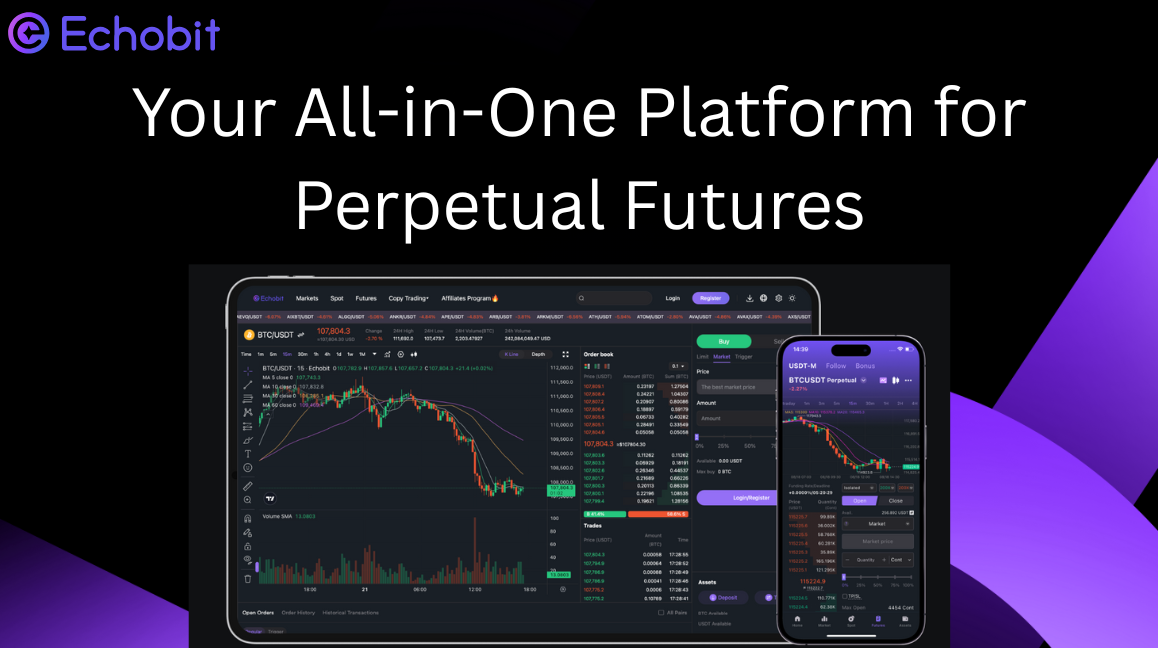
Perpetual futures have become one of the most widely used instruments in crypto trading, providing round-the-clock exposure without the need to roll contracts. While the core mechanics are shared across exchanges, each venue implements its own margining, pricing protections, and risk-engine rules. This article explains how perpetual futures work in general—and how the mechanism is applied on Echobit—based on publicly available disclosures and observable platform behavior.
What is Perpetual Futures?
No Expiry
Perpetual futures differ from quarterly or monthly contracts because they never expire. Traders can hold positions indefinitely as long as they maintain the required margin.
Funding Rate
Instead of settling at expiry, perpetual futures rely on a funding rate—a periodic payment between long and short traders that keeps the contract price close to spot.
- If the perp trades above spot, longs usually pay shorts.
- If it trades below spot, shorts usually pay longs.
Funding is dynamic and can change direction multiple times per day.
Mark Price
Exchanges calculate PnL and liquidations using a mark price, typically derived from spot indices and a pricing model.
This prevents unnecessary liquidations caused by temporary price spikes or thin-liquidity trades.
Margin and Leverage
Perpetual positions require:
- Initial margin to open the trade
- Maintenance margin to prevent liquidation
Collateral is often posted in stablecoins, and traders choose their own leverage level.
Liquidation and ADL
If a trader’s equity falls below maintenance margin, the exchange liquidates part or all of the position.
In extreme cases where the insurance fund is insufficient, auto-deleveraging (ADL) reduces opposing positions to maintain solvency.
Illustrative Example
Setup:
A trader opens a long 1 BTC-perp at 92,000 USD, using 10× leverage and 9,200 USD collateral (isolated).
Price Movement:
- If the mark price rises to 93,000, unrealized PnL ≈ +1,000 USD
- If it falls to 91,000, unrealized PnL ≈ −1,000 USD
Funding:
If the funding rate is +0.01% and longs pay shorts, the position pays the fee at the next interval.
If funding turns negative, the position receives a payment instead.
Risk:
Should the trader’s equity drop near maintenance margin, the risk engine may reduce or close the position.
Stop-losses, conservative leverage, and smaller position sizes can help mitigate this.
How Perpetual Futures Work on Echobit?
Contract Structure
Echobit offers perpetual futures on major cryptocurrencies with no expiry, tracking externally sourced indices to calculate the mark price and unrealized PnL.
Collateral & Margin Modes
Contracts are typically margined using stablecoins such as USDT.
Traders can choose:
- Isolated margin—risk contained to one position
- Cross margin—shared collateral across the portfolio
Leverage is adjustable depending on user preference and market conditions.
Funding Mechanism
Echobit applies a variable funding rate determined by order-book dynamics and the basis between perpetual and spot prices. Funding can be positive or negative and is paid at scheduled intervals.
Pricing Protections
Liquidations and unrealized PnL are based on the platform’s mark price, not the last traded price.
This aims to reduce the impact of short-lived wicks and improve fairness for both long and short traders.
Order Types & Tools
Echobit generally supports:
- Market and limit orders
- Conditional orders
- Stop-loss and take-profit settings
- Price alerts
These tools help implement risk controls, especially during high volatility.
Risk Engine & ADL
When maintenance margin is breached, Echobit’s risk engine liquidates positions in tiers.
If market stress exceeds the insurance fund’s capacity, ADL procedures may be triggered to maintain system stability.
Fees
Traders pay maker/taker fees on trade execution.
Funding payments operate separately and flow peer-to-peer.
As fee tiers can change, checking the latest schedule remains essential.
What Traders Should Watch Before Opening Perpetual Positions
- Volatility & Liquidity: Sudden spikes widen spreads and rapidly change funding direction.
- Effective Cost: Consider total cost—maker/taker fees + funding + slippage.
- Leverage Discipline: High leverage magnifies liquidation risk.
- Event Risk: Macroeconomic events, ETF flows, or venue-specific news can trigger large basis shifts.
Perpetuals vs. Dated Futures
| Feature | Perpetual Futures | Dated Futures |
| Expiry | None | Fixed date |
| Basis | Funding rate mechanism | Term structure converges at expiry |
| Best For | Short-term trading, hedging, systematic strategies | Calendar spreads, carry trades, expiry-specific hedging |
FAQ: How do perpetual futures work on Echobit?
They operate with no expiry, adjustable leverage, funding payments between longs and shorts, and a mark-price-based risk engine designed to reduce unnecessary liquidations.
FAQ: What margin types does Echobit support for futures trading?
Echobit offers isolated and cross margin modes to help traders control risk.
FAQ: How is the Mark Price calculated on Echobit futures?
Echobit references external price indices and a fair-value model to determine the mark price used for PnL and liquidation.
FAQ: Does Echobit apply ADL in extreme conditions?
Yes. If the insurance fund is insufficient during market stress, the platform may apply ADL to offset imbalanced positions.
FAQ: What fees apply when trading perpetual futures on Echobit?
Maker/taker fees apply to each trade, while funding is exchanged peer-to-peer and varies based on market conditions.
Echobit Official Links
🌐 Website: http://echobit.com/