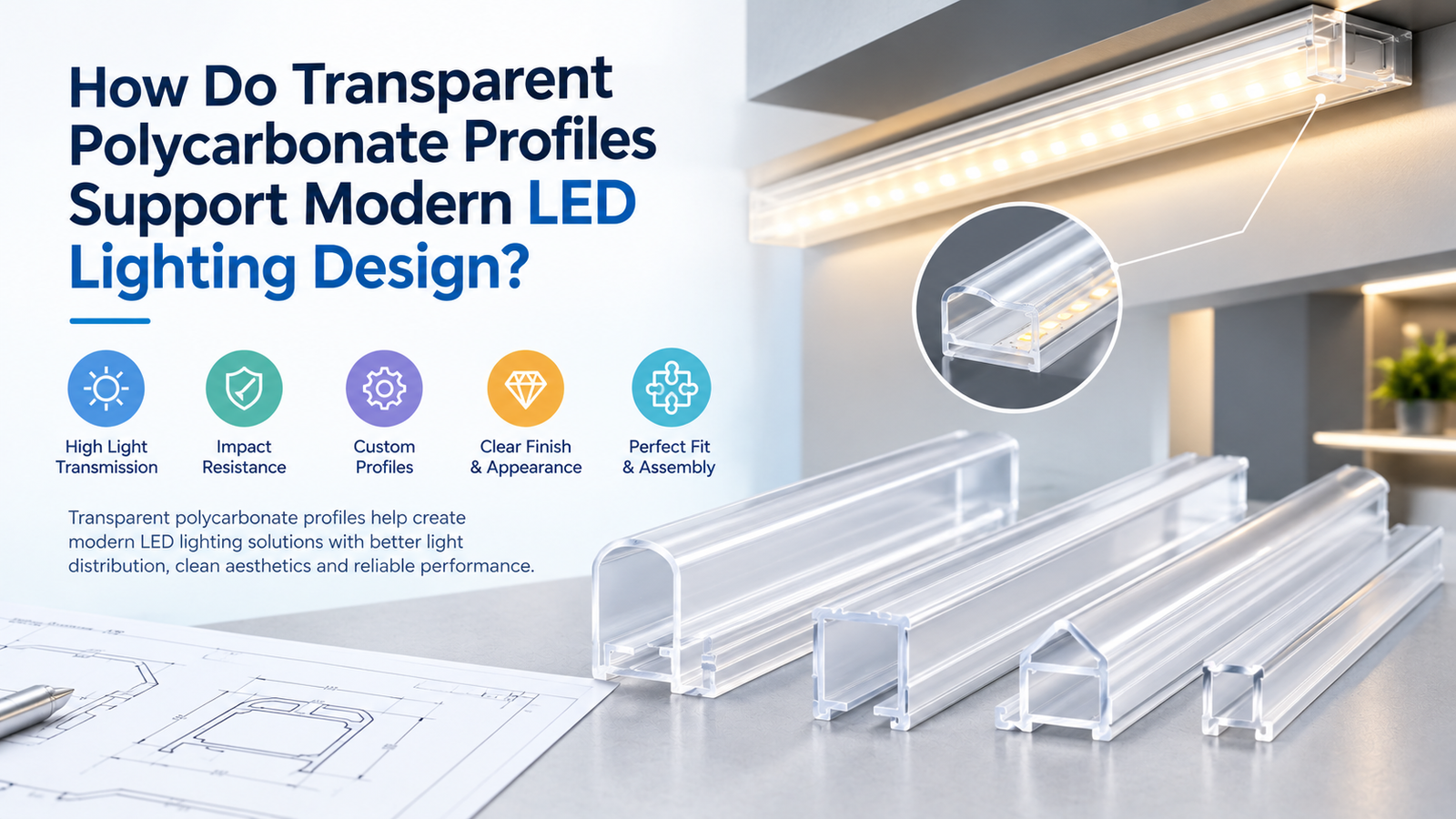
Transparent polycarbonate profiles support modern LED lighting design by providing shaped plastic components that allow light to pass through while helping protect or position lighting elements. Their suitability depends on the material grade, profile design, surface finish, and requirements of the lighting application. For lighting manufacturers developing custom fixtures, custom transparent polycarbonate profiles for LED lighting can be considered when standard shapes do not meet the required design or fitting needs.
From commercial lighting systems to industrial fixtures, choosing the right profile helps manufacturers balance light transmission, appearance, fit, and practical production requirements.
Why Are Transparent Polycarbonate Profiles Used in LED Lighting?
Transparent polycarbonate profiles are used in lighting assemblies where a clear plastic component is needed. Depending on the design, the profile may cover a lighting element, form part of a housing, or provide a shaped section through which light can pass.
Polycarbonate is known for its impact resistance compared with many other common plastics, although actual performance depends on the grade, profile dimensions, and operating conditions. It can also be extruded into custom cross-sections to suit different lighting designs.
Manufacturers may consider transparent polycarbonate profiles when they need:
- A clear profile shape for a lighting assembly.
- A custom cross-section to fit a specific fixture.
- A plastic component that allows light to pass through.
- A profile made to defined dimensions and production requirements.
- A design that can be reviewed and tested before bulk manufacturing.
The right choice depends on the intended use. A profile suitable for indoor display lighting may not be suitable for an outdoor fixture or a high-temperature application without further material checks.
How Do Transparent Polycarbonate Profiles Affect LED Lighting Design?
The profile is more than a cover. Its shape, material, and surface can influence how it fits into a lighting system and how the finished fixture looks.
1. Light transmission and clarity
A transparent profile allows light to pass through the material. This can be useful when the design needs a clear cover or a visible lighting element.
However, transparency alone does not guarantee a particular lighting result. Light transmission can vary with material grade, thickness, surface finish, and the geometry of the profile. Lighting manufacturers should confirm the optical requirements for their application before selecting a material.
2. Profile shape and fixture design
LED lighting products come in different shapes and sizes. Some use straight channels, while others need a custom profile to fit a particular housing or installation.
Plastic extrusion allows a profile to be formed with a consistent cross-section along its length. This can help manufacturers develop components that match a fixture’s dimensions and assembly method.
For example, a lighting manufacturer may need a narrow transparent profile that fits into a designed channel. The profile’s dimensions and fitting features should be confirmed against the full assembly.
3. Protection of lighting components
Depending on the design, a transparent polycarbonate profile may act as a cover or protective section around part of a lighting assembly.
The level of protection depends on the profile design, fit, thickness, installation, and material grade. A transparent profile should not automatically be treated as a sealed, waterproof, or impact-rated enclosure unless the complete assembly has been designed and tested for that purpose.
4. Appearance and finish
The surface finish can affect the appearance of a finished lighting product. A clear profile may suit designs where the lighting elements need to remain visible, while other applications may call for a frosted or diffusing finish.
If a lighting system needs controlled light diffusion, a transparent profile may not provide the required result on its own. The designer should assess whether a clear, frosted, or other suitable profile is needed.
5. Fit and assembly
Lighting components often need to fit into a channel, housing, bracket, or other part. Incorrect dimensions can cause assembly problems or leave gaps.
Before production, manufacturers should confirm the cross-section, wall thickness, tolerances, cutting lengths, and fitting details. Sample approval can help identify issues before a larger order is produced.
Which LED Lighting Applications May Use Transparent Polycarbonate Profiles?
Transparent polycarbonate profiles may be considered for several lighting applications, depending on the material grade and design requirements.
Commercial lighting fixtures
Commercial lighting products may use transparent profiles as covers or shaped components where a clear appearance is required. The profile design should match the fixture’s size, installation method, and lighting requirements.
Display and showcase lighting
Retail displays and showcases may use compact LED lighting systems to highlight products or signs. A transparent profile can be useful where the design needs a clear component around the lighting element.
Industrial lighting assemblies
Industrial equipment and work areas may use lighting fixtures with custom housings or covers. When selecting a profile, manufacturers should assess the expected temperature, exposure conditions, impact requirements, and cleaning methods.
Custom LED channels and housings
Some lighting products require a particular cross-section to fit an enclosure or mounting system. Custom polycarbonate extrusion profiles may be considered when a standard shape does not meet the design requirements.
These are possible applications rather than guaranteed uses for every polycarbonate profile. The material and finished component should be assessed against the actual operating conditions.
Transparent Polycarbonate Profiles vs LED Diffuser Profiles
Transparent profiles and diffuser profiles can serve different purposes in a lighting design. The choice depends on whether the application prioritises clear visibility or a more diffused appearance.
| Feature | Transparent polycarbonate profile | LED diffuser profile |
| Main purpose | Allows light to pass through a clear profile | Helps spread or soften light, depending on its design |
| Appearance | Usually intended to maintain a clear appearance | Often uses a frosted or diffusing surface |
| Light distribution | May allow individual LED points to remain visible | May reduce the visibility of individual light points when properly designed |
| Typical design need | Clear covers or shaped lighting components | More even-looking light distribution |
| Selection factors | Clarity, dimensions, fit, and operating conditions | Diffusion, light output, appearance, and fit |
A diffuser does not guarantee completely uniform light. The result depends on the LED spacing, distance from the light source, material properties, profile shape, and other parts of the fixture.
The lighting designer should assess the complete assembly rather than selecting a profile based on transparency or appearance alone.
What Should Lighting Manufacturers Check Before Selecting a Profile?
Choosing a suitable profile starts with the requirements of the finished lighting product. The following checks can help manufacturers prepare for profile development.
Material grade and temperature
Identify the temperature conditions around the profile, including any heat generated by the LEDs and nearby components. Confirm that the selected material grade is suitable for those conditions.
Required clarity and finish
State whether the design needs a clear, frosted, or other surface finish. If light transmission or diffusion is important, define how it will be evaluated.
Dimensions and tolerances
Provide a drawing showing the cross-section, wall thickness, dimensions, fitting features, and acceptable tolerances. Include the required cutting lengths if the profile will be supplied in fixed sections.
Exposure and installation conditions
Explain whether the profile will be used indoors or outdoors and whether it may be exposed to moisture, sunlight, chemicals, dust, or repeated cleaning. These conditions can affect material selection and product design.
Sample testing and approval
Review a sample for dimensions, fit, appearance, and other agreed requirements before moving to bulk production. If the finished lighting product must meet specific safety or performance standards, define the required tests for the complete assembly.
Production volume and delivery planning
Discuss the expected order quantity and any repeat-order requirements. Tooling, setup, material availability, and profile complexity can affect the production schedule, so it is useful to clarify these details early.
What Role Does Custom Extrusion Play in LED Lighting Design?
Custom extrusion allows manufacturers to develop a profile around a required cross-section rather than choosing only from standard shapes. This can be useful when a lighting fixture has specific dimensions, mounting features, or appearance requirements.
The development process typically involves reviewing the drawing, confirming the material and profile requirements, assessing tooling needs, and producing samples for review. Changes may be needed if the sample does not meet the required fit or finish.
Custom extrusion does not mean every design is automatically practical to manufacture. The proposed dimensions, material, tooling, and production quantity need to be reviewed before the order is confirmed.
For a wider view of where these profiles may be used, see industrial uses of transparent polycarbonate profiles.
How M3 Extrusion Supports Custom Polycarbonate Profile Requirements
M3 Extrusion is an Indian manufacturer of customised plastic extrusion profiles for industrial and commercial applications, supplying products to customers worldwide. With more than 13 years of manufacturing experience, the company works with business customers on profiles developed to their drawings, dimensions, specifications, and bulk production requirements.
For LED lighting projects, manufacturers can share their profile drawing, required dimensions, preferred material, surface finish, intended application, and expected order quantity. These details help establish the requirements for reviewing the proposed profile and assessing manufacturing feasibility.
M3 Extrusion supports sample production before bulk orders, allowing customers to review the profile against agreed requirements before proceeding with larger quantities.
Frequently Asked Questions
1. What are transparent polycarbonate profiles used for in LED lighting?
They may be used as clear covers, shaped components, or parts of custom lighting housings and channels. Their suitability depends on the profile design, material grade, and lighting assembly.
2. Do transparent polycarbonate profiles improve LED brightness?
Not necessarily. A clear profile allows light to pass through, but the amount of light transmitted depends on the material, thickness, surface finish, and profile geometry. Lighting performance should be checked for the specific design.
3. Are transparent polycarbonate profiles suitable for outdoor LED lighting?
They may be suitable for some outdoor applications, but the selected material and finished assembly must be assessed for sunlight exposure, temperature, moisture, and other environmental conditions. Outdoor suitability should not be assumed from transparency alone.
4. What is the difference between transparent and frosted polycarbonate LED profiles?
Transparent profiles are designed to maintain a clear appearance, while frosted profiles are intended to diffuse light to some degree. The best option depends on the desired lighting effect and the design of the complete fixture.
5. Can transparent polycarbonate LED profiles be made to custom dimensions?
Custom profiles can be developed to agreed drawings and specifications, subject to design and manufacturing feasibility. Dimensions, tolerances, material requirements, and sample approval should be confirmed before bulk production.
6. What information should I provide when requesting a custom LED profile?
Provide a cross-sectional drawing, dimensions, tolerances, required finish, intended lighting application, operating conditions, expected quantity, and any specific testing requirements. These details help the manufacturer assess the profile requirements.
Summary
Transparent polycarbonate profiles can support modern LED lighting design by providing clear, shaped components for covers, channels, and custom lighting assemblies. Their suitability depends on light transmission needs, material grade, dimensions, surface finish, temperature, and installation conditions.
Lighting manufacturers should define their requirements, compare transparent and diffusing options, and review samples before bulk production. A profile that looks suitable may still need testing to confirm its fit and performance in the finished fixture.
For businesses developing custom LED lighting components, M3 Extrusion can review profile drawings and production requirements. Contact M3 Extrusion to discuss your application, specifications, and bulk manufacturing needs.