The global manufacturing sector is currently navigating a complex landscape marked by frequent supply chain disruptions, escalating production costs, and increasingly stringent demands for part precision and consistency. These challenges significantly elevate the risks of project delays and budget overruns.The root causes of these issues lie in the inflexibility of traditional supply chain models, the limited adaptability of conventional production techniques, and quality control systems that struggle to keep pace with rapidly evolving market demands.
This article will articulate how adopting innovative Manufacturing Solutions, with a specific focus on advanced CNC Machining Services, can empower enterprises to build more resilient and responsive supply chains, effectively mitigating these prevalent challenges.The following sections will delve into five critical dimensions, examining how precision manufacturing serves as a strategic cornerstone for modern businesses.
Why is Global Supply Chain Instability Forcing Manufacturers to Re-evaluate Their Partners?
The traditional model of selecting manufacturing partners based primarily on cost is being fundamentally challenged. Geopolitical tensions, persistent logistics bottlenecks, and significant fluctuations in raw material prices have exposed the profound vulnerabilities of long-distance, low cost centric outsourcing strategies. These instabilities directly impact production timelines and lead to unpredictable cost inflation, making the once-appealing low initial quote a potential source of risk .
This volatility forces manufacturers to prioritize new criteria when selecting partners. Factors such as technological agility, geographical proximity or multi-regional production capacity, and robust digital management capabilities for end-to-end supply chain transparency are becoming paramount. This strategic shift reflects a move away from seeking the lowest price towards securing the best long-term value and lowest risk, a trend highlighted in industry analyses of supply chain resilience . This evolution in partner selection criteria naturally leads to the consideration of more innovative and reliable Custom Manufacturing solutions.
What Role Does Precision CNC Machining Play in Ensuring the Consistency of Complex Parts?
In high-stakes industries, the consistency of components is non-negotiable, directly impacting product performance, safety, and reliability. Precision CNC Machining is the foundational technology that guarantees this consistency.
The Foundation of Digital Manufacturing
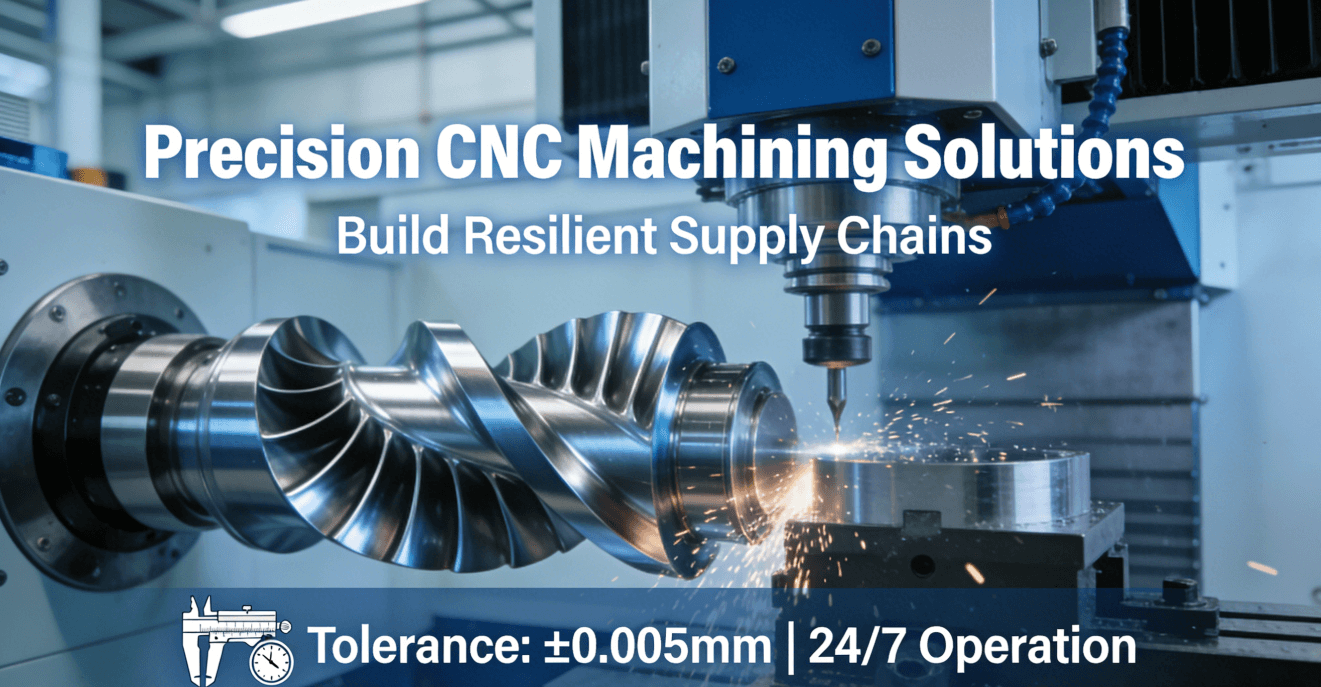
Unlike manual machining processes, the core of Computer Numerical Control (CNC) technology lies in digital instruction. A 3D design model is translated into a precise G-code program that dictates the machine tool’s movements. This process eliminates human error, enabling the achievement of exceptional tolerances as tight as ±0.005mm. Crucially, once a program is verified, a CNC machine can replicate the same cutting paths, speeds, and parameters indefinitely, ensuring that the first part and the ten-thousandth part are virtually identical . This built-in repeatability is a cornerstone of effective Quality Control.
Achieving Complex Geometries and Upholding Standards
- Mastering Complex Designs:
Whether for an aerospace turbine blade with complex aerodynamics or a medical implant requiring intricate biocompatible structures, CNC technology excels. Multi-axis CNC machines can complete machining on five or more faces in a single setup. This not only ensures exceptional geometric accuracy but also avoids the cumulative errors associated with multiple fixturing, which is critical for parts with complex internal features or contoured surfaces. - A Comprehensive Quality Assurance System:
Precision is not accidental. Top-tier manufacturers embed quality control throughout the production process. This may include in-process inspection using probes for real-time tool wear compensation. Following machining, parts are often subjected to a full dimensional inspection using Coordinate Measuring Machines (CMMs) to verify compliance with design specifications, ensuring every Custom CNC Parts meets requirements. For insights into specific applications, one can explore resources detailing precision CNC machining services.
What are the Specific Requirements for CNC Machining in Critical Industries like Aerospace and Medical?
Different leading industries impose unique and rigorous requirements on CNC Machining, defining the expertise required of service providers.The aerospace industry demands uncompromising safety and performance. Manufacturing CNC Machining Aerospace Parts often involves difficult-to-machine materials like titanium and Inconel alloys, requiring machines with high rigidity and stability. Furthermore, adherence to stringent quality management standards like AS9100D is typically mandatory, with full traceability for all components .
The medical device sector, where human health is paramount, requires Medical Device CNC Machining to utilize biocompatible materials and achieve impeccable surface finishes to prevent bacterial growth and ensure compatibility. Production must often occur in controlled environments following medical quality standards like ISO 13485. A supplier like JS Precision, which holds both AS9100D and ISO 13485 certifications, is well-positioned to meet these critical industry requirements .
The automotive industry, including Automotive CNC Machining Services, balances demands for efficiency, durability, and cost-effectiveness. It requires suppliers capable of supporting the entire product lifecycle, from rapid prototyping using CNC prototyping services to high-volume production, while meeting standards like IATF 16949 .
Beyond Precision, How Do Modern CNC Solutions Enhance Manufacturing Efficiency?
The value of modern CNC Machining Services extends far beyond delivering high-precision parts; they are a catalyst for comprehensive manufacturing efficiency through Innovation in Manufacturing.
Advancements in Automation and Flexibility
The integration of automation, such as robotic loading/unloading systems and automated pallet changers, enables extended periods of “lights-out” production. This significantly reduces labor costs and intervention while boosting Overall Equipment Effectiveness (OEE). Additionally, advanced CNC systems support flexible manufacturing, allowing for quick changeovers between different parts, which is ideal for low-volume, high-mix production scenarios .
The Power of Digitalization and Data
- Unprecedented Production Transparency:
Digital platforms allow clients to access instant quotes, view real-time order progress, and monitor production status, creating a new level of supply chain visibility and trust. - Proactive Maintenance Strategies:
Using IoT sensors to monitor machine health parameters like vibration and temperature enables predictive maintenance, allowing for planned interventions that prevent unplanned downtime and maintain production schedules. - Data-Driven Optimization:
The collection and analysis of machining data facilitate the continuous optimization of cutting parameters, leading to improved processing efficiency and extended tool life.
Hybrid Manufacturing and Process Integration
The most forward-looking Manufacturing Solutions involve combining additive (3D printing) and subtractive (CNC) methods. For instance, a near-net-shape part can be 3D printed and then finished with CNC machining to achieve high tolerances and superior surface quality. This hybrid approach allows for the creation of highly complex, lightweight structures that are difficult or impossible to produce with traditional methods alone, reducing material waste and expanding design possibilities, as discussed in research on advanced manufacturing techniques .
What Qualifications and Capabilities Should Be Prioritized When Selecting a CNC Machining Service Provider?
Choosing a partner requires a systematic evaluation framework where price should not be the sole deciding factor. The following capabilities are critical for establishing a successful long-term partnership in Custom Manufacturing.
- Technical and Equipment Capability:
The supplier’s equipment portfolio should be evaluated for its modernity, multi-axis capabilities, and the brands’ reputations. The diversity of equipment often dictates the range of materials that can be processed and the complexity of parts that can be manufactured. - Quality Systems and Certifications:
These are critical benchmarks. While a basic ISO 9001 certification is a starting point, specific industries require specialized certifications such as AS9100D (aerospace), ISO 13485 (medical), or IATF 16949 (automotive). Certifications like ISO 14001 also demonstrate a company’s commitment to environmental management. - Material and Process Expertise:
It is essential that the supplier has deep knowledge of the materials commonly used in the client’s industry and the experience to machine them effectively, avoiding common pitfalls . - Design for Manufacturability (DFM) Feedback:
A valuable partner provides proactive DFM analysis during the initial project stage, suggesting design modifications to enhance manufacturability, reduce costs, and shorten lead times .
A comprehensive understanding of a supplier’s full CNC machining capability is recommended before making a final selection .
Conclusion
In an increasingly complex and unpredictable global manufacturing environment, building a resilient operation hinges on advanced manufacturing capabilities. Embracing technology-driven, quality-focused, and highly flexible precision CNC Machining Services has transitioned from an option to a strategic necessity for mitigating risk and ensuring project success. From guaranteeing part-to-part consistency to meeting the extreme standards of the aerospace and medical industries, advanced manufacturing technology is a pivotal strategic asset.
Manufacturing decision-makers seeking to understand how these innovative solutions can be concretely applied to their operations to enhance competitiveness and mitigate risk are encouraged to explore professional CNC Machining Services to obtain more technical resources and customized consultation.
FAQs
Q1: What level of tolerance precision can typically be achieved with CNC machining?
A: Modern precision CNC machining can achieve exceptionally high tolerance levels, typically up to ±0.005 mm or better, depending on the part material, geometry, and equipment used .
Q2: What materials are suitable for CNC machining?
A: CNC machining is suitable for a very wide range of materials, including various metals (such as aluminum, steel, titanium alloys) and engineering plastics (such as PEEK, Nylon), as well as composites, to meet the performance requirements of different industries .
Q3: How are the advantages of CNC machining reflected from prototyping to mass production?
A: CNC machining supports a seamless transition from single-unit prototypes to mass production. Prototypes can be produced using the same processes as final production parts, validating the design early and ensuring consistency from design to manufacturing, significantly shortening the product development cycle .
Q4: How is quality consistency ensured for large-volume CNC machined parts?
A: Quality consistency in large-volume production is guaranteed through programming automation, high-rigidity equipment, and strict quality control processes, including first-article inspection, in-process inspections, and final inspection, to ensure highly consistent dimensions and performance of mass-produced parts .
Q5: How important are industry certifications (e.g., ISO, AS9100) when selecting a CNC service provider?
A: Industry certifications are crucial objective evidence that a service provider has a standardized quality management system and meets the specific regulatory requirements of industries such as aerospace and automotive. They are particularly important for sourcing parts for critical applications .